


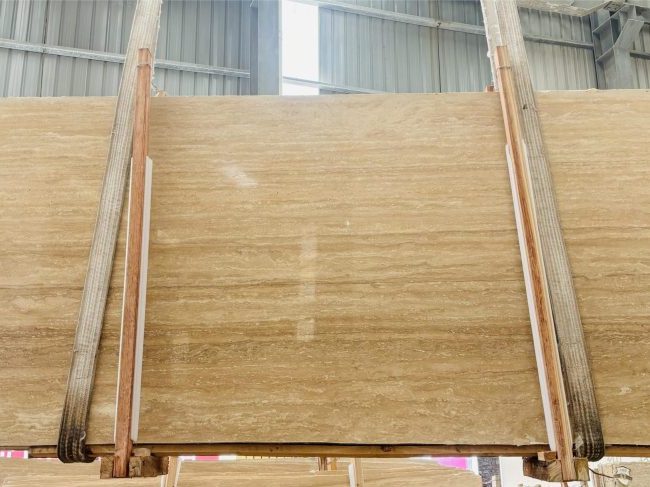

Quick SummaryThere is no single correct thickness for every natural-stone dining table. Around 20 mm and 30 mm are common stone-industry slab references, but they should be treated as starting material thicknesses rather than universal furniture-engineering rules. The correct dining-table top depends on the actual stone, tabletop length and width, unsupported span, base and support distribution, edge design, connection method, total weight, transport route and assembly strategy. A visually thick table also does not always require one massive solid slab; a built-up or mitered edge can sometimes create the intended proportion while controlling unnecessary mass.
How Thick Should a Stone Dining Table Top Be?
For most custom natural-stone dining tables, begin with the actual slab thickness available—commonly around 20 mm or 30 mm in the stone industry—then engineer the tabletop, support and edge concept as one furniture system.
A thicker stone top is not automatically safer, and a thinner top is not automatically too weak. A relatively compact table with broad, well-distributed support behaves very differently from a long oval table resting on two narrow pedestals or a large rectangular top with substantial cantilevers.
The most useful design question is therefore not simply “20 mm or 30 mm?” It is:
Can this actual stone, at this thickness, over this span, on this base, be fabricated, moved, assembled and used safely while achieving the intended visual proportion?
Design Brief
Approve the tabletop as one complete object: Stone + Slab Position + Top Dimensions + Thickness + Edge + Base + Support + Connection + Assembly + Logistics. Do not choose thickness as an isolated specification.
Why 20 mm vs 30 mm Is Only the Starting Question
Natural-stone slabs are commonly discussed in nominal thicknesses such as approximately 20 mm and 30 mm. That makes those values useful when designers begin material sourcing, but slab thickness does not by itself define the final furniture structure.
A 20 mm top can appear visually slim and refined, but a large table may require carefully designed support beneath the stone. A 30 mm solid top creates greater visual mass and increases the amount of stone being handled, supported and transported.
Neither approach should be selected by appearance alone.
Natural Stone Institute’s current Dimension Stone Design Manual now includes a dedicated chapter on stone furniture, specifically addressing stone surfacing used as table tops rather than installed continuously over cabinetry. This reinforces an important distinction: furniture needs its own support and engineering logic rather than countertop assumptions.
What Actually Determines Stone Dining Table Top Thickness?
| Design Factor | Engineering Consideration | Buyer Decision |
| Tabletop Size | Longer and wider tops create greater mass and potentially larger unsupported areas. | Provide final length, width or diameter before fixing the structure. |
| Natural Stone | Different slabs have different mineral structure, fissures, repairs and fabrication behavior. | Approve the actual slab, not only the stone name. |
| Base Geometry | Support locations and footprint determine how the top is carried. | Develop top and base together rather than independently. |
| Unsupported Span | Stone between support points must resist bending and handling loads. | Review support distribution before assuming thickness solves the problem. |
| Visual Edge | A thick visual profile can be created in different ways. | Choose solid, built-up or mitered appearance according to the design and fabrication method. |
| Delivery / Assembly | Increasing stone mass affects lifting, crating, access and assembly. | Confirm transport route and removable components before fabrication. |
Table Size and Span Matter More Than Thickness Alone
A small round dining table and a long rectangular hospitality table may use the same stone but require very different support concepts.
A round top with a broad central pedestal can distribute support relatively close to the table center. A long rectangular table with bases concentrated near each end can create a much larger unsupported central zone.
Likewise, a large oval or racetrack table may have long unsupported perimeter sections even when the support system beneath the center is substantial.
For these reasons, simply increasing the slab from one nominal thickness to another should not replace support design. Larger spans may need a hidden structural frame, broader support plates or another project-specific solution.
Stone Type Changes the Decision
“Natural stone” is not one uniform structural material.
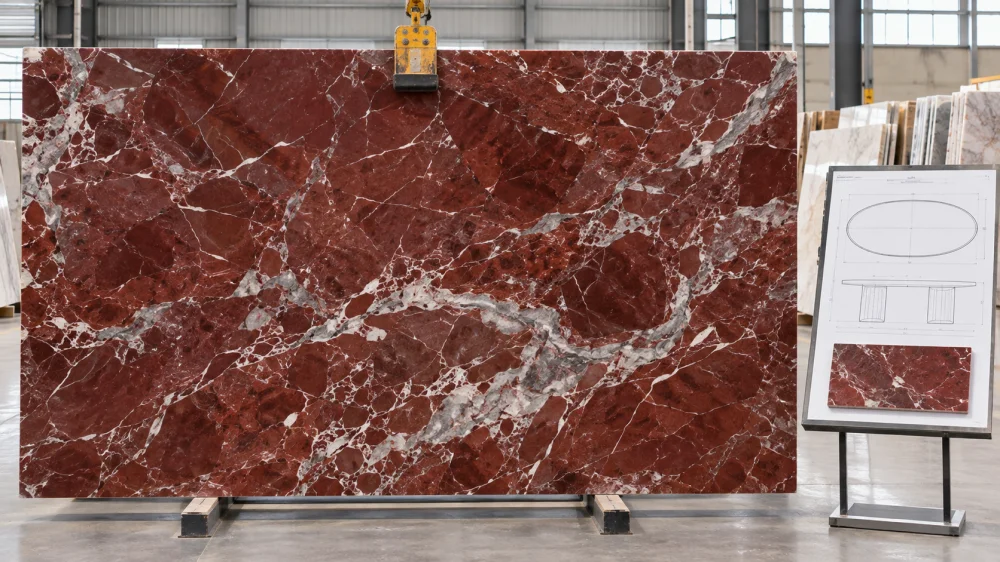
Marble, Quartzite, Granite and Travertine can have different geological structures, while individual slabs within one stone family can contain different veins, fissures, voids, crystalline transitions, repairs or resin treatment.
A dramatic slab may be visually perfect for a dining table but require greater care around the way its strongest features cross the tabletop geometry.
For example, Languedoc Marble is particularly relevant to furniture because the tabletop, visible edge and pedestal form one visual composition. Its current product presentation also emphasizes that a round tabletop can capture a completely different slab composition depending on where the circle is positioned.
Likewise, Shangrila Quartzite is currently shown in dining-table applications, illustrating why Quartzite furniture also needs slab-position and custom fabrication decisions rather than generic countertop assumptions.
A Thicker-Looking Table Does Not Always Need a Massive Solid Top
Designers often want the table edge to appear substantial because a thicker visual profile can make a dining table feel monolithic, architectural or sculptural.
That does not necessarily mean the entire top should be one solid piece at the full visible edge thickness.
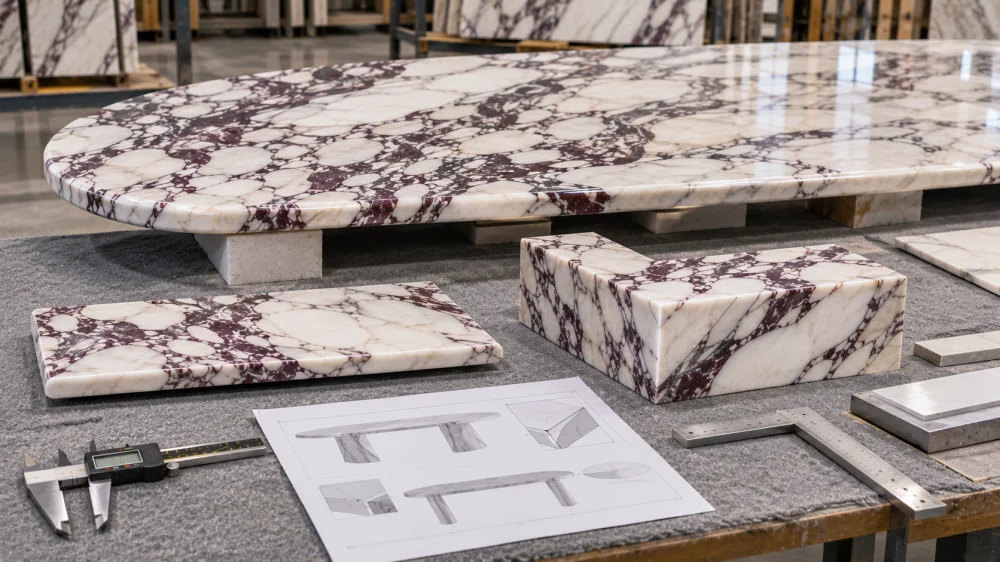
Depending on the material and design, a fabricated edge assembly or mitered perimeter may create a deeper visual profile while avoiding unnecessary stone mass across the entire tabletop.
Engineering Risk
A built-up or mitered edge is not automatically the “lighter and safer” solution. It introduces joints, edge strips and additional fabrication. The correct construction still needs to suit the actual stone, tabletop geometry, support system and intended furniture design.
How Should the Base Support the Stone Top?
The base is a structural component of the dining table, not simply a decorative object beneath the stone.
A pedestal, twin-base system, metal frame, timber base or stone-clad base can each distribute support differently.
The support design should consider:
- where the stone physically bears on the base;
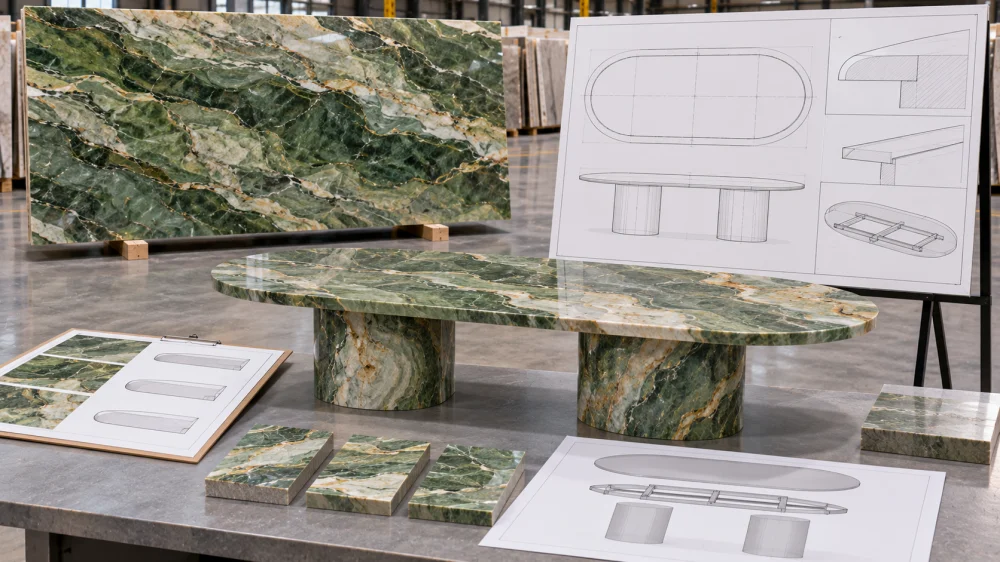
shangrila quartzite dining table thickness structure cad - how large the supported area is;
- how far the stone projects beyond the support;
- whether hidden framing is required;
- how the top is restrained from movement;
- how the table behaves when someone applies force near the perimeter;
- whether connection points can be accessed during installation.
A visually heavy 30 mm top on a narrow pedestal can still be a poor furniture design if the support geometry is inappropriate.
Thickness Also Changes Weight and Handling
Increasing stone thickness increases the amount of stone in the tabletop. For a large dining table, that can materially change handling, base design, packing and site access.
The design team should consider whether the completed top can pass through doors, corridors, lifts and stairways, and whether the installation crew can position it safely at the destination.
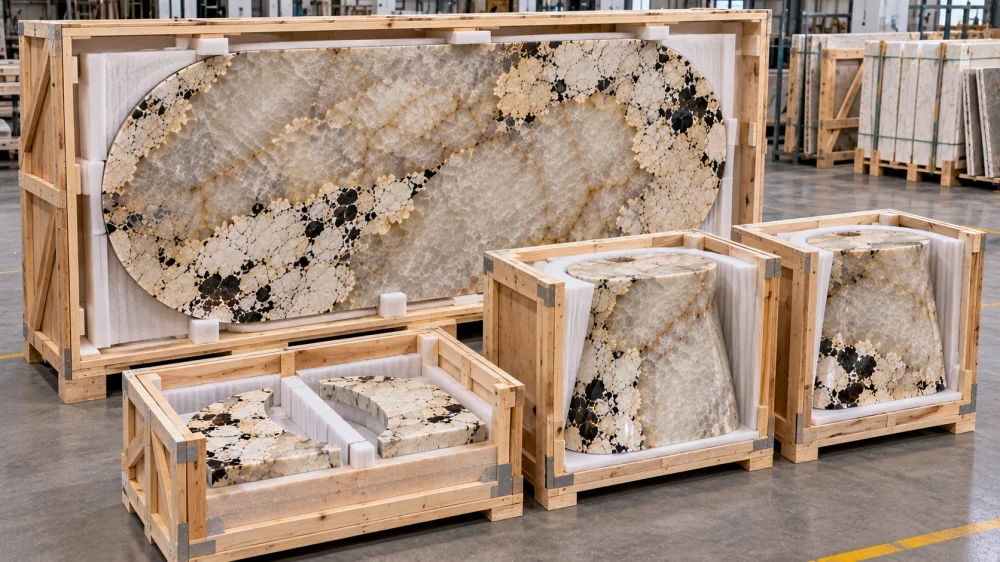
A fully assembled stone table may also be much harder to crate and transport than a removable tabletop and separate base.
This is why the broader CENTURY STAR luxury dining-table guide treats dimensions, weight, support, removable components, trial assembly and packing as part of one furniture system rather than isolated purchasing decisions.
Should a Large Stone Dining Table Use a Hidden Frame?
Sometimes, but not automatically.
A hidden metal or engineered support system can help distribute loads beneath long or complex tops, especially when the visual design calls for a slim profile or large unsupported areas.
However, the appropriate frame geometry and connection details depend on the actual table, stone and base. There is no universal support-frame pattern that should be copied across every dining table.
For custom furniture, the structural support concept should be developed before the slab is cut so attachment areas, hidden components and visible edge relationships can all be coordinated.
Edge Design Is Part of the Thickness Decision
The edge is continuously visible on a dining table, so it plays a much larger role than on many installed countertop applications.
A slim straight edge can make the table appear lighter and more contemporary. A deeper mitered edge can create a monolithic architectural character. Rounded or sculpted profiles can soften the furniture and change how the thickness is visually perceived.
For strongly veined stone, edge construction also determines how the pattern terminates around the perimeter.
Designers should therefore approve the visible edge concept together with tabletop thickness rather than treating edge finishing as a later workshop detail.
Trial Assembly Should Confirm More Than Appearance
A custom stone table should be tested as a piece of furniture before it is packed as cargo.
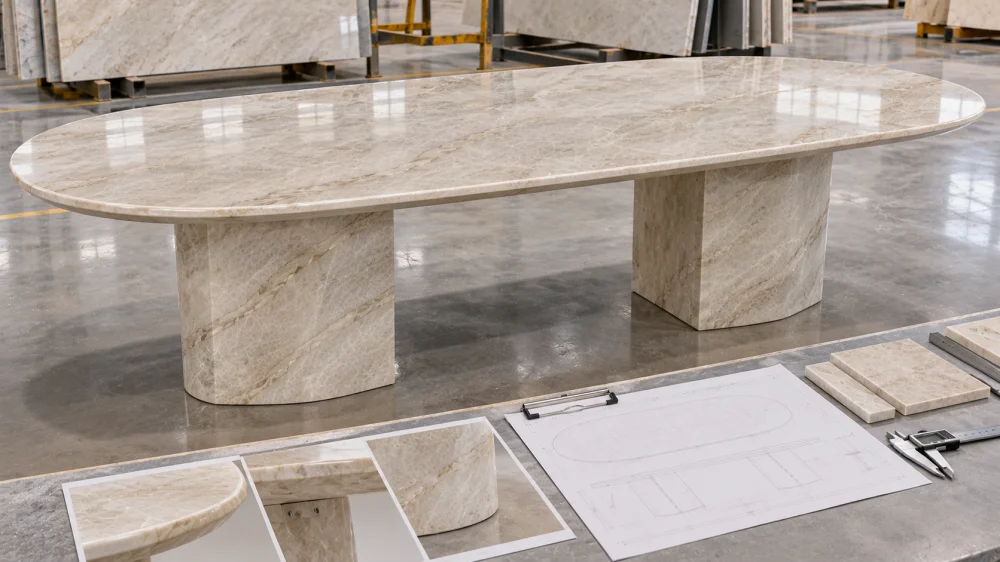
Where practical, trial assembly can confirm:
- top-to-base alignment;
- support contact;
- tabletop centering;
- connection-point alignment;
- visible edge and joint quality;
- overall proportion;
- stability of the assembled configuration;
- component identification for reassembly.
If the tabletop thickness, base design or hidden support concept is not working as intended, trial assembly is a much better stage to identify the problem than after international delivery.
When Should the Top or Base Be Removable?
A removable top is often useful when the table is large, heavy or difficult to access at the destination.
A knock-down strategy can also reduce the size of individual shipping components and allow the base, support system and tabletop to receive protection designed for their different fracture and handling risks.
The decision should be made before fabrication. Connection points need to be designed into the furniture rather than improvised after a heavy tabletop is complete.
Thickness, Support and Logistics Decision Guide
| Furniture Situation | Design Direction | What Must Be Verified |
| Compact top with broad support | A relatively slim visual profile may be feasible. | Actual stone, edge, support contact and attachment. |
| Long rectangular top | Support distribution may matter more than simply increasing stone thickness. | Span, base positions, hidden structure and handling. |
| Large oval / racetrack top | Coordinate perimeter projection with the central support system. | Cantilever areas, base footprint and slab layout. |
| Monolithic thick visual edge | Consider whether a fabricated edge can achieve the visual proportion. | Miter detail, joints, slab pattern and edge fabrication. |
| Export or difficult-access project | Consider removable or knock-down components early. | Crate size, access route, lifting and final assembly. |
Buyer Specification Checklist
- Confirm the final tabletop shape: rectangular, oval, round, racetrack or custom.
patagonia quartzite dining table export packing - Confirm the final length, width or diameter and finished table height.
- Identify the actual natural stone or design direction.
- Review the slab thickness actually available for the selected material.
- Approve the actual slab and tabletop cut position when pattern placement matters.
- Define the desired visual edge thickness and edge construction.
- Develop the base footprint and support locations together with the top.
- Review unsupported spans and perimeter projections.
- Define hidden framing or reinforcement where the design requires it.
- Confirm how the tabletop connects to the base.
- Decide whether the top or base should be removable.
- Confirm destination door, corridor, elevator and handling constraints.
- Trial-assemble the table when project complexity justifies it.
- Review component-specific packing before shipment.
Practical Takeaway
There is no universal “best” stone dining table top thickness. Approximately 20 mm and 30 mm are common slab references, but they are only starting points. A successful table balances the actual stone, tabletop size, span, support distribution, edge design, base connection, total weight, delivery route and assembly plan. If the design needs a visually thick table, consider whether that appearance should come from solid stone or a fabricated edge system. Thickness should support the furniture concept—not substitute for furniture engineering.
Frequently Asked Questions
1. Is 20 mm stone thick enough for a dining table?
It can be suitable for some table designs, but thickness alone is not enough to determine suitability. The actual stone, tabletop dimensions, support distribution, unsupported span, edge design and connection system must be evaluated together.
2. Is 30 mm better than 20 mm for a stone dining table?
Not automatically. A 30 mm top creates more stone mass and a heavier visual profile, while a 20 mm top may require a different support strategy. The better option depends on the complete table design.
3. Does a large stone dining table need a thicker top?
A larger table usually requires more attention to support, span, weight and handling, but simply increasing stone thickness is not always the best solution. Hidden framing or better support distribution may be more important.
4. Can a stone table look 50 mm or thicker without using a solid 50 mm slab?
Yes. Depending on the design and stone, a built-up or mitered edge can create a thicker visual profile. The fabrication method, joints and pattern relationship should be approved before production.
5. Does Marble need a different dining-table thickness from Quartzite?
Material family alone does not determine the correct thickness. The actual slab condition, natural veins or fissures, table geometry, support and fabrication method are more useful inputs than a generic Marble-versus-Quartzite rule.
6. Should a stone dining table have a metal frame underneath?
Some designs benefit from a hidden frame, especially where long spans, slim profiles or limited support areas are involved. The appropriate structure should be developed for the specific tabletop and base rather than added automatically.
7. Should a large stone dining table be shipped assembled?
Not necessarily. Removable tops or knock-down base components can make transport and site access more practical. The assembly method should be designed before fabrication so connections remain controlled and visually discreet.
8. What information should I send for a custom stone dining table?
Provide the final shape and dimensions, stone or visual direction, desired thickness and edge appearance, base concept, support or connection requirements, quantity, assembly preference and destination-access constraints. A drawing or furniture reference is especially useful for large or sculptural designs.