


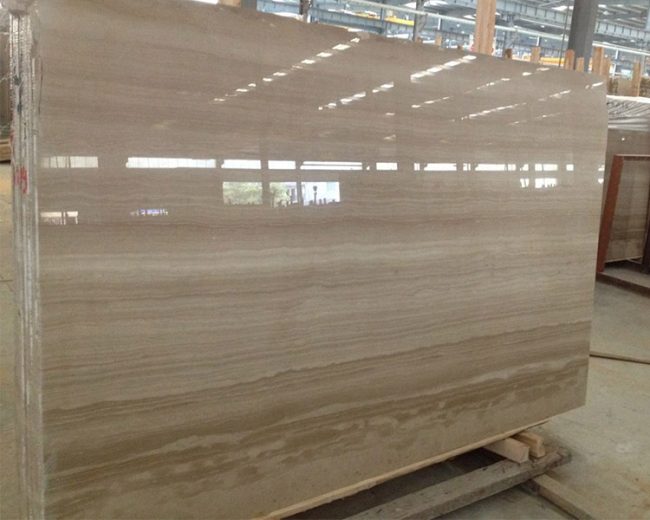
Prevention of yellowing of white marble
The yellowing caused by the internal composition and structure of white marble occurs through external conditions. This external condition is water and oxygen in the air. Therefore, as long as water is effectively prevented from passing through the inside of the stone, the yellowing caused by the stone’s composition and structure will be effectively suppressed.
An effective way to prevent water from passing through the inside of white marble is to waterproof the back of the board before the stone is installed. The early waterproofing treatment of stone board backs was to apply siloxane/ silane as a as a penetrating waterproofing agent. Facts show that applying this waterproofing agent to the back of the board cannot effectively suppress the occurrence of stone diseases, including yellowing.

Agent penetration of waterproofing has particular limits. Environmental factors will progressively cause the waterproofing agent’s performance to drop, regardless of how good it is. This is why it needs to be regularly reapplied following the first application of the waterproofing agent in order to restore the declining waterproofing effectiveness. Penetrating waterproofing compounds are therefore only fit for board surfaces that can be reapplied at any moment, such as the front of the floor or the wall board facing outward. Using waterproofing compounds on the bottom of the board renders it impossible to track their waterproofing ability. We cannot reapply and fix even if there are indications that the waterproofing agent has deteriorated; we can only let it worsen and finally lose its waterproofing capacity totally. This is the reason many projects applying this floor installation technique still cannot prevent the main factor causing stone deterioration.

A stone waterproof adhesive with cement as the base material and a high-molecular polymer emulsion came into being. This type of waterproof adhesive is called a two-component waterproof adhesive. One component is cement as the main body, with other inorganic fillers and a small amount of polymer additives, and the other component is an organic polymer emulsion. This two-component waterproof adhesive must be mixed on-site. Workers who lack professional knowledge often do not realise the importance of the ratio of the two components and do not mix them strictly according to the specified ratio. Therefore, the quality cannot be fully guaranteed. In addition, there are many brands of this type of waterproof adhesive, and the quality is uneven. If the polymer type in the emulsion is not properly selected or the solid content is too low, it is likely to not have a waterproof effect.
This two-component waterproof adhesive is not suitable for white marble with high iron content or marble with many dark cracks, because when applying this waterproof adhesive, the strong alkaline cement water will immediately enter the cracks or pores of the white marble and seep out from the board surface, and the board surface may turn yellow soon.
For white marble yellowing caused by external reasons, it can be prevented through reasonable use and maintenance, such as placing fiber carpets at the entrance to remove sand or other hard particles on the soles of shoes before entering the marble paving area, reducing the wear of foreign hard particles on the stone board surface. The mop used to clean the floor must be kept clean, and the water used for mopping the floor must be clean. After mopping the floor, wipe the water on the floor clean, and use dry mopping as much as possible and less wet mopping. If conditions permit, it is best to use marble cleaning fluid for maintenance.
Floor waxing has been proven to be a maintenance method for marble boards, with more disadvantages than advantages. First of all, the gloss of the floor polished with wax does not last long. On the other hand, most waxes have a blocking effect on the ventilation pores of the stone, which blocks the normal gas passage of marble that adjusts with the climate. Finally, when the accumulated wax layer turns yellow due to ageing and needs to be removed, a wax remover must be used. The use of wax removers will seriously affect the indoor air quality.
Crystal surface treatment is a common polishing treatment for marble floors. Choosing the right crystal surface agent can help the treated stone surface obtain a dense, but not breathable, bright film. However, when performing crystal surface treatment, such as polishing with steel wool, the scattered steel wool powder must be vacuumed clean. Any steel wool powder remaining on the ground may become a source of pollution for the yellowing of the board surface.
Stone installation practitioners must have a certain professional foundation, understand the reasons for the yellowing of stone, have the necessary skills for installing stone, keep the construction environment clean and tidy, and avoid yellowing of stone caused by installation. Scientifically care for stone to avoid the introduction of iron that will make the stone yellow from the cleaning water or floor polishing process. Use a good-quality penetrating waterproofing agent to regularly protect the floor and reduce the time and opportunity for water to contact stone.
Therefore, effective prevention of white marble yellowing should be a comprehensive measure. In the absence of effective waterproofing treatment on cement floors or walls, it is particularly important to treat the back of stone slabs. Selecting waterproof adhesive with guaranteed quality to waterproof the back of the slab is the most important step among all measures.
Removal of yellowing of stone slabs
Once the yellowing of white marble slabs is found, the cause of yellowing must be found out first. Before turning the cause of yellowing white marble to rust, first make sure that the yellowing of white marble is not caused by aging wax or other external factors. After excluding factors other than iron, start preparing for rust removal.

At present, stone care stores have various brands of iron and yellowing removers. Although no product discloses the basic chemical composition, most of the iron and yellowing removers on the market are acidic. Due to the poor acid resistance of marble, many acidic rust removers also cause great erosion on the slab surface while removing rust. Excessive erosion of the white marble slab surface will cause permanent damage to the slab surface.