


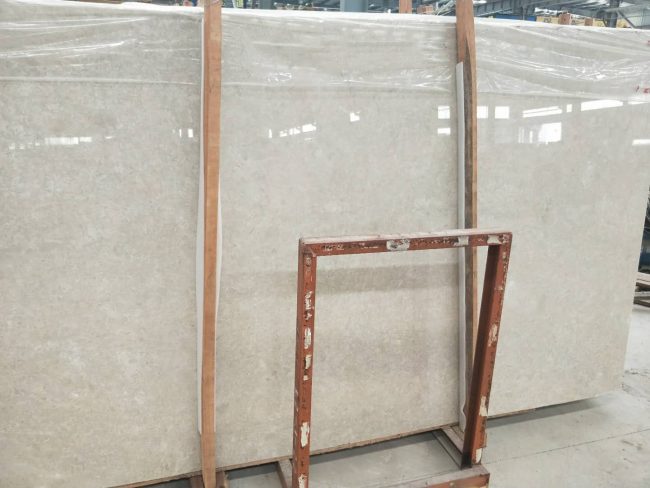
Quick SummaryMarble countertop cost cannot be judged from slab price alone. The final project budget depends on the selected Marble and visual grade, actual slab dimensions, gross material quantity, usable cutting yield, vein direction, countertop geometry, sink and cooktop openings, edge details, fabrication, QC, packing, freight and trade terms. A lower slab rate can produce a higher completed countertop cost when yield is poor or important fabrication items are excluded. Compare complete like-for-like project scopes, not isolated material prices.
What Actually Determines Marble Countertop Cost?
The final cost of a Marble countertop is driven by the complete conversion from actual slab to finished kitchen component—not by the raw stone price alone.
Two suppliers can quote the same Marble name and still produce very different totals. One may be pricing broad commercial-grade material with simple fabrication. Another may be pricing a tighter visual selection, multiple matched slabs, mitered edges, large openings, dry-layout approval, reinforced packing and a defined delivery scope.
The more useful budget formula is:
Material Selection + Gross Slab Requirement + Usable Yield + Fabrication + QC + Packing + Freight / Commercial Scope.
Direct Cost Answer
If a supplier gives only a Marble price per square meter or square foot, you still do not know the true countertop project cost. Buyers need the actual slab basis, cutting yield, finished component scope, fabrication details, QC, packing and delivery responsibility before quotations are genuinely comparable.
Main Marble Countertop Cost Drivers
| Cost Driver | Why It Changes Cost | Buyer Control |
| Marble Variety / Visual Grade | Different Marble varieties and different slab selections can carry different material values and availability. | Define the required visual range instead of approving by commercial name alone. |
| Gross Slab Quantity | Finished countertop area does not equal purchased slab area. | Request an actual slab cutting layout before confirming material quantity. |
| Usable Yield | Veins, fissures, repairs, slab dimensions and component orientation can reduce usable area. | Compare alternative nesting and seam strategies before cutting. |
| Vein Matching | Strong directional Marble may require selective cutting or related slabs. | Define which seams, waterfalls or backsplash areas need visual continuity. |
| Fabrication | Cutouts, shaped edges, miters, backsplashes and custom pieces add production work. | Issue enough drawing information for suppliers to quote the same scope. |
| QC / Dry Review | Complex or visually sensitive packages may require additional approval evidence. | Match inspection depth to actual project risk. |
| Packing / Freight | Finished geometry, crate configuration, destination and trade term change delivered cost. | Compare quotations on the same packing and delivery basis. |
1. Marble Variety and Visual Grade Set the Starting Material Cost
“Marble countertop” is not one standardized commodity.
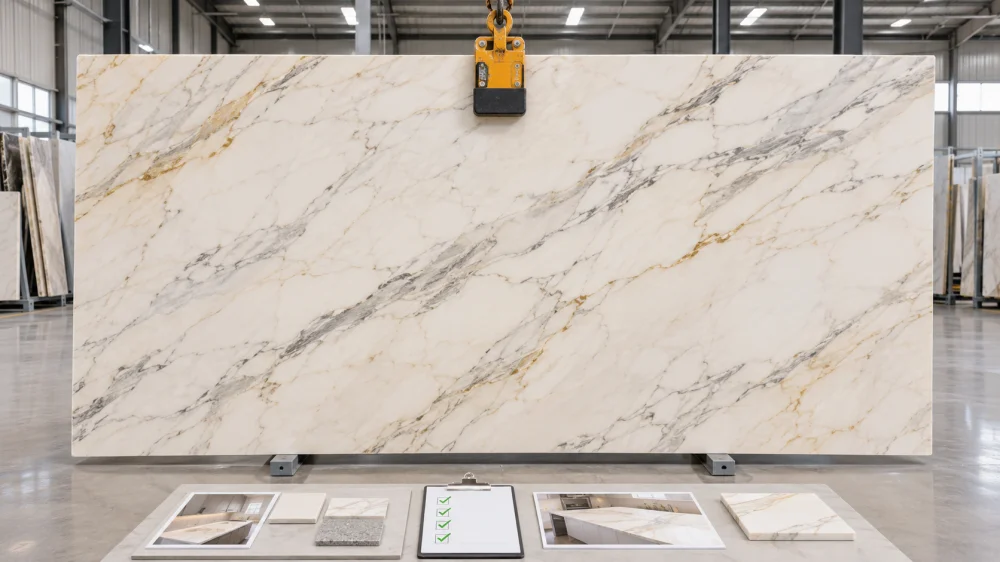
Carrara-type Marble, Volakas, Calacatta varieties, Arabescato materials, grey Marble and strongly colored statement Marbles can represent very different visual and commercial positions. Within one commercial name, actual slabs can also vary in background tone, vein density, repairs, fissures and overall composition.
A project asking for very white backgrounds, limited natural markings or tightly coordinated slabs may reduce the number of acceptable pieces available to the buyer. A project accepting a broader natural range may have more sourcing flexibility.
The CENTURY STAR Marble collection can be used to compare broad material directions, but final project pricing should be based on the actual Marble proposed for the order rather than the category name alone.
2. Net Countertop Area Is Not the Same as Purchased Marble Area
This is one of the most common causes of budget misunderstanding.
A kitchen may have a defined net countertop area, but the required pieces must still fit into complete slabs. Long perimeter runs, islands, backsplash sections, waterfall panels, miter strips and other visible components all consume usable stone.
The commercial sequence is better understood as:
Gross Slabs → Usable Stone Zones → Approved Cutting Layout → Finished Countertop Components.
Material outside the finished pieces is not automatically “supplier waste.” Some offcuts may be reusable, while other areas may be too small, unsuitable in direction or visually incompatible with the remaining components.
3. Slab Yield Can Matter More Than a Small Difference in Slab Price
A lower-priced Marble slab can become the more expensive option if its dimensions or visual composition produce poor cutting yield.
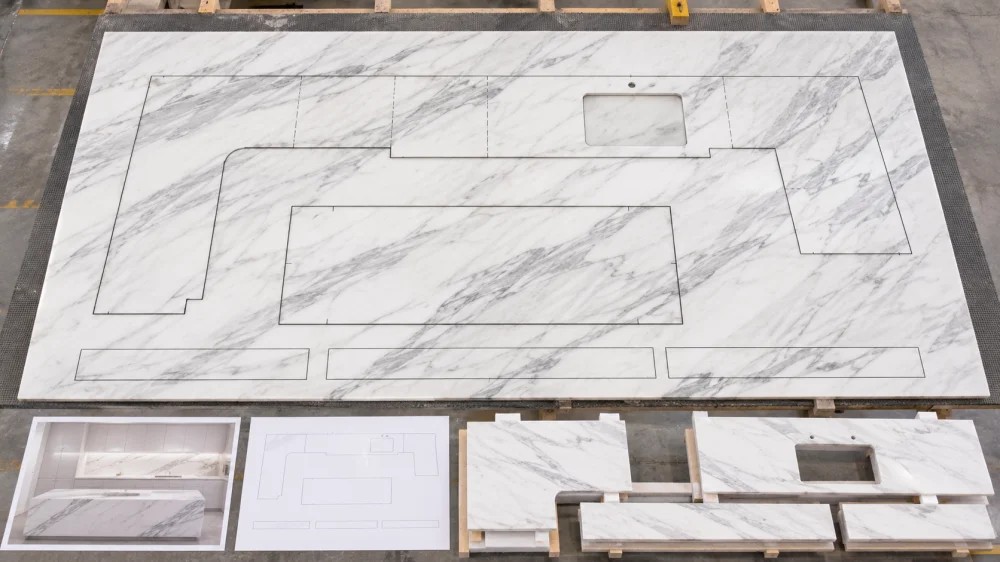
Consider a kitchen requiring a long island, perimeter pieces and backsplash panels. A slab with enough total surface area may still fail to contain the longest components in the required vein direction. Another slab group may have a higher raw material value but allow cleaner nesting and fewer seams.
Marble makes this especially important when the project depends on deliberate vein placement.
Hidden Cost Warning
Do not compare Marble suppliers by slab rate until you know how many gross slabs each supplier requires to produce the same approved countertop package. Poor yield can erase an apparent material-price advantage.
4. Vein Direction and Matching Can Increase Material Consumption
Highly directional Marble cannot always be rotated simply to improve nesting.
If the design requires the vein to run continuously through a long island, relate across a seam or turn down a waterfall panel, some otherwise usable areas may no longer suit the approved composition.
The same issue applies to full-height backsplash pieces. A designer may prefer the backsplash to relate visually to the countertop below it, which can require reserving specific slab zones instead of using whichever offcuts remain after the top is cut.
The buyer therefore needs to distinguish between:
- ordinary material yield;
- visual-layout yield;
- bookmatch or vein-match requirements;
- usable remnants after the approved composition is protected.
5. Fabrication Scope Can Change the Quote Substantially
A straight polished perimeter top and a complex custom kitchen are not equivalent fabrication packages.
Common cost drivers include:
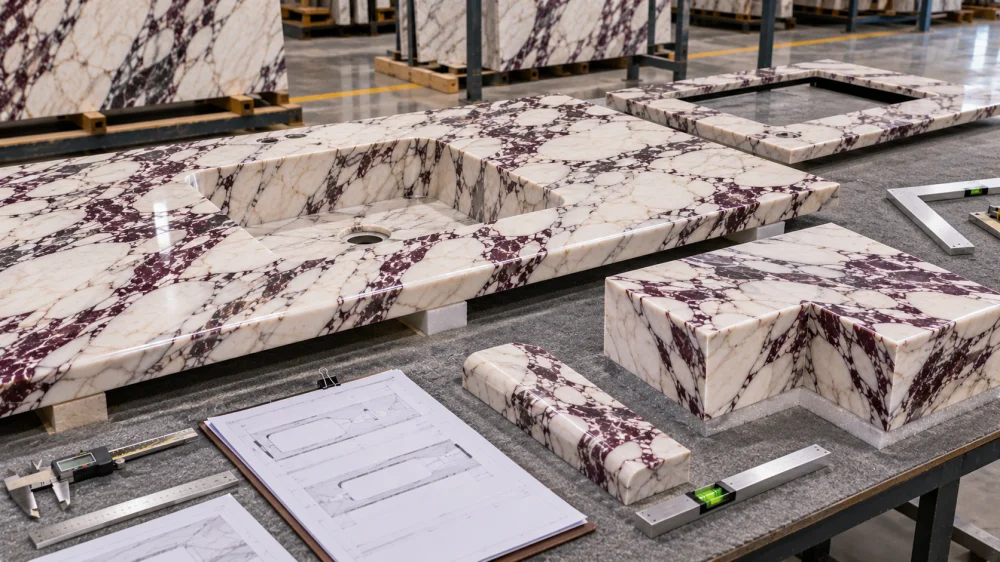
- undermount or special sink openings;
- cooktop openings;
- faucet and accessory holes;
- mitered or built-up edges;
- waterfall panels;
- curved or shaped components;
- full-height backsplash pieces;
- seam preparation;
- special visible-edge polishing;
- reinforcement where appropriate to the actual geometry.
The cost issue is not that one Marble is always more difficult to fabricate than another. The actual natural features, component geometry and finished details determine the work required.
CENTURY STAR’s stone fabricator quotation drawing guide explains why finished dimensions, openings, edges, seams and scope assumptions need to be visible before suppliers can quote custom stone fairly.
6. Sink and Cooktop Openings Can Affect Both Fabrication and Yield
An opening creates machining work, but it does not automatically reduce the gross stone requirement.
The entire countertop piece must still fit within the slab before the sink or cooktop section is removed. Strong veins, fissures or repaired natural features may also influence where that piece should be positioned.
Late appliance changes can therefore create several cost consequences at once:
- revised fabrication drawings;
- changed cutting layout;
- different remaining rail geometry;
- additional fabrication or reinforcement review;
- possible loss of already approved slab yield.
7. Edges and Waterfalls Add More Than Labor
A visually thick mitered edge requires additional stone strips, cutting, assembly and finishing. A waterfall panel requires another large component, often with its own pattern relationship to the island top.
For expressive Marble, a poor waterfall relationship can also become a design problem even when the dimensions are technically correct.
That means buyers should define the visible edge and waterfall concept before the final material quantity is approved.
8. QC and Dry Lay Should Be Proportionate to Project Risk
Not every Marble countertop package requires the same inspection depth.
A relatively simple perimeter countertop may need routine dimensional, finish and edge checks. A large multi-slab island with strong veining may justify actual slab approval, CAD layout review, seam review, dry assembly or more detailed pre-shipment evidence.
Possible QC stages include:
- actual slab approval;
- cutting-layout approval;
- finished dimensions;
- sink and cooktop inspection;
- edge and miter review;
- finish consistency;
- piece identification;
- packing verification.
QC is part of the project scope and should be visible before competing quotations are compared.
9. Packing Is Part of the Finished Countertop Cost
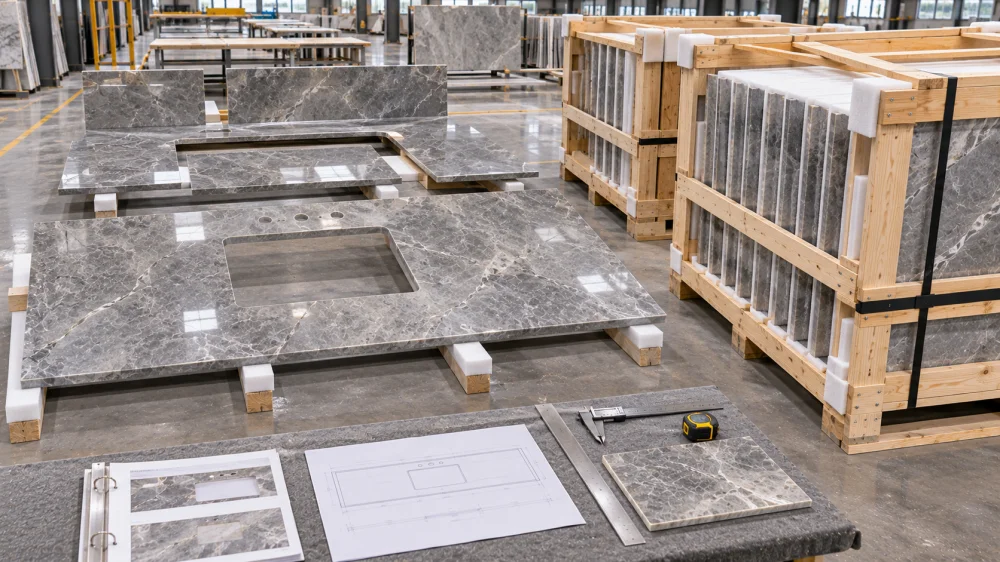
A Marble countertop can pass factory inspection and still be damaged if the finished geometry is not protected correctly for transport.
Long pieces, finished edges, large sink openings and waterfall components create different packing risks from raw slabs.
For finished countertop components, buyers should clarify whether the supplier’s price includes appropriate edge protection, internal restraint, crate structure and piece identification.
A vague line such as “standard export packing” may not represent the same commercial scope between suppliers.
10. Freight and Trade Terms Change the Delivered Budget
Freight is not a fixed percentage of Marble value.
The logistics cost can change with destination, shipment dimensions and weight, crate configuration, route, transport mode and commercial term.
An EXW quotation therefore cannot be compared directly with a delivered quotation unless the buyer normalizes the logistics scope.
For broader project procurement, CENTURY STAR’s architectural stone sourcing guide also emphasizes cutting yield, fabrication, QC, packing and logistics as connected procurement decisions rather than independent purchases.
How Can Buyers Control Marble Countertop Cost?
- Finalize geometry early. Late changes can invalidate an efficient cutting layout.
- Define the acceptable visual range. Extremely narrow selection criteria may reduce material flexibility.
- Approve actual slabs. Especially when veins or strong natural variation affect the final composition.
- Request gross slab quantity. Do not rely only on net finished countertop area.
- Review cutting yield. Ask how the island, perimeter runs, backsplashes and smaller pieces are nested.
- Define seam and vein requirements. Avoid demanding continuity everywhere when it adds little design value.
- Finalize cutouts and edges. Appliance and edge changes affect both machining and layout.
- Define QC evidence. Match approval depth to project risk.
- Separate material, fabrication, packing and freight. This makes competing quotes easier to compare.
What Information Is Needed for an Accurate Marble Countertop Quote?
| Quote Input | Why Needed | Cost Risk if Missing |
| Marble / Visual Direction | Defines the material and selection level. | Supplier may quote a different visual grade or stone. |
| Current Drawings / Dimensions | Required for gross material and fabrication planning. | Slab quantity and processing scope may be inaccurate. |
| Finish / Thickness | Defines material and production scope. | Suppliers may quote different specifications. |
| Sink / Cooktop Details | Defines openings and machining. | Fabrication cost can be understated. |
| Edges / Waterfalls / Backsplash | Identifies additional components and visual-layout requirements. | Quote may cover only simple horizontal tops. |
| Destination / Trade Term | Defines logistics responsibility. | Delivered totals cannot be normalized. |
Material Price vs Final Marble Countertop Project Cost
The raw slab is only the starting input.
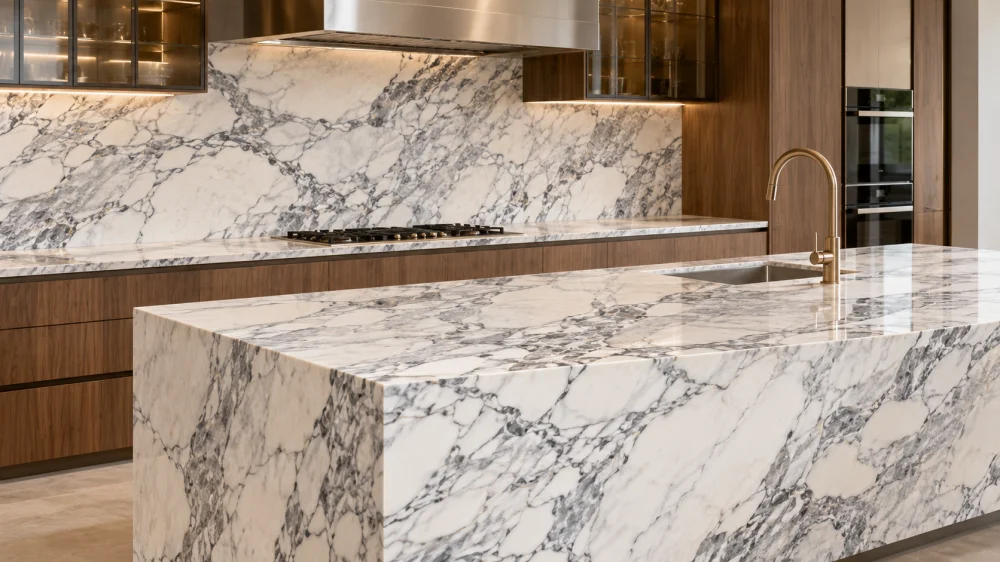
Once slab selection, cutting yield, vein placement, fabrication, QC, packing and shipping are included, the commercial scope becomes a finished project package rather than a stone purchase.
This explains why a higher-value slab can occasionally produce a competitive finished cost when its dimensions and visual composition fit the project efficiently. A cheaper slab can produce the opposite result when additional material is required to work around unsuitable dimensions, natural features or vein direction.
Practical Takeaway
The useful question is not simply “What is the Marble price per square meter?” It is “What will these actual slabs cost to turn into this approved kitchen countertop package?” Compare actual Marble selection, gross slab quantity, usable yield, vein layout, cutouts, edges, fabrication, QC, packing and the same delivery term. That is the Marble countertop cost a procurement team can use for a real award decision.
Frequently Asked Questions
1. Why is there no single Marble countertop price?
Because Marble varies by stone, visual grade, slab dimensions and availability, while each kitchen has different cutting yield, openings, edges, seams, fabrication, packing and logistics requirements.
2. Is Marble countertop cost based only on square footage?
No. Finished area is only one input. Gross slab quantity, usable yield, vein direction, fabrication, QC, packing and freight can all affect the completed project cost.
3. Why can a cheaper Marble slab create a more expensive countertop?
A lower raw slab price can be offset by poor dimensions, difficult vein placement, unusable areas or the need for additional slabs. The buyer should compare finished-project yield rather than raw material rate alone.
4. Does vein matching increase Marble countertop cost?
It can. Requiring strong visual continuity across seams, waterfall panels or backsplashes may restrict how slabs can be nested and can increase material consumption or layout work.
5. Do sink and cooktop openings affect cost?
Yes. They add machining and inspection requirements and can affect where a countertop component can be positioned on the slab. The full piece must still fit the slab before the opening is removed.
6. Are mitered Marble edges more expensive than simple edges?
Mitered or built-up edge details generally require additional stone strips, cutting, assembly and finishing compared with a simple finished edge.
7. Is shipping normally included in a Marble countertop quotation?
Not necessarily. Buyers should confirm the trade term and whether packing, freight, local delivery or destination charges are included before comparing supplier totals.
8. What should I send for an accurate Marble countertop quote?
Provide the preferred Marble or visual direction, current drawings and dimensions, thickness, finish, sink and appliance details, edge profile, backsplash or waterfall scope, quantities, destination and requested commercial basis. Mark any information that remains preliminary.