




What Drawings Should You Send to a Stone Fabricator for Quotation?
For a stone fabrication quotation, send enough information for the supplier to understand what pieces are required, their approximate or finished geometry, how they are exposed, what fabrication is required, how many are needed, and what commercial scope should be quoted.
The ideal RFQ package normally includes relevant plans, elevations or sections, a stone schedule or BOQ if available, component dimensions, material and finish requirements, edge and joint information, openings, special details, quantity, and delivery destination.
You do not always need final fabrication shop drawings before requesting a quotation. Early-stage design drawings can be used for preliminary pricing, provided the supplier clearly identifies assumptions and the quotation is not treated as production approval.
Direct Procurement Checklist
- Current plan / elevation / section relevant to the stone scope
- Stone piece dimensions or enough geometry to calculate them
- Material or visual direction
- Thickness and surface finish, if already specified
- Exposed edges, miters, returns and joints
- Sink, cooktop, faucet, fixture or other openings where applicable
- Quantity / BOQ / piece schedule
- Special-shaped fabrication details
- Drawing revision or issue date
- Destination and requested quotation / trade scope
The RFQ Package Should Answer Three Questions
A useful drawing package does not need to be visually elaborate. It needs to allow the fabricator to answer three practical questions.
- What stone components are being priced?
- What processing does each component require?
- What is included in the supplier’s commercial responsibility?
If the drawings answer only the first question, two suppliers can interpret the same project very differently. One may price simple rectangular cut-to-size pieces while another includes sink polishing, miters, edge finishing, reinforcement, dry layout and export packing.
The resulting totals are not commercially comparable even though both quotations appear to reference the same project.
Which Drawings and Information Matter at RFQ Stage?
| RFQ Item | Required Detail | Why It Matters |
| Plans | Stone locations, overall geometry, interfaces and openings | Establishes the scope and relationship between pieces |
| Elevations / Sections | Heights, vertical panels, returns, joints and exposed conditions | Reveals fabrication not visible in plan view |
| Dimensions | Finished sizes or clearly identified preliminary dimensions | Controls material quantity and machining scope |
| Stone Specification | Material / visual target, thickness and finish where known | Defines what material and processing are being priced |
| Edge / Joint Details | Exposed edges, miters, laminated edges, returns and seams | Changes fabrication labor and stone consumption |
| Openings | Sink, cooktop, faucet, outlets, fixtures or penetrations | Determines CNC, drilling, polishing and layout requirements |
| BOQ / Piece Schedule | Piece references, dimensions and quantities where available | Reduces omissions and duplicate counting |
| Destination / Scope | Destination and requested commercial basis | Defines whether packing and logistics need to be evaluated |
Plans Tell the Fabricator Where the Stone Goes
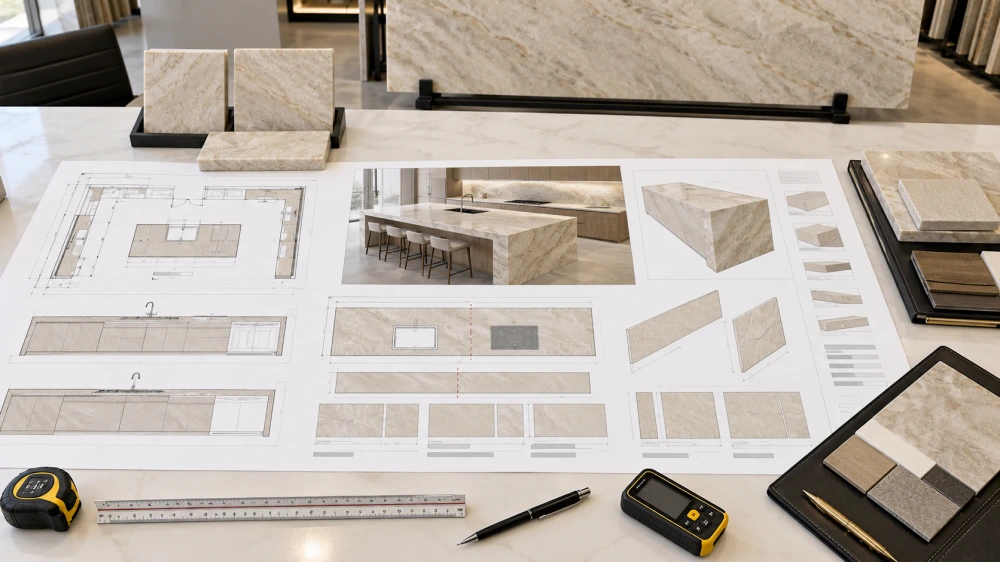
Plans are usually the first drawing layer to send because they establish the relationship between the stone and the surrounding project.
For a kitchen, the plan may show perimeter countertops, island geometry, sink and cooktop locations, backsplashes and adjacent cabinetry. For a bathroom, it may identify vanity tops, shower walls, thresholds and niches. For wall cladding, plans help identify corners, openings and transitions between stone zones.
Do not crop drawings so aggressively that the fabricator loses the context required to understand how pieces connect.
Elevations and Sections Reveal Fabrication That Plans Cannot Show
A plan may show a rectangular countertop, but the elevation can reveal a waterfall end, apron, backsplash or exposed edge. A wall plan may show the footprint, while the elevation reveals panel joints, pattern direction and openings.
Sections are especially useful where thickness, buildup, return geometry, edge conditions or interfaces matter.
CENTURY STAR’s existing Natural Stone Drawing and Site Surveying Guide goes deeper into the measurement-to-production drawing process. For quotation purposes, the important distinction is simpler: send enough drawing views to expose the fabrication scope, even when the final production drawings will be developed later.
Separate Design Drawings From Production Drawings
A common procurement mistake is assuming that the drawing used for quotation is automatically ready for fabrication.
Design drawings communicate architectural intent. They may contain nominal dimensions, concept details or information that still depends on final field conditions.
Shop drawings translate that intent into producible stone components. They should resolve finished sizes, openings, exposed edges, seams, piece IDs and other fabrication information relevant to the project.
Cutting lists identify the individual pieces that must actually be produced.
CENTURY STAR’s current guide to evaluating a natural stone supplier and fabrication factory makes the same distinction: design drawings, shop drawings and cutting lists have different roles, and the controlling production document should be clear before fabrication begins.
For Countertops and Islands, Send Cutout and Edge Information Early
Countertop RFQs are particularly sensitive to information that may appear minor on an architectural plan.
A rectangular island top with polished exposed edges is not the same fabrication scope as an island with an undermount sink, cooktop opening, faucet holes, thick-look miter, waterfall panels and multiple seams.
Where available, send:
- Sink make/model or cutout information
- Cooktop / hob information
- Faucet and accessory hole requirements
- Undermount versus top-mount condition
- Exposed edge locations
- Edge profile or miter concept
- Waterfall ends
- Backsplash / side splash scope
- Seam expectations where relevant
If final appliance templates are unavailable at quotation stage, say so. The supplier can price from the current information while identifying final template approval as a pre-production requirement.
For Wall Panels, Floors and Stairs, the RFQ Inputs Change
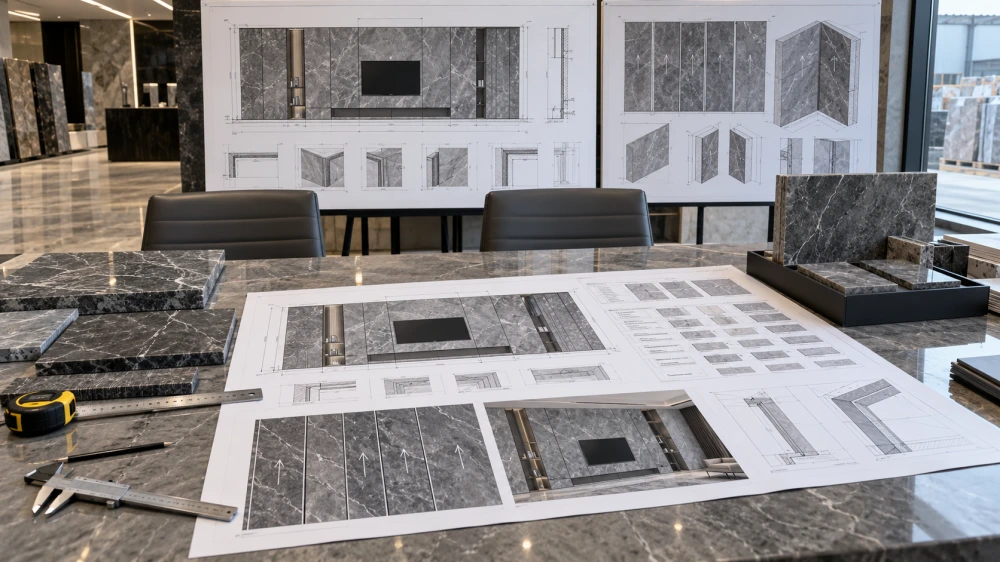
The drawing package should respond to the application rather than follow one universal countertop checklist.
For wall panels, the fabricator may need elevations, panel divisions, openings, corners, returns, visible edges, pattern direction and any fixing-related preparation included in the stone scope.
For flooring, the critical information may include area, module size, border conditions, pattern, transitions, quantity and finish.
For stairs, plans and sections may need to establish tread, riser, landing, exposed edges and special-shaped conditions.
This is why the RFQ should identify the application and stone scope before the supplier begins quantity takeoff.
Material Information Is Part of the Drawing Package

A drawing can define perfect geometry while still being impossible to price meaningfully if the stone itself is undefined.
At minimum, identify the natural-stone family or visual target. If a specific marble, granite, quartzite, limestone or other stone has already been selected, state that material. Where known, also provide thickness and surface finish.
If the stone has not been finalized, make the quotation request explicit: for example, ask the supplier to propose suitable material options against the stated visual and application requirements rather than assuming a particular stone.
For highly variable natural stones, final project cost can also depend on actual slab selection, usable yield and pattern allocation. The RFQ drawing therefore establishes geometry, while later slab approval establishes what material can realistically be cut into that geometry.
What Should the Supplier Return With the Quotation?
A useful RFQ is not a one-way document transfer. The supplier’s response is evidence of whether the project has actually been reviewed.
| Procurement Stage | What to Confirm | Evidence to Request | Risk if Missed |
| RFQ Review | Supplier understands drawing revision and scope | Clarification list / marked drawing | Wrong assumptions enter quotation |
| Quantity | Pieces and quantities match the RFQ | Quotation schedule / takeoff | Missing or duplicated pieces |
| Fabrication | Edges, openings and special work are included | Itemized fabrication scope | Low quote followed by extras |
| Material | Stone, finish and assumptions match request | Material description / proposed slab evidence when applicable | Quotes compare different specifications |
| Commercial Scope | Packing, freight and exclusions are clear | Structured quotation with inclusions/exclusions | Supplier totals are not comparable |
| Pre-Production | Unresolved RFQ assumptions are closed | Approved shop drawings / written revision approval | Preliminary information reaches production |
How to Handle Missing Information Without Delaying the RFQ
Procurement teams often request prices before every project detail is finalized. That is normal. The correct solution is not to wait for a perfect drawing package, and it is not to let the supplier guess.
Separate the information into three groups:
- Confirmed: information that should be priced exactly as issued.
- Preliminary: information adequate for budgeting but subject to revision.
- Pending: information that must be resolved before final quotation or production.
For example, the island dimensions may be confirmed while the sink model is still pending. The quotation can state the assumed opening scope and identify final sink-template approval as a condition before cutting.
This approach makes the commercial uncertainty visible instead of hiding it inside the supplier’s price.
Drawing Approval Becomes More Important After Supplier Selection
The quotation drawing and production drawing serve different commercial stages.
Once a supplier is selected and the project proceeds, unresolved RFQ assumptions should be converted into controlled production information. Final dimensions, material approval, cutouts, edges, seams, visible faces, pattern direction where relevant and piece numbers should be resolved before fabrication.
For highly variable natural stone projects, actual slabs may also need to be connected to the fabrication drawings through slab allocation or CAD nesting. CENTURY STAR’s Quartzite Kitchen Island procurement workflow demonstrates this later-stage control: actual slab approval, CAD layout, appliance openings, waterfall alignment, staged QC and packing evidence are managed as one sequence rather than separate tasks.
What Production and QC Evidence Should Follow?
The buyer does not need every factory photograph available. Evidence should correspond to the risks in the approved order.
Depending on the project, useful records may include:
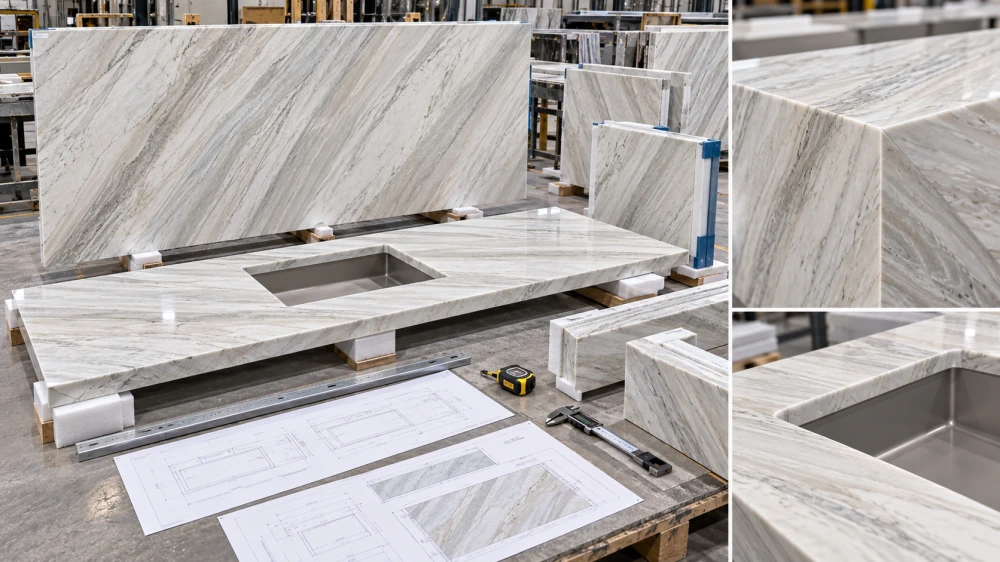
- Approved material or slab references
- Approved shop drawing revision
- Cutting or slab-layout approval where visually important
- Dimensional inspection
- Opening and hole-position checks
- Edge / miter close-ups
- Surface and finish inspection
- Dry-layout images for coordinated pieces
- Piece identification before packing
- Internal packing and closed-crate photographs
The key principle is traceability: the fabricated stone should be verifiable against the document that was approved for production.
Packing and Shipping Information Should Not Be an Afterthought
If the supplier is quoting export packing or logistics, the RFQ should state the destination and requested commercial scope. Piece dimensions, openings and special shapes can influence packing design as well as fabrication.
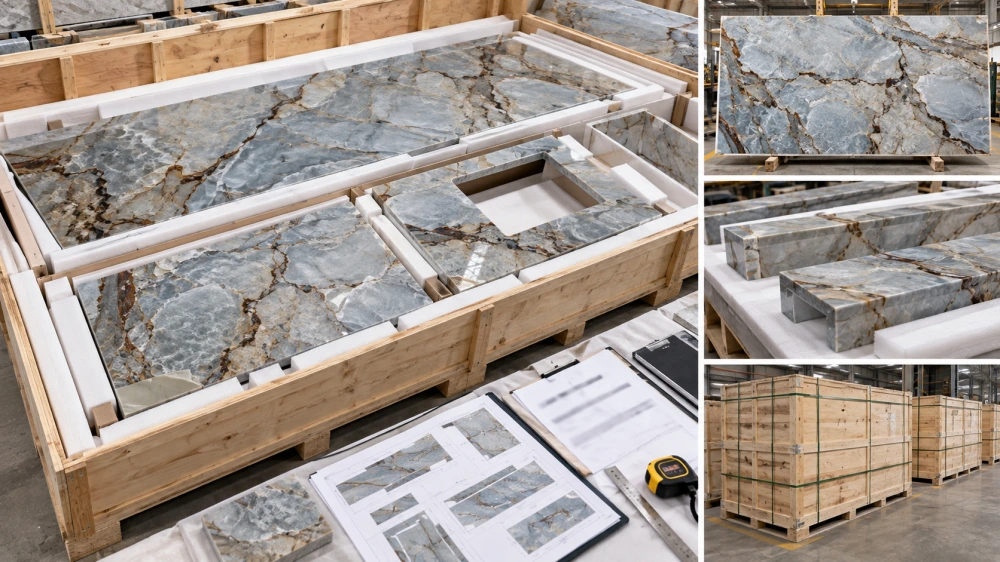
Before shipment, the buyer may request a packing list, piece-to-crate identification, internal protection photographs and closed-crate photographs where appropriate to the project.
Shipping documents depend on the agreed commercial and logistics arrangement, so the RFQ should not assume that every supplier quotation includes the same transport responsibility.
Red Flags When a Fabricator Quotes From Your Drawings
- No questions despite obvious missing information. Silence is not proof that the drawing is complete.
- Quotation contains only a total. Material and fabrication assumptions cannot be compared.
- Preliminary dimensions are treated as final. This creates production risk later.
- Openings and edge details are ignored. The initial price may be artificially incomplete.
- No drawing revision is referenced. Buyer and supplier may be pricing different document versions.
- The supplier cannot explain what drawing will control production. RFQ documents may be passed directly into fabrication without proper technical conversion.
- Material scope is vague. Natural stone grade, finish or actual slab requirements may not match between competing quotations.
Buyer Checklist Before Comparing Stone Quotations
- Did every supplier receive the same current drawing revision?
- Are the stone material, finish and thickness assumptions equivalent?
- Do quoted quantities match the BOQ or takeoff?
- Are visible edges, miters, returns and special shapes included?
- Are sink, cooktop and other openings included where applicable?
- Are drawing-development responsibilities clear?
- Are preliminary assumptions identified?
- Are packing and logistics inclusions comparable?
- Is the quotation clear about exclusions?
- Does the supplier require final written drawing approval before production?
Frequently Asked Questions
1. Do I need final shop drawings before asking a stone fabricator for a quotation?
No. A fabricator can often prepare a preliminary quotation from current architectural or design drawings. However, dimensions and details that are not final should be identified as preliminary, and the quotation should state the assumptions that must be resolved before production.
2. Is a PDF drawing enough for a stone quotation?
A readable PDF can be sufficient for initial review if it contains the required dimensions and scope. Editable CAD files may become useful for detailed takeoff, shop drawing development or cutting-layout work, but file format alone does not determine whether an RFQ is complete.
3. Should I send a BOQ as well as drawings?
Yes, when a BOQ or stone schedule is available. It helps the fabricator reconcile piece types and quantities with the drawings. Any discrepancy between the BOQ and drawings should be clarified rather than silently resolved by assumption.
4. What countertop details are most often missing from quotation drawings?
Common missing information includes exposed edge locations, edge profile or miter requirements, sink and cooktop details, faucet holes, waterfall ends, backsplashes, seams and whether dimensions are finished or preliminary.
5. Can a stone supplier quote before the exact natural stone slabs are selected?
Yes, a budget or preliminary quotation may be possible from the specified material or visual target. However, highly variable natural stone may require actual slab approval and cutting-yield review before material quantity and final project cost can be confirmed accurately.
6. What should a fabricator return after reviewing my RFQ drawings?
A useful response should identify the quoted material and fabrication scope, quantities, assumptions, exclusions and any information requiring clarification. Marked drawings, takeoff schedules or clarification lists can provide additional evidence that the RFQ has been technically reviewed.
7. When should quotation drawings become production drawings?
After supplier selection, unresolved dimensions, openings, material approvals, edge conditions, seams, piece IDs and other fabrication details should be incorporated into controlled shop drawings or equivalent production documents. Production should use the approved revision rather than an earlier RFQ drawing.
References
- Natural Stone Institute — Dimension Stone Design Manual, current applicable edition. Used as general industry guidance for natural-stone selection, fabrication and installation considerations.