



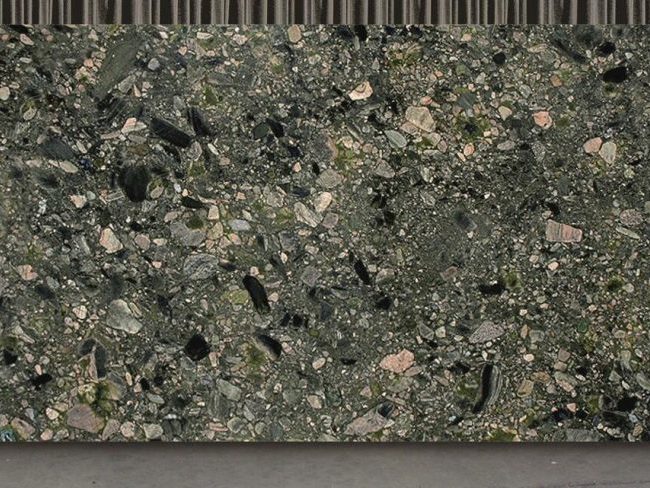
Quick SummaryDo not compare stone supplier quotations by unit price until you confirm that every supplier is quoting the same material basis, quantity, fabrication scope, quality-control requirements, packing method and delivery responsibility. A lower price can reflect better efficiency, but it can also reflect missing cutouts, simpler edges, different slab assumptions, excluded packing, different trade terms or limited pre-shipment evidence. The most useful comparison is a normalized quotation table that separates material, fabrication, QC, packing, logistics, exclusions and unresolved assumptions before the supplier is selected.
How Should Buyers Compare Stone Supplier Quotations?
First normalize the scope, then compare the price. If two stone quotations are based on different material grades, quantities, finishes, fabrication details, packing methods or delivery terms, their unit prices are not directly comparable.
For natural stone projects, the problem is especially important because the material itself can vary. One supplier may quote current project slabs; another may quote only a commercial stone name. One may include finished cut-to-size fabrication and reinforced export packing; another may price raw material plus basic processing.
The buyer’s task is therefore not simply to identify the lowest number. It is to determine what each number actually buys.
Direct Procurement ChecklistBefore ranking quotations, confirm that all suppliers are aligned on:
- Material and visual / grade basis
- Quantity and measurement basis
- Thickness and finish
- Finished sizes or drawing revision
- Edges, miters, cutouts, holes and special fabrication
- Slab approval or sample approval requirements
- QC and pre-shipment evidence
- Packing scope
- Freight and trade term
- Exclusions, assumptions and pending information
Why Unit Price Alone Can Be Misleading
A unit price looks objective because it reduces a quotation to one number per square meter, square foot, piece or slab. But that number is meaningful only when the underlying scope is equivalent.
Consider two countertop suppliers. Supplier A quotes a lower unit rate but excludes sink cutouts, mitered edges, reinforcement, dry-layout review and export crates. Supplier B quotes a higher rate but includes those items. The first quotation may appear cheaper even though the completed project package is not.
The same issue occurs with wall panels, flooring, stairs, furniture and mixed-material projects. Differences in dimensions, finish, edge processing, piece numbering, visual selection, QC and packing can all change the commercial meaning of the quote.
CENTURY STAR’s guide to stone fabricator quotation drawings explains why RFQ drawings, dimensions, edges, openings and delivery scope need to be clear before quotations can be compared fairly.
Step 1 — Confirm That Every Supplier Quoted the Same Material
Natural stone should not be compared by commercial name alone.
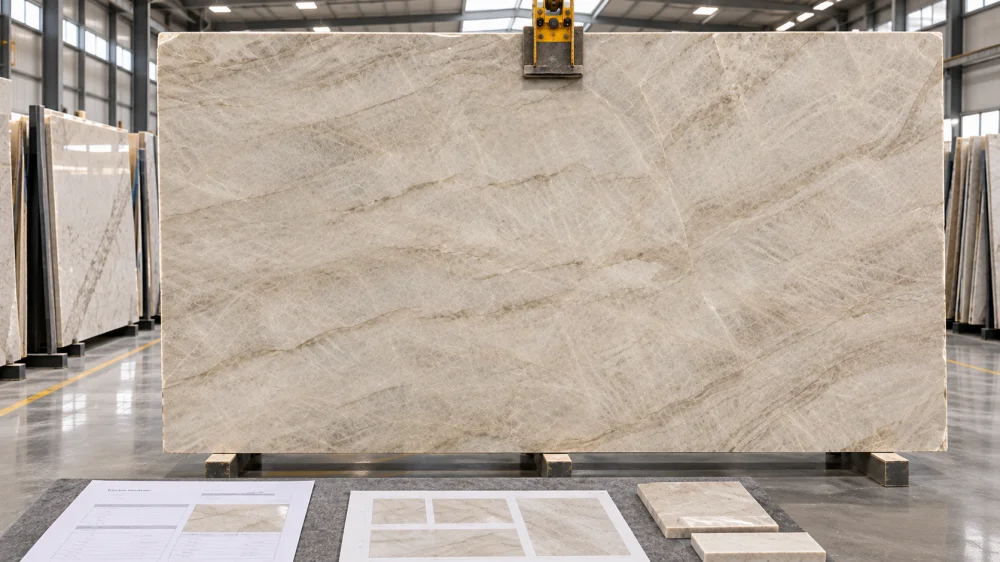
Two suppliers may both write the same Marble or Quartzite name while pricing different visual ranges, slab conditions, available batches or levels of selection. One quotation may assume broad natural variation, while another assumes tighter background-color or vein-control requirements.
The comparison should therefore confirm:
- material name or approved visual direction;
- natural stone versus engineered material;
- finish;
- thickness where specified;
- slab, tile or finished-product form;
- current material evidence where relevant;
- acceptable natural variation;
- whether final slab approval is included in the workflow.
If the project is highly visual, recent full-slab photographs, slab references or a defined sample-approval process are more useful than relying only on catalogue imagery.
Step 2 — Normalize the Quantity Basis
Two quotations can use the same unit rate but calculate different quantities.
One supplier may quote the net finished area from the BOQ. Another may calculate gross slabs required after cutting yield. A third may include spare pieces, while another excludes them.
For customized stone, quantity should be reconciled against the drawings or piece schedule. Buyers should understand whether the quotation is based on:
- net finished area;
- gross slab or tile quantity;
- finished pieces;
- a BOQ quantity;
- a supplier takeoff;
- included spare or replacement material.
A lower unit rate can be offset by a higher quoted quantity. Conversely, a supplier with stronger cutting-layout planning may sometimes require less gross material for the same finished scope.
Step 3 — Compare Fabrication Line by Line
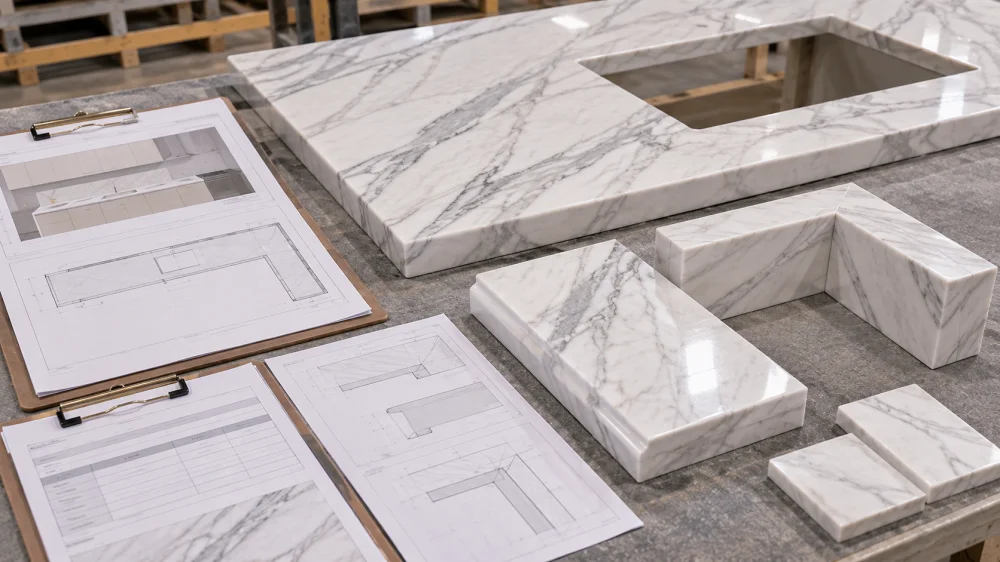
Fabrication is one of the most common reasons stone quotations cannot be compared directly.
For countertops, the quote may need to distinguish straight polishing, shaped edges, miters, sink openings, cooktop openings, faucet holes, waterfall panels, backsplashes, reinforcement and seam preparation.
For wall panels, the relevant scope may include panel cutting, visible edges, returns, openings, piece numbering, pattern orientation and dry layout.
For stairs or furniture, another set of fabrication items becomes relevant.
The buyer should therefore compare the quotation against the actual application instead of using one generic “processing included” line.
Quotation Normalization Matrix
| Comparison Item | What to Normalize | Evidence to Request | Risk if Missed |
| Material | Stone, visual range, thickness and finish | Material description, current slab/sample evidence | Suppliers are pricing different material quality |
| Quantity | Net area, gross material, pieces and spares | BOQ reconciliation or supplier takeoff | Low rate hides higher quantity |
| Fabrication | Edges, cutouts, holes, miters, shapes and reinforcement | Itemized fabrication scope | Extras appear after supplier selection |
| QC | Inspection stages and approval evidence | QC checklist, photos, videos or measurements | Errors discovered only after delivery |
| Packing | Packing type and internal protection | Packing specification or project-relevant photos | Breakage or site-handling problems |
| Commercial Scope | Trade term, freight and responsibility boundary | Named trade term and destination basis | Totals appear comparable but include different obligations |
Step 4 — Evaluate Supplier Questions as Evidence of Review
A supplier that asks technical questions is not necessarily making the procurement process more difficult. Those questions can be evidence that the RFQ has actually been reviewed.
For example, a stone fabricator may ask:
- Which drawing revision controls the quotation?
- Are dimensions final or preliminary?
- Is the sink undermount or top-mount?
- Which edges are visible?
- Is the waterfall panel included?
- Does the buyer require actual slab approval?
- Are dry-layout photographs required?
- What destination and trade term should be quoted?
Silence is not proof that the quotation is complete. When a complex project receives an immediate final price without any clarification, buyers should check what assumptions have been made.
Step 5 — Compare Material and Supplier Evidence
A quotation is stronger when important claims can be verified.
If a supplier states that suitable slabs are available, request current slab evidence where the project requires it. If a supplier claims experience with complex fabrication, request evidence relevant to the required detail rather than generic factory photographs.
CENTURY STAR’s guide on how to evaluate a natural stone supplier and fabrication factory recommends assessing the supplier as a complete delivery system—material access, drawing support, fabrication, QC, packing and export coordination—rather than selecting from website size or unit price alone.
Evidence to Request
- Current material or slab photographs where relevant
- Marked RFQ drawings or clarification list
- Quantity reconciliation
- Relevant fabrication examples
- QC checklist or inspection examples
- Project-appropriate packing evidence
- Written inclusions, exclusions and assumptions
Step 6 — Check What the Quote Says About Quality Control
“Good quality” is not a quotation scope.
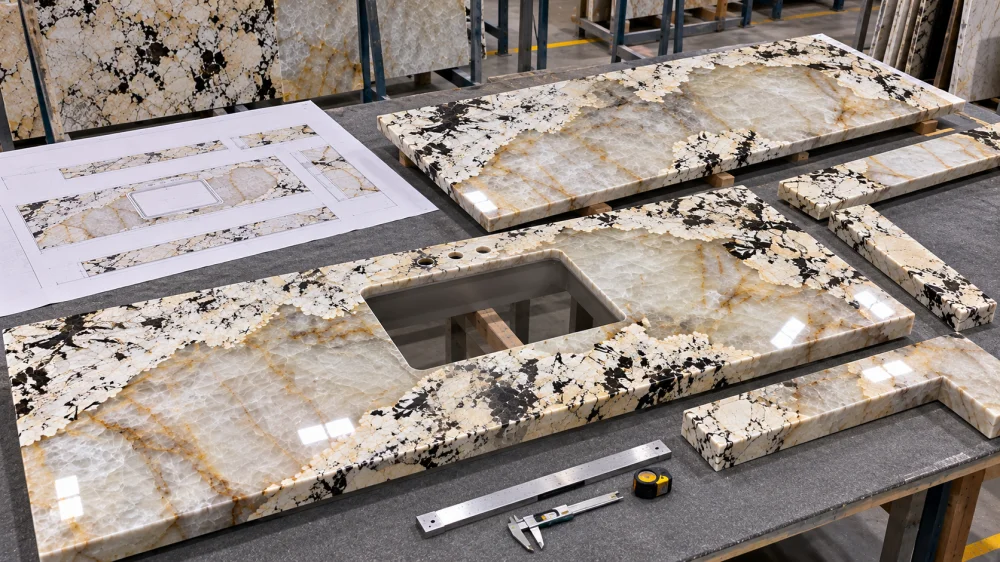
The quotation or accompanying technical response should make clear what will be inspected and what evidence the buyer can expect before shipment.
Depending on the order, QC may cover:
- material or slab approval;
- finish;
- finished dimensions;
- visible edges;
- sink, cooktop or fixture openings;
- piece numbering;
- dry-layout sequence;
- surface condition;
- packing allocation.
Not every project needs the same QC package. The key is to connect inspection evidence to the actual project risks.
Step 7 — Compare Packing Before Comparing Delivered Cost
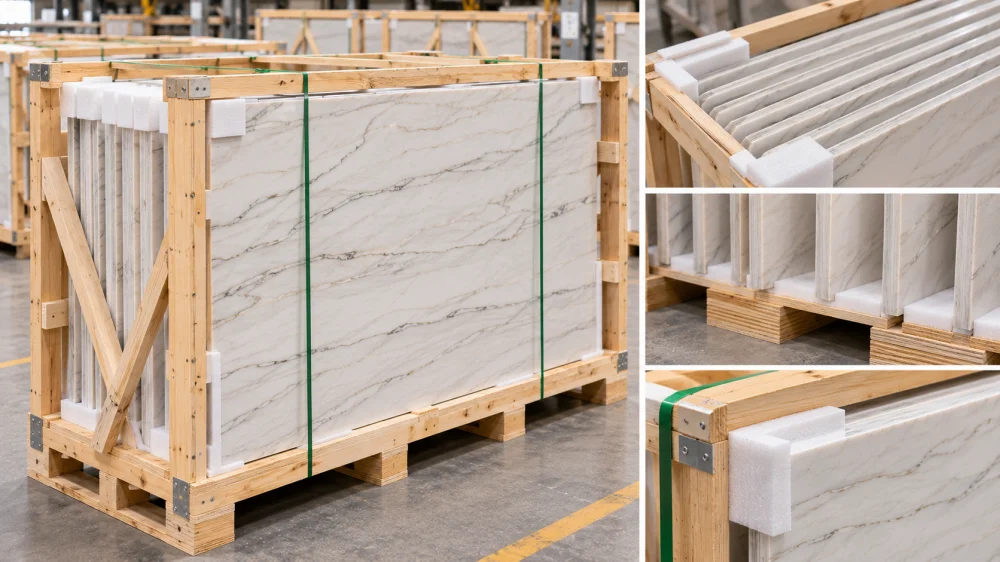
Packing is frequently hidden inside a quotation total or described only as “export packing.” That phrase does not establish what protection will actually be used.
Large slabs, finished countertops, thin panels, tiles, stairs and stone furniture require different handling strategies.
A supplier pricing basic wooden support is not necessarily quoting the same scope as a supplier that includes edge protection, internal restraint, piece identification and geometry-specific protection.
Before supplier award, ask whether packing is included and what type of product the proposed packing is designed to protect.
Step 8 — Normalize the Trade Term and Freight Scope
EXW, FOB, CFR, CIF, DAP and DDP do not represent the same seller responsibility.
For example, comparing an EXW quotation with a CIF or DDP quotation purely by total value produces a misleading result because transport, insurance, export procedures and other responsibilities differ.
International Chamber of Commerce Incoterms® rules exist specifically to clarify tasks, costs and risk allocation between buyer and seller. Buyers should therefore record the named trade term and destination when comparing international stone quotations.
If logistics are not yet finalized, it can be useful to compare the stone/fabrication package separately from freight so the supplier selection is not distorted by different transportation assumptions.
Procurement Stage Verification Table
| Procurement Stage | What to Confirm | Evidence to Request | Risk if Missed |
| RFQ Alignment | All suppliers received the same current scope | RFQ issue record and drawing revision | Quotes start from different assumptions |
| Quotation Review | Material, quantity and fabrication are equivalent | Normalized bid comparison | Lowest rate appears better only because scope is missing |
| Supplier Verification | Claims match actual project capability | Material, fabrication, QC and packing evidence | Supplier selected from sales claims rather than evidence |
| Commercial Normalization | Packing, freight, trade term and exclusions match | Structured inclusions / exclusions list | Quoted totals represent different responsibility levels |
| Pre-Award Clarification | Open assumptions are resolved or visibly carried forward | Revised quotation / clarification record | Commercial dispute after PO |
| PO / Production Handover | Quoted assumptions are converted into controlled order requirements | PO, approved drawing and material approval records | Preliminary RFQ assumptions enter fabrication |
Step 9 — Identify Exclusions Before Selecting the Lowest Quote
Exclusions often explain why one quotation is much lower than another.
Common exclusions may include:
- final slab selection;
- shop drawing development;
- cutouts or holes;
- special edge work;
- dry lay;
- piece labels;
- reinforcement;
- export crates;
- local delivery;
- taxes, duties or destination charges;
- installation.
An exclusion is not automatically negative. The problem occurs when buyers compare one supplier’s excluded item against another supplier’s included item without adjusting the comparison.
Step 10 — Compare Commercial Risk, Not Just Commercial Total
The cheapest complete scope may still be the best offer. But the buyer should know why it is cheaper.
Useful questions include:
- Is the supplier using the same material specification?
- Is the quantity lower because of better yield or because pieces are missing?
- Are fabrication details genuinely included?
- Is QC evidence included or only promised verbally?
- Is packing appropriate for the product?
- Does the trade term match the competing quotes?
- Are any assumptions likely to become change-order costs later?
A quotation comparison should make uncertainty visible. Hidden uncertainty is often more dangerous than a clearly stated higher price.
Red Flags When Comparing Stone Supplier Quotations
Red Flags
- The quotation has one total with no material or fabrication scope.
- No drawing revision is referenced.
- Supplier quotes complex custom work without asking any technical questions.
- Material is described only by a vague commercial name.
- Quantities do not reconcile with the BOQ or drawings.
- Cutouts, edges or special shapes are not mentioned.
- QC is described only as “good quality.”
- Packing is described only as “standard export packing.”
- The trade term or destination is missing.
- Major exclusions appear only after price negotiation.
Buyer Checklist Before Supplier Award
- Confirm that every supplier priced the same current RFQ revision.
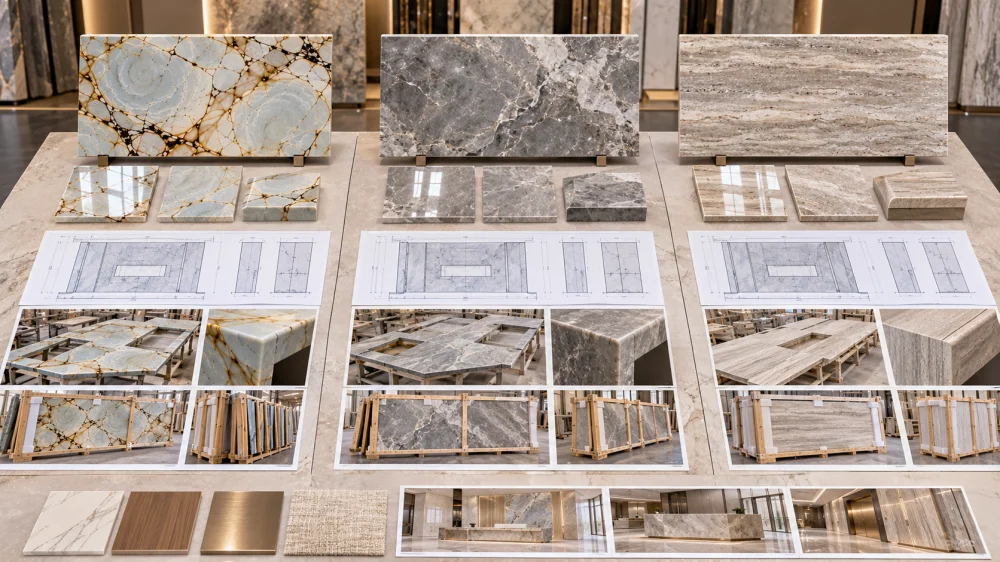
stone supplier quotation final comparison decision - Normalize material, thickness, finish and visual-selection assumptions.
- Reconcile quantities against the same BOQ or drawing takeoff.
- Separate raw material from fabrication where useful.
- Compare edges, miters, cutouts, holes and special processing.
- Confirm whether slab or sample approval is included.
- Compare QC evidence rather than generic quality claims.
- Confirm piece identification and packing scope.
- Normalize freight, destination and trade term.
- List exclusions and pending information side by side.
- Resolve major assumptions before issuing the PO.
- Make sure the final approved commercial scope can be transferred into production documents.
For larger architectural packages involving multiple materials and applications, CENTURY STAR’s architectural stone sourcing guide provides a broader framework for connecting material approval, cutting yield, fabrication, QC, packing and logistics across the whole project.
Practical Takeaway
The best stone quotation is not automatically the lowest unit price and not automatically the highest total. Normalize the scope first. Confirm that suppliers are pricing the same material, quantity, fabrication, QC, packing and commercial responsibility. Then compare the evidence behind the quotation: current material, drawing review, quantity reconciliation, production capability, QC records and packing plan. A lower price is valuable when it reflects real efficiency; it is risky when it reflects missing scope that will return later as extras, delays or quality problems.
Frequently Asked Questions
1. Why should stone supplier quotations not be compared by unit price alone?
Because suppliers may be quoting different material grades, quantities, fabrication work, QC, packing or delivery responsibilities. Unit price becomes meaningful only after those differences are normalized.
2. What should I compare first in a natural stone quotation?
Start with material specification, quantity basis and fabrication scope. If those are not equivalent, the commercial totals cannot be compared fairly.
3. How can I tell whether a low stone quotation is incomplete?
Check whether edges, openings, special shapes, slab approval, QC, packing and logistics are identified. Also review exclusions and whether the supplier asked clarification questions about missing project information.
4. Should buyers ask suppliers to itemize fabrication?
For custom work, enough structure should be provided to understand what fabrication is included. The quotation does not need to become excessively complex, but buyers should be able to distinguish material, major processing, packing and logistics scope.
5. How should buyers compare different quantities in supplier quotations?
Reconcile each supplier’s quantity against the same drawings, BOQ or piece schedule. Determine whether the supplier is quoting net finished area, gross material, finished pieces or included spares before comparing unit rates.
6. Does packing need to be compared separately?
Yes, especially for international shipments and fabricated products. Packing can differ substantially between slabs, tiles, countertops, panels and custom furniture, and weak protection can create costs that are invisible in the initial unit price.
7. Why does the Incoterms rule matter when comparing quotations?
Incoterms® rules help define which party is responsible for specific delivery tasks, costs and risks. Two quotations using different trade terms may therefore include different commercial responsibilities even when the stone scope is similar.
8. What evidence should I request before awarding a stone order?
Request evidence relevant to the project: current material or slab records, marked drawings or clarification notes, quantity reconciliation, fabrication examples, QC procedures, packing evidence and a clear list of inclusions, exclusions and commercial terms.