



Quick Answer
Both Greek Volakas marble and Carrara marble are premium natural white marbles, but they differ in terms of their geological origin, mineral composition, visual appearance, and commercial classification. Volakas marble, which comes from the Drama–Falakro area of northern Greece, is commonly described as a fine-grained dolomitic or dolomitic-calcitic marble. In contrast, the Carrara marble region in Tuscany, Italy, is predominantly associated with calcitic marble and encompasses a much broader spectrum of commercial varieties. Geological research on Volakas marble and documentation by the International Union of Geological Sciences (IUGS) on Carrara marble provide the key references for this comparison.
Visually, Greek Volakas marble generally features a bright white background with grey, beige, brownish, diagonal or cloud-like veining, whereas Carrara marble typically ranges from white to grey and is characterised by grey veining of varying intensity. It is important to note that neither “Volakas” nor “Carrara” describes a completely uniform product, so architects, fabricators, and buyers should evaluate the exact quarry, commercial grade, slab pattern, finish, and technical test data before specifying the stone.
What Is Greek Volakas Marble?
Greek Volakas marble, a well-known white marble, comes from northern Greece, particularly the Volakas and wider Falakro area near Drama. It is commercially appealing due to its luminous white background, fine crystalline texture, and natural veining, which can range from delicate grey lines to stronger diagonal or more complex patterns. Geological research into the marble deposits around Volakas, Granitis, Ochyro, Piges and Pyrgoi has identified several types of marble and found that many of the materials studied are dolomitic or dolomitic-calcitic in composition. Some analysed varieties contained approximately 85–97% dolomite, with calcite representing a smaller proportion.
This mineralogical composition helps to explain why Volakas marble should not simply be considered a decorative ‘white stone’. Its fine-grained structure and dolomite-rich composition give it a unique geological identity, and differences between quarry zones can result in significant variations in colour, veining, grain, and the overall appearance of slabs. Published research also describes Volakas marble as ultra-fine-grained with a granoblastic texture — characteristics that contribute to its refined crystalline appearance when polished.
From a design perspective, Volakas’s most recognisable feature is its movement. Depending on the grade selected, the white field may be intersected by grey or grey-brown veins, diagonal structures, cloud-like areas or flower-like patterns. Consequently, two slabs sold under the broad name ‘Volakas marble’ may look substantially different. Therefore, for large walls, luxury interiors, reception counters, stairs or bookmatched installations, it is much more important to select the actual blocks or slabs than to rely on the material name alone.

What Is Carrara Marble?
Carrara marble originates from the Carrara marble region of the Apuan Alps in Tuscany, Italy. This area has a long and distinguished history of marble extraction, playing an important role in European architecture and sculpture for centuries. The IUGS recognises the Carrara Marble Province as a significant geological and cultural heritage region, noting that it contains over 100 commercial varieties. This is an important distinction because ‘Carrara marble’ does not refer to a single visual specification.
The Carrara Marble Province’s dominant mineralogical feature is calcitic marble, though the wider geological area also contains other types of marble and associated rocks. Commercial materials include familiar names such as Bianco Carrara, Carrara Venato, Bardiglio, Nuvolato, Arabescato, Statuario and Calacata, which differ considerably in background colour, grain, veining and commercial positioning.
This commercial diversity is one reason why comparisons between Carrara and Volakas can be misleading if the exact varieties are not specified. Relatively uniform Bianco Carrara and strongly veined Arabescato can create completely different architectural effects, despite both originating from the broader Carrara marble region. Therefore, a professional specification should identify the precise Carrara variety whenever appearance is an important part of the project brief.
Volakas Marble vs. Carrara Marble: Key Differences at a Glance
The following table summarizes the main differences while keeping in mind that natural stone varies between individual deposits and commercial grades.
| Property | Greek Volakas Marble | Carrara Marble |
| Main origin | Drama/Falakro region, northern Greece | Carrara district, Apuan Alps, Tuscany, Italy |
| Geological character | Commonly dolomitic or dolomitic-calcitic | Predominantly calcitic in the principal marble formations |
| Typical background | White to bright white | White, ivory-white, pearly white to light grey |
| Typical veining | Grey, beige, brownish, diagonal or cloud-like | Grey to darker grey, depending on variety |
| Grain character | Commonly very fine-grained | Generally fine-grained, but varies by variety |
| Commercial diversity | Multiple grades and visual categories | Very broad variety range across the province |
| Visual impression | Bright, directional and naturally contrasting | Classical white-to-grey appearance with varied veining |
| Common applications | Flooring, walls, stairs, bathrooms, countertops and decorative interiors | Flooring, walls, stairs, countertops, sculpture and architectural details |
| Main mineral distinction | Dolomite is important in many Volakas materials | Calcite is dominant in many Carrara materials |
| Selection priority | Whiteness, vein structure, block consistency and technical data | Exact variety, background, vein structure, and technical data |
This comparison is a general industry guide rather than a universal specification. Natural marble is heterogeneous, and the properties of a particular slab can differ from generic values associated with its trade name.
How Do the Appearance and Veining Differ?
Appearance is usually the first reason a designer considers Volakas or Carrara. Greek Volakas marble is particularly associated with a bright white background and distinctive directional movement, making it suitable for interiors where the stone itself is intended to become a visual feature. Depending on the quarry and grade, veins may appear as thin grey lines, diagonal bands, diffuse clouds, or more complex structures.
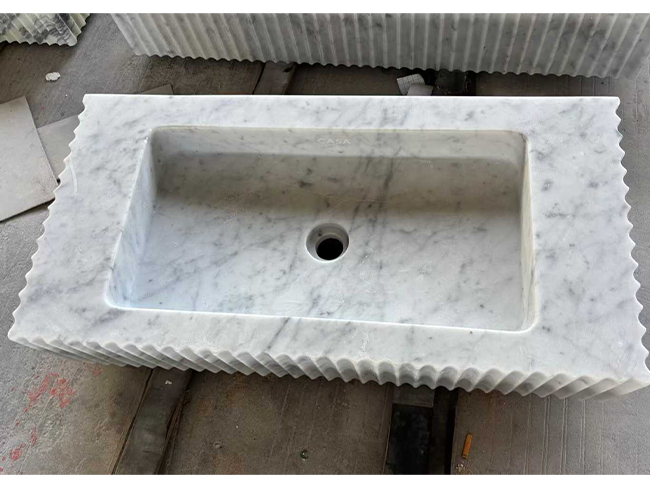
Carrara offers a broader visual spectrum. Some varieties have a relatively calm white background with fine grey veins, while others have stronger, more irregular or network-like veining. The IUGS classification of the Carrara Marble Province includes numerous commercial varieties, which explains why the appearance of Carrara can vary much more than a generic photograph of “Carrara marble” might suggest.
For designers, this distinction affects how the stone behaves across a large surface. Volakas with diagonal movement can produce a dynamic appearance when several slabs are installed together, while a restrained Bianco Carrara can provide a more consistent background for minimalist interiors. Strongly veined Carrara varieties, however, can also become dramatic feature materials. The comparison therefore depends on the specific grades being considered rather than the country of origin alone.
How Are Their Mineral Composition and Physical Properties Different?
The most fundamental scientific difference between Volakas and Carrara materials is the dominant carbonate mineral present in them. Studies of Volakas marble have identified dolomite-rich compositions, whereas calcitic marble is primarily associated with Carrara. This distinction is important because mineralogy can affect characteristics such as chemical behaviour, microstructure, thermal response, and weathering performance.
However, mineral composition should not be used as a shortcut for predicting a particular stone’s complete performance. The behaviour of marble is also influenced by grain size, crystallographic orientation, porosity, microcracks, mineral impurities, fabric, and environmental exposure. Research comparing European building marbles shows that degradation can vary significantly according to mineralogical and microstructural characteristics, even among visually similar materials.
Therefore, buyers should not assume that all Volakas slabs have the same water absorption, density, or mechanical strength, or that all Carrara varieties share the same specifications. For commercial projects, the correct approach is to request laboratory test results for the material that will actually be supplied. Relevant information may include water absorption, apparent density, compressive strength, flexural strength, abrasion resistance, and any other tests required by the intended application.
Which Marble Is Better for Flooring and Interior Applications?
Both materials can be appropriate for interior architecture, but the selection should be based on the combination of aesthetics, exposure, fabrication requirements, and maintenance. Volakas is often attractive for white marble flooring, wall cladding, stairs, bathroom interiors, hotel spaces, and high-end residential projects where a luminous surface with natural movement is desired.
Carrara is similarly versatile and has been used extensively in floors, walls, staircases, countertops, sculpture, and architectural details. Its long history and broad range of commercial varieties make it possible to select anything from a relatively quiet white marble to a strongly veined decorative stone.
For flooring, the relevant considerations extend beyond appearance. Traffic level, surface finish, slip behavior, abrasion, cleaning methods, and expected maintenance should all be considered. A polished marble may emphasize color and veining, while a honed finish can provide a softer visual effect and a different response to everyday wear.
Countertops require additional attention because marble can react with acidic substances. Lemon juice, vinegar, aggressive bathroom chemicals, and some acidic cleaners can etch carbonate-based marble surfaces. Proper cleaning practices and, where appropriate, sealing can help manage staining and maintenance, but sealing does not make marble completely resistant to acids or physical damage.
Is Volakas Marble More Durable Than Carrara Marble?
It is not technically accurate to declare one to be more durable than the other simply based on their names, Volakas and Carrara. Both are natural marbles, and their performance in practice depends on factors such as mineralogy, quarry characteristics, microstructure, thickness, fabrication, finish, and environmental conditions.
The distinction between the dolomite-rich Volakas and the calcite-dominant Carrara can be relevant in certain technical evaluations, particularly where there is significant chemical or environmental exposure. Nevertheless, the performance of individual commercial materials must be determined through testing rather than inferred from mineralogical labels alone.
Exterior projects require especially careful evaluation because marble can be affected by moisture, temperature fluctuations, salt, pollution, freeze-thaw cycles, and thermal expansion, depending on its location. Research on marble weathering shows that microstructure and mineral composition can influence degradation mechanisms, which reinforces the importance of carrying out a technical assessment specific to each project.
For interior applications, maintenance and installation quality may have a greater effect on the stone’s long-term appearance. The specification should include correct substrate preparation, professional installation, suitable adhesives, appropriate joint design, proper finishing, and stone-compatible cleaning products.

How Should Architects and Buyers Choose Between Volakas and Carrara?
The selection process should begin with the intended visual effect. If the design calls for a bright white marble with recognizable diagonal or organic movement, selected Greek Volakas marble may meet that requirement particularly well. If the project requires the established aesthetic of Italian Carrara or a specific white-and-grey variety, the buyer should identify the exact Carrara commercial grade rather than specifying only “Carrara marble.”
The second step is to evaluate sample consistency. A small sample can demonstrate the general color but may not represent the scale or direction of veining across a full slab. For large-format projects, buyers should review slab photographs, block photographs, sequential slabs, or physical slabs whenever possible, especially if bookmatching or vein continuity is required.
The third step is technical verification. A professional quotation should ideally identify the quarry, commercial variety, slab thickness, finish, dimensions, tolerances, packaging requirements, and available laboratory test results. This approach is more reliable than comparing generic online statements such as “Volakas is harder” or “Carrara is more durable,” because such claims can ignore the considerable natural variation within both marble families.
Practical Comparison for Different Design Requirements
The most useful question is not necessarily “Which marble is better?” but rather “Which material matches the design and technical requirements of this project?”
| Design or Project Requirement | Greek Volakas Marble | Carrara Marble |
| Bright white background | Frequently available, depending on grade | Widely available in selected varieties |
| Subtle grey veining | Available | Common in several Carrara varieties |
| Strong directional movement | Available in selected Volakas grades | Depends strongly on the commercial variety |
| Classical white marble appearance | Suitable | Strong historical association |
| Decorative feature wall | Suitable when the block has desirable movement | Suitable, particularly with selected strongly veined varieties |
| Luxury residential interiors | Suitable | Suitable |
| Hotel and hospitality interiors | Suitable | Suitable |
| Stairs and flooring | Suitable when technical requirements are met | Suitable when technical requirements are met |
| Countertops and vanities | Suitable with appropriate care | Suitable with appropriate care |
| Sculpture and artistic heritage | Used primarily as an architectural/decorative stone | Particularly important historical association |
| Large bookmatched installation | Requires careful block and slab selection | Requires careful variety and block selection |
| Key procurement concern | Grade, vein pattern and consistency | Exact variety, vein pattern and consistency |
This comparison highlights an important principle for natural stone procurement: the commercial name is the starting point, not the final specification. A project that requires a consistent white background, controlled veining, or precise bookmatching should specify the visual acceptance criteria in addition to the marble name.
FAQ: Greek Volakas Marble and Carrara Marble
- Is Volakas marble the same as Carrara marble?
No. Volakas marble comes from northern Greece, while Carrara marble comes from the Apuan Alps in Tuscany, Italy. Their geological origins and typical mineral compositions are different.
- What color is Greek Volakas marble?
Greek Volakas marble is generally recognized by a white to bright-white background with grey, beige, brownish, or other natural mineral veining. The exact pattern and contrast vary according to quarry area, block, and commercial grade.
- Is Carrara marble always white?
No. Carrara includes a broad family of commercial marble varieties ranging from white and ivory-white to grey and strongly veined materials. The Carrara Marble Province contains numerous recognized commercial varieties with different visual characteristics.
- Is Greek Volakas marble calcite or dolomite?
Many studied Volakas marbles are dolomitic or dolomitic-calcitic rather than purely calcitic. Research on Volakas-area samples has reported high dolomite contents, although exact mineral composition varies among deposits.
- Is Carrara marble calcite?
Carrara marble is predominantly calcitic in the principal Carrara marble formations. However, the wider geological province contains different marble types and accessory minerals, so individual commercial materials should not be assumed to have an identical composition.
- What is the main difference between Greek Volakas marble and Carrara marble?
The main differences are geological origin, mineralogy, and visual character. Volakas is commonly associated with bright white dolomitic marble and distinctive directional veining, while Carrara is predominantly calcitic and includes a much broader range of white, grey, and veined commercial varieties.
Conclusion
Comparing Greek Volakas marble with Carrara marble is about more than just choosing between Greek and Italian stone. Volakas marble is closely linked to the white dolomitic marble deposits in the Drama–Falakro region, and is highly prized for its fine grain, bright background, and unique natural patterns. By contrast, Carrara represents a historically important marble-producing area in Tuscany, dominated by calcitic marble and containing a diverse range of commercial varieties.
The most reliable selection method for architects, interior designers, stone fabricators, importers, and project purchasers is to compare the exact commercial variety, quarry source, slab appearance, and verified technical data. Volakas is an effective choice for projects requiring a luminous white background with more directional natural movement, while a suitable variety of Carrara marble can provide anything from a restrained classical appearance to a highly decorative veined surface. In either case, reviewing the actual production slabs and specifying measurable acceptance criteria is the safest way to ensure consistent results throughout a project.