


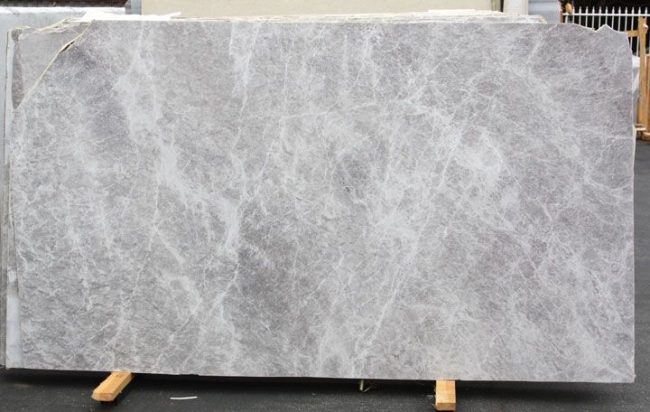
Quick Summary
Travertine vs Limestone Pool Coping is not a comparison with one universal winner. Travertine usually offers more visible pores, natural texture and a relaxed Mediterranean character, while selected limestone can create a cleaner and more restrained architectural pool edge. Both are calcium-based natural stones, so the right choice depends on the actual material, surface finish, climate, pool chemistry, installation system and maintenance expectations.
When evaluating Travertine vs Limestone Pool Coping, buyers should compare real stone samples, dimensions, thickness, finish, coping profile and technical project requirements instead of choosing only by material name. This guide explains where each material works best and what should be checked before ordering custom natural stone pool coping.
Travertine vs Limestone Pool Coping: What Is the Main Difference?
The first thing to understand in a Travertine vs Limestone Pool Coping comparison is that the two materials are related. Travertine is a form of limestone, but its geological formation gives it a different visual and physical character from many conventional compact limestones.
Travertine commonly shows visible pores, cavities, layered mineral structures and directional movement. Many beige limestones have a finer and quieter surface, with more subtle grain, fossil details or tonal variation.
In swimming-pool design, this distinction often becomes a visual decision. Turkey Roman Travertine can create a warmer and more naturally textured pool edge, while Porto Beige Limestone can create a calmer architectural result.
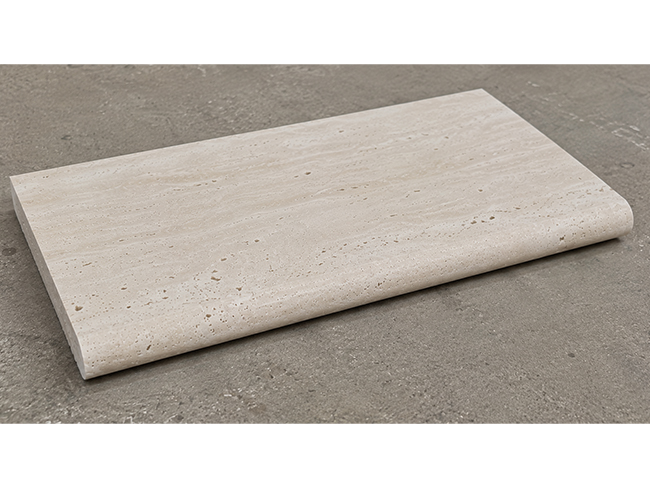
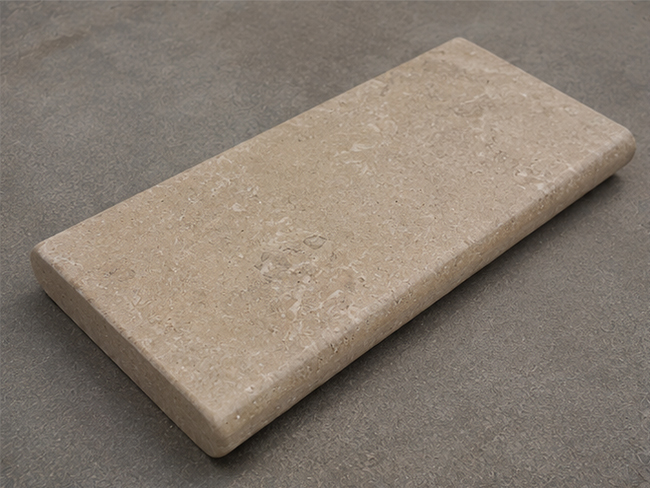
Century Star’s Travertino Romano collection provides a useful reference for Roman travertine, while the limestone collection includes additional natural limestone options for architectural and landscape projects.
Travertine vs Limestone Pool Coping Comparison Table
| Comparison Factor | Travertine Pool Coping | Limestone Pool Coping |
| Visual Character | Visible pores, layered movement and warm natural texture | Often finer, quieter and more architecturally restrained |
| Typical Design Direction | Mediterranean, resort, villa and relaxed natural pools | Contemporary, European and refined architectural pools |
| Finish Options | Honed, brushed, tumbled and project-specific finishes | Honed, tumbled and project-specific finishes |
| Natural Variation | Variation in pores, filling, tone and directional structure | Variation in beige tone, grain, fossils and mineral detail |
| Edge Fabrication | Bullnose, eased, rounded, straight and custom profiles | Eased, rounded, softened, straight and custom profiles |
| Custom Shapes | Straight coping, corners, radius pieces, steps and spa components | Straight coping, corners, radius pieces, steps and spa components |
| Maintenance | Stone-compatible cleaning and maintenance required | Stone-compatible cleaning and maintenance required |
| Best Design Fit | Warm texture and relaxed natural character | Clean beige and restrained architectural character |
This table gives a useful starting point, but a professional Travertine vs Limestone Pool Coping decision should still be based on the specific stone being offered rather than general category descriptions.
1. Travertine vs Limestone Pool Coping for Appearance
Appearance is usually the first factor designers evaluate when comparing Travertine vs Limestone Pool Coping.
Travertine Pool Coping
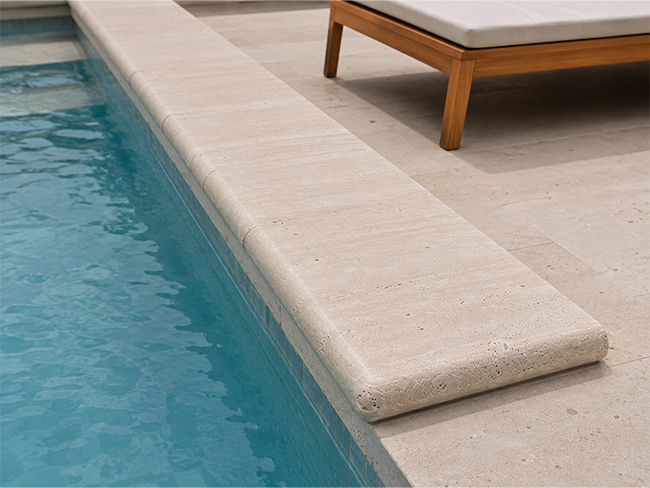
Turkey Roman Travertine typically combines cream, ivory and beige tones with visible pores and natural mineral movement. Depending on the cut and finish, the stone can look more linear, cloudy or softly layered.
This visible texture works well where the pool is intended to feel integrated with the surrounding landscape. Travertine can coordinate naturally with timber, stucco, warm masonry and other outdoor materials.
Limestone Pool Coping
Porto Beige Limestone provides a quieter visual direction. Its beige surface is generally more restrained, with finer natural grain and less obvious pore structure than travertine.
For contemporary villas, modern resorts and clean architectural pools, this quieter surface can allow the pool geometry itself to become the visual focus.
Design Decision
In a Travertine vs Limestone Pool Coping comparison, choose travertine when visible texture is part of the design language. Consider beige limestone when the pool edge should remain quieter and more architectural.
2. Which Material Works Better for Mediterranean Pool Design?
For Mediterranean-inspired projects, Travertine vs Limestone Pool Coping can be a close decision because both materials work naturally with warm architectural palettes.
Travertine often produces the more immediately recognizable Mediterranean or resort character. Tumbled edges, brushed surfaces and warm beige variation can make the stone feel relaxed and established.
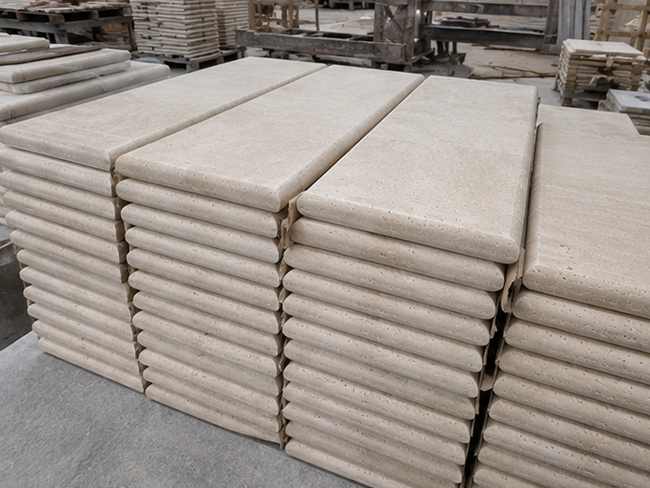
Beige limestone can also create a Mediterranean look, but it generally feels more architectural when cut into precise pieces with controlled joints and a refined finish.
For a rustic villa or resort, travertine may be the stronger starting point. For a contemporary Mediterranean residence, Porto Beige Limestone can provide a cleaner interpretation.
3. Travertine vs Limestone Pool Coping Surface Finishes
Surface finish is one of the most important factors in Travertine vs Limestone Pool Coping because the finish affects appearance, texture and wet-area behavior.
Travertine can be honed, brushed, tumbled or treated with other project-specific finishes. Limestone can also be honed, tumbled or textured depending on the material and specification.
It is not technically accurate to say that every travertine surface is automatically safer around water than every limestone surface. Wet-area performance depends on the specific stone and finish combination.
Where the project specifies a measurable slip-resistance requirement, the proposed stone and finish should be evaluated according to the applicable project standard.
4. Travertine vs Limestone Pool Coping in Hot Climates
Surface temperature is another major question in a Travertine vs Limestone Pool Coping comparison, particularly in hot climates where users walk barefoot around the pool.
Light-colored natural stones can be more comfortable than very dark materials exposed to direct sunlight, but surface temperature is influenced by multiple variables.
- stone color;
- surface finish;
- solar exposure;
- ambient temperature;
- moisture condition;
- installation assembly;
- time of day.
A light Turkey Roman Travertine and a light Porto Beige Limestone can both be reasonable candidates for warm climates. If surface temperature is a critical project criterion, physical samples should be evaluated under representative outdoor conditions.
5. Travertine vs Limestone Pool Coping and Water Absorption
One common assumption in Travertine vs Limestone Pool Coping is that travertine must always absorb more water because the surface may contain visible pores. The reality is more complicated.
Travertine and limestone cover many different stone varieties, and water absorption can vary between individual materials. Travertine can also be supplied filled or unfilled, which changes its exposed surface character.
For demanding projects, buyers should request information about the actual material being proposed rather than relying on a generic category assumption.
6. Pool Chemistry and Stone Maintenance
Pool chemistry matters when evaluating Travertine vs Limestone Pool Coping because both stones are calcium-based materials.
Acidic cleaners and concentrated chemicals can affect calcareous natural stone. This is why maintenance should focus on stone-compatible products and controlled pool-water chemistry.
Suitable penetrating sealers may help reduce liquid absorption and staining risk depending on the particular stone and finish, but sealing does not make natural stone completely impermeable or maintenance-free.
For general care information, buyers can consult the
Natural Stone Institute natural stone care guidance.
7. Travertine vs Limestone Pool Coping in Freeze-Thaw Climates
Cold climates require a more technical Travertine vs Limestone Pool Coping evaluation than warm-climate residential pools.
Not every travertine or limestone variety behaves identically when exposed to repeated freezing, moisture and thawing. The suitability of a specific material should therefore be evaluated together with:
- water absorption;
- relevant freeze-thaw information where required;
- stone thickness;
- installation system;
- substrate and bedding;
- drainage;
- joint design;
- local construction requirements.
For projects in severe climates, technical material approval should take priority over choosing stone only from a photograph.
8. Bullnose, Eased and Custom Pool Coping Edges
Edge design is another important part of Travertine vs Limestone Pool Coping. Both materials can be fabricated with different exposed profiles when the selected stone and thickness are suitable.
Common possibilities include:
- bullnose edges;
- softened edges;
- eased edges;
- straight edges;
- rounded profiles;
- project-specific custom profiles.
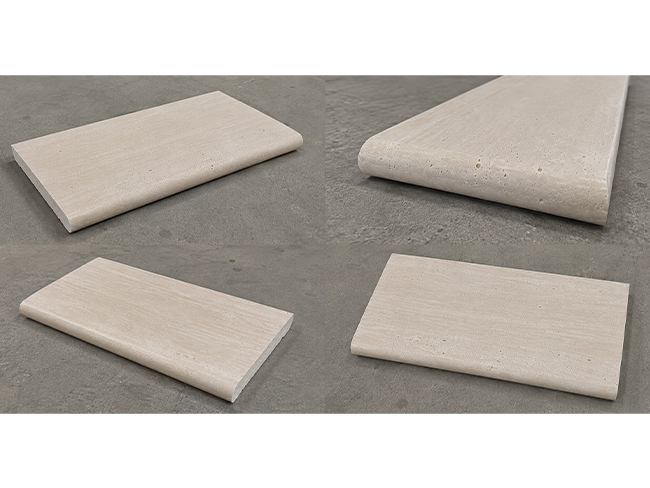
Bullnose profiles create a softer visual transition toward the water, while simpler eased or straight edges may work better in minimalist architecture. The required profile should always be shown clearly on fabrication drawings.
9. Travertine vs Limestone Pool Coping for Curved Pools
For curved swimming pools, Travertine vs Limestone Pool Coping also becomes a fabrication question.
Standard rectangular pieces work efficiently along straight sections, while radius pool edges normally require custom pieces produced from CAD drawings, accurate site dimensions or templates.
Useful fabrication information includes:
- inside radius;
- outside radius;
- coping width;
- piece length;
- stone thickness;
- joint width;
- exposed-edge profile;
- corner transitions;
- spa and step geometry.
Both travertine and limestone can be considered for curved coping when the specific material and component dimensions are suitable for fabrication.
10. Travertine vs Limestone Pool Coping with Matching Pool Decks
The Travertine vs Limestone Pool Coping decision should also consider the surrounding pool deck.
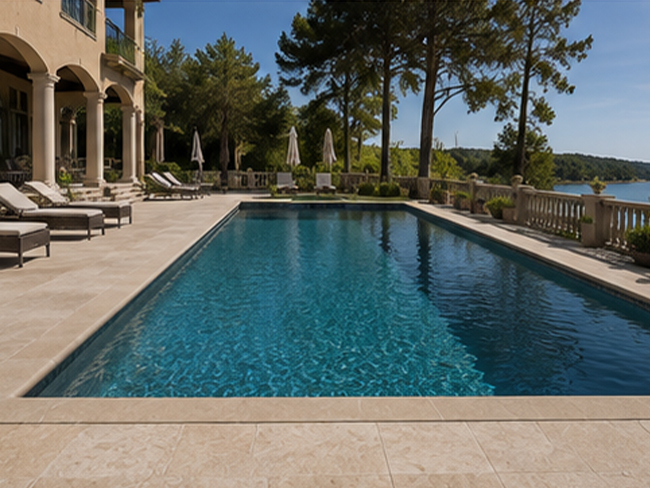
Using the same or a coordinated stone across coping and paving can create a more continuous landscape composition. Turkey Roman Travertine can continue into pool-deck pavers, while Porto Beige Limestone can create a similarly coordinated beige limestone terrace.

Deck paving requires its own evaluation of finish, drainage, joint layout, installation and wet-area performance because the walking surface is much larger than the coping edge itself.
11. Which Is Better for a Modern Swimming Pool?
For contemporary architecture, Travertine vs Limestone Pool Coping often comes down to how much natural texture the designer wants to see.
Porto Beige Limestone can work particularly well with minimalist architecture because its restrained beige appearance complements concrete, pale plaster, glass, timber and simple landscape geometry.
Roman Travertine can also work in contemporary pools when a carefully selected stone is combined with precise fabrication. In that case, the natural pores and warm texture become a deliberate contrast to otherwise minimal architecture.
| Design Priority | Strong Starting Point |
| Visible natural pores and textured character | Turkey Roman Travertine |
| Clean beige architectural surfaces | Porto Beige Limestone |
| Mediterranean or resort atmosphere | Travertine |
| Minimal contemporary villa | Fine beige limestone |
| Custom curved pool | Either material, subject to fabrication feasibility |
12. Travertine vs Limestone Pool Coping Cost
Cost is one of the most common questions in Travertine vs Limestone Pool Coping, but material name alone does not determine the final price.
The finished cost can be influenced by:
- stone selection;
- block or slab availability;
- piece dimensions;
- thickness;
- surface finish;
- edge processing;
- number of radius pieces;
- number of corners;
- cutting yield;
- quantity;
- packing;
- shipping destination.
A pool using repeating rectangular coping may be relatively straightforward to fabricate, while a freeform pool with many custom radius pieces can require significantly more cutting and drawing coordination.
For B2B procurement, quotations should therefore be compared using the same drawings and specifications rather than only comparing raw stone prices per square meter.
13. Installation Can Matter More Than Stone Selection
A proper Travertine vs Limestone Pool Coping comparison should also recognize that installation has a major influence on the finished project.
High-quality natural stone cannot compensate for an unsuitable substrate, poor drainage or unresolved movement joints.
The coping detail should coordinate with:
- pool shell;
- waterline finish;
- deck build-up;
- coping overhang;
- movement joints;
- drainage;
- bedding or adhesive system;
- local construction requirements.
The stone manufacturer can fabricate components to approved drawings, but installation design should remain coordinated with the project architect, pool contractor and installer.
14. How to Specify Custom Natural Stone Pool Coping
Once the Travertine vs Limestone Pool Coping decision has been made, the next step is converting the pool plan into a clear fabrication specification.
| Required Information | Why It Matters |
| Stone Selection | Defines the approved color and natural material range |
| Dimensions | Determines material requirement and cutting schedule |
| Thickness | Coordinates edge depth and construction detail |
| Surface Finish | Affects appearance, texture and project requirements |
| Edge Profile | Identifies bullnose, eased, straight or custom exposed edges |
| Pool Plan / CAD | Defines corners, curves, steps and special pieces |
| Destination | Supports packing and logistics planning |
Buyers can also use the Century Star Product Library to compare other natural stones for swimming pools, paving and landscape applications.
15. Quality Control Before Pool Coping Shipment
For custom Travertine vs Limestone Pool Coping projects, quality control should follow the approved dimensions and drawings rather than focusing only on surface appearance.
A practical inspection sequence may include:
- Material Inspection: color range and approved natural stone characteristics;
- Cutting Inspection: dimensions, thickness and special geometry;
- Surface & Edge Check: finish, visible edges and profiles;
- Layout / Piece Confirmation: radius pieces, corners and quantities;
- Final QC: finished dimensions and visible condition;
- Packing Inspection: separation, edge protection, internal support and secure fixing.
For complex custom pools, unique coping pieces can also be numbered according to installation drawings before packing.
16. Travertine vs Limestone Pool Coping: Which Should You Choose?
The final Travertine vs Limestone Pool Coping decision should combine design intent with technical project conditions.
Choose Travertine When…
You want warm natural texture, visible pores and a relaxed Mediterranean, resort or villa atmosphere.
Choose Limestone When…
You want a cleaner beige surface, restrained mineral movement and a more architectural pool edge.
For Hot Climates…
Compare actual light-colored samples and finishes rather than assuming one entire stone family is always cooler.
For Cold Climates…
Review the specific stone’s technical suitability together with drainage and installation conditions.
For Curved Pools…
Either material can be considered when accurate CAD drawings or templates are available for radius fabrication.
In practical terms, Turkey Roman Travertine is a strong option when texture and Mediterranean character are priorities. Porto Beige Limestone is a strong option when the pool design calls for a cleaner beige architectural edge.
Century Star Support for Travertine and Limestone Pool Coping
After completing the Travertine vs Limestone Pool Coping material comparison, project buyers still need to convert the selected stone into finished components.
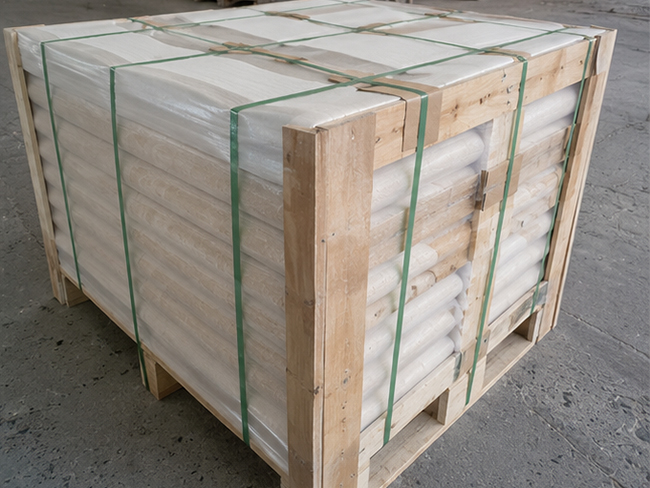
Century Star can support natural stone pool projects with material selection, CAD/shop drawing coordination, cut-to-size production, edge processing, radius components, corner pieces, surface finishing, production inspection and reinforced fumigated wooden packing.
For large villa or hospitality projects, pool coping can also be coordinated with deck pavers, steps, wall caps and related landscape stone to create a consistent material package.
Century Star’s travertine villa and pool project overview also provides an example of how travertine can continue from architectural surfaces into outdoor pool areas.
Final Note
Travertine vs Limestone Pool Coping should not be reduced to a simple question of which stone is universally better. Turkey Roman Travertine offers warmer natural texture and a relaxed poolside character, while Porto Beige Limestone can create a quieter and more architectural beige edge. A reliable Travertine vs Limestone Pool Coping decision should consider actual stone selection, finish, climate, pool chemistry, dimensions, edge profile, drainage, installation and maintenance together.
FAQ
1. Is travertine or limestone better for pool coping?
There is no universal winner in Travertine vs Limestone Pool Coping. Travertine is often preferred where natural pores, warm texture and a Mediterranean appearance are important, while beige limestone can suit cleaner architectural pool designs. The specific stone, finish, climate, pool chemistry and installation conditions should be evaluated before final approval.
2. What is the main difference between travertine and limestone pool coping?
In a Travertine vs Limestone Pool Coping comparison, travertine usually shows more visible pores, cavities and layered mineral movement, while many beige limestones have a finer and quieter visual appearance. Travertine is itself a form of limestone, so the distinction is mainly based on geological formation, stone structure and architectural character.
3. Is travertine more slip resistant than limestone?
Not automatically. Surface finish and the individual stone affect wet-area behavior. A tumbled or textured travertine may perform differently from a smooth finish, just as different limestone finishes can behave differently. Where a measurable slip-resistance requirement applies, the actual stone and finish combination should be evaluated against the relevant project specification.
4. Which is cooler around a pool, travertine or limestone?
When comparing Travertine vs Limestone Pool Coping for hot climates, color and surface exposure are important. Light-colored examples of both materials may be appropriate, but surface temperature also depends on finish, sunlight, ambient conditions and moisture. Physical samples provide a more reliable comparison than broad category claims.
5. Which material is better for a saltwater pool?
Travertine vs Limestone Pool Coping for a saltwater pool should be evaluated using the actual material rather than the stone category alone. Stone characteristics, surface finish, drainage, pool chemistry, cleaning and maintenance all influence long-term performance. Demanding environments should be reviewed using project-specific material information.
6. Can travertine and limestone pool coping be customized?
Yes. Both materials can potentially be fabricated into custom coping widths, lengths, corner pieces, radius sections, steps and other special shapes when the selected stone and dimensions are suitable. Bullnose, eased, straight and other exposed edge profiles can also be produced according to approved drawings.
7. Which is better for a modern swimming pool?
In Travertine vs Limestone Pool Coping for modern architecture, beige limestone often provides the quieter and more minimal appearance. Travertine can still work well in contemporary pools when its natural pores and texture are intentionally used as contrast against clean architectural surfaces.
8. Can the same stone be used for pool coping and decking?
Yes. Travertine or limestone can often be coordinated across both coping and adjacent pool-deck paving when the selected stone, thickness and finish are appropriate for those applications. Using one material family can create a continuous design, although deck drainage and wet-area requirements must still be considered separately.
9. Does natural stone pool coping need sealing?
Some travertine and limestone installations may benefit from a suitable penetrating sealer, but requirements depend on the actual stone, finish and project environment. A sealer may improve resistance to liquid absorption and staining but does not make natural stone completely stain-proof or maintenance-free.
10. What information is needed for a custom pool coping quotation?
After completing the Travertine vs Limestone Pool Coping selection, provide the chosen stone, dimensions, quantity, thickness, surface finish, edge profile and project destination. For curved or custom pools, CAD plans, radius dimensions, corner details, steps and deck layouts are especially useful for accurate fabrication and packing evaluation.