


Quick Summary
Sintered stone and porcelain slabs are often discussed together because both are large-format engineered surfaces used for modern kitchens, bathrooms, walls, floors, fireplaces, counters, sinks, furniture, and commercial interiors. For project buyers, the real question is not only what the material is called, but how it should be selected, fabricated, packed, and installed for the correct application.
Sintered Stone vs Porcelain Slabs: What Is the Difference?
When architects, designers, contractors, and project buyers search for large-format interior surfaces, two terms often appear together: sintered stone and porcelain slabs. In many markets, these names are sometimes used in overlapping ways, especially when referring to large engineered slabs for countertops, wall panels, bathroom surfaces, decorative cladding, and modern floors.
However, for a real project, the name alone is not enough. A buyer still needs to confirm slab size, thickness, surface finish, intended use, edge processing, cutouts, installation method, packing, and supplier fabrication capability. This guide explains the comparison from a practical B2B project perspective.
What Is Sintered Stone?
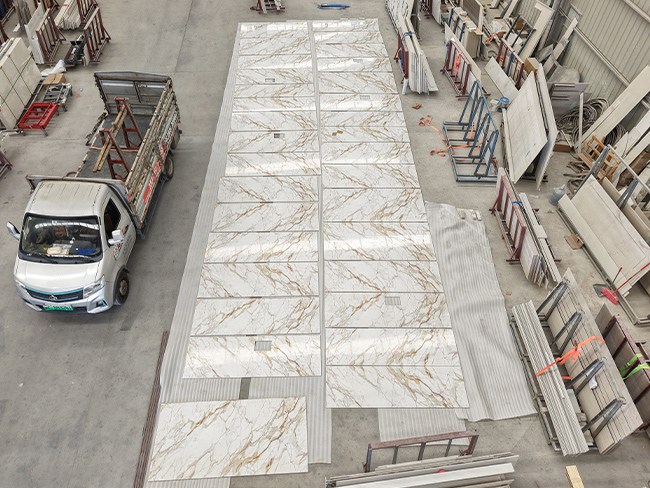
Sintered stone is an engineered slab material made through a high-pressure and high-temperature production process. It is designed to create a dense, durable, and large-format surface suitable for modern architectural applications. In interior projects, sintered stone is widely used for kitchen countertops, kitchen islands, bathroom wall panels, shower panels, vanity tops, feature walls, reception counters, furniture surfaces, fireplace surrounds, steps, floors, and decorative sinks.
The main value of sintered stone is its combination of design flexibility and project practicality. It can be produced in marble-look, travertine-look, concrete-look, plain color, black stone, grey stone, pink stone, Calacatta style, designer pattern, and bookmatched designs. This allows designers to achieve a clear visual direction while using a controlled slab product for fabrication.


What Are Porcelain Slabs?
Porcelain slabs are large-format ceramic-based slabs used for architectural surfaces. Compared with traditional porcelain tiles, porcelain slabs are much larger and are designed to create broader continuous surfaces with fewer joints. They are used for wall cladding, floors, bathrooms, furniture surfaces, kitchen areas, and decorative panels.
In many practical markets, large-format porcelain slabs and sintered stone slabs may appear very similar to buyers. Both can offer large sizes, thin or thick slab options, stone-look patterns, and modern surface finishes. Because of this overlap, some suppliers, designers, and buyers may use the terms differently depending on region, product category, or marketing language.
The important point is that buyers should confirm the actual product specifications instead of relying only on the name. For example, a material described as porcelain slab may still need the same project checks as sintered stone: size, thickness, finish, edge treatment, cutting method, installation support, packaging, and transportation protection.
Are Sintered Stone and Porcelain Slabs the Same?
They are closely related in many interior-surface applications, but they should not always be treated as exactly the same without checking technical details. In real sourcing, the difference may depend on the manufacturer, composition, production process, thickness system, slab size, surface finish, and intended application.
From a project buyer’s point of view, the more useful question is not simply whether they are the same. A better question is: does this slab meet the requirements of my specific application?
| Comparison Point | Sintered Stone | Porcelain Slabs | Project Buyer Should Confirm |
| Material Category | Engineered large-format surface | Large-format ceramic-based slab | Actual manufacturer specification and project suitability |
| Typical Design | Marble look, stone look, solid color, concrete look, bookmatch, designer pattern | Stone look, concrete look, plain color, decorative surfaces | Pattern scale, batch consistency, and visible surface area |
| Common Applications | Countertops, islands, walls, bathrooms, floors, fireplaces, furniture, sinks, counters | Walls, floors, bathrooms, furniture, selected countertop use | Application-specific thickness, support, and fabrication details |
| Fabrication | Cut-to-size, edge processing, openings, mitered edges, layout planning | Cutting, panel processing, openings, edge details depending on slab type | Supplier experience with the exact product and application |
Key Difference 1: Application Selection
The first practical difference appears in application selection. Sintered stone is often promoted for countertops, kitchen islands, bathroom walls, fireplace surrounds, floors, decorative sinks, commercial counters, and feature walls. Porcelain slabs are also used in many of these areas, but buyers must check whether the specific slab thickness and product type are suitable for the intended use.
For example, a wall panel project may use a thinner slab to reduce weight and simplify installation. A kitchen countertop or large island may require a thicker slab, reinforced support, or a mitered edge system. A fireplace wall may require accurate opening processing and panel sequence control. A cashier counter or stone sink may require more detailed fabrication drawings than a flat wall panel.


Key Difference 2: Thickness and Structural Planning
Thickness is one of the most important project questions when comparing sintered stone and porcelain slabs. Thin slabs can be useful for wall cladding, bathroom panels, decorative surfaces, and furniture applications. Thicker slabs may be preferred for countertops, islands, heavy-use surfaces, or areas requiring stronger edge presence.
Before ordering, buyers should confirm how the slab will be supported. Large-format materials can perform very well when properly installed, but incorrect support, poor handling, or unsuitable fabrication details may create risk during transportation, installation, or daily use.
| Application | Common Selection Logic | What to Confirm Before Ordering |
| Kitchen Countertops | Usually requires stronger surface planning, edge detail, and cutout accuracy | Thickness, cabinet support, sink cutout, cooktop opening, edge profile |
| Bathroom Wall Panels | Large panels reduce joints and create cleaner shower or vanity walls | Panel size, substrate, waterproofing, joint position, installation access |
| Floors and Steps | Finish, thickness, traffic level, and installation base are important | Surface finish, anti-slip requirement, piece size, substrate condition |
| Feature Walls and Fireplaces | Visual layout and opening accuracy matter more than name alone | Panel sequence, visible face, opening size, edge returns, fixing method |
Key Difference 3: Design and Pattern Control
Both sintered stone and porcelain slabs can offer marble-look, travertine-look, grey stone, black stone, concrete-look, Calacatta style, and bookmatch-style designs. The project value comes from selecting the right pattern scale for the right surface area.
A soft white marble-look slab may work well for a bathroom vanity or shower wall where the design should feel clean and bright. A bold Calacatta design may be better for an island, floor, or feature wall where the surface is meant to become a focal point. Black or dark grey slabs may suit fireplaces, TV walls, commercial counters, luxury floors, or modern kitchens where contrast is required.


Key Difference 4: Fabrication Requirements
Fabrication is where many project problems begin. Large-format slabs require careful cutting, edge processing, opening preparation, surface protection, and packing. Whether the material is called sintered stone or porcelain slab, the project result depends heavily on the supplier’s fabrication experience.
For countertops, buyers should confirm sink cutouts, faucet holes, cooktop openings, backsplash size, edge details, and seam positions. For wall panels, buyers should confirm panel layout, finished size, installation group, visible edges, and whether any socket or fireplace openings are required. For commercial counters, sinks, and planters, fabrication may involve three-dimensional structure, returns, internal support, and visible-face control.
Custom Fabrication for Large-Format Slab Projects
Century Star supports project buyers with material selection and custom fabrication for sintered stone and other large-format surface applications. Depending on the project type, fabrication support may include cut-to-size panels, countertop fabrication, kitchen island tops, backsplashes, vanity tops, shower wall panels, fireplace surround pieces, feature wall panels, mitered edge processing, cutouts, visible edge finishing, and panel layout planning.
For products involving openings, edges, curves, or three-dimensional forms, drawings are important before production starts. This helps confirm dimensions, piece numbers, installation direction, and finished visual surfaces.


Which Is Better for Kitchen Countertops?
For kitchen countertops, the better choice depends on the slab thickness, edge requirement, surface finish, support system, and fabrication quality. Sintered stone is widely used for modern kitchen countertops because it supports large-format designs, waterfall islands, backsplash matching, and marble-look surfaces.
Porcelain slabs can also be used for selected kitchen projects, but buyers should confirm whether the specific product is suitable for countertop fabrication. Important questions include: Can the slab handle sink and cooktop cutouts? What edge profiles are recommended? Is mitered edge processing possible? How should the countertop be supported? What is the maximum size for safe fabrication and transportation?
Which Is Better for Bathroom Wall Panels and Vanity Tops?
For bathrooms, both sintered stone and porcelain slabs can be suitable, especially when the project requires large wall panels, fewer joints, and a cleaner visual effect. The key advantage is that large-format slabs can cover shower walls, vanity walls, and bathtub surrounds with fewer grout lines than small tiles.
For wet areas, buyers should focus on installation preparation rather than only material appearance. The wall substrate, waterproofing system, adhesive, panel size, joint treatment, and handling access must be considered before ordering.


Which Is Better for Feature Walls, TV Walls, and Fireplaces?
For feature walls and fireplace surrounds, the most important factor is visual layout. Large-format sintered stone and porcelain slabs can both create dramatic wall effects, but the final result depends on panel size, pattern direction, seam planning, and installation accuracy.
Bookmatched designs need special attention. The buyer should confirm whether the pattern sequence works with the wall elevation, whether the centerline is properly aligned, and whether openings such as fireplace boxes, TV zones, sockets, or shelves affect the visual balance.

Commercial and Special-Shaped Applications
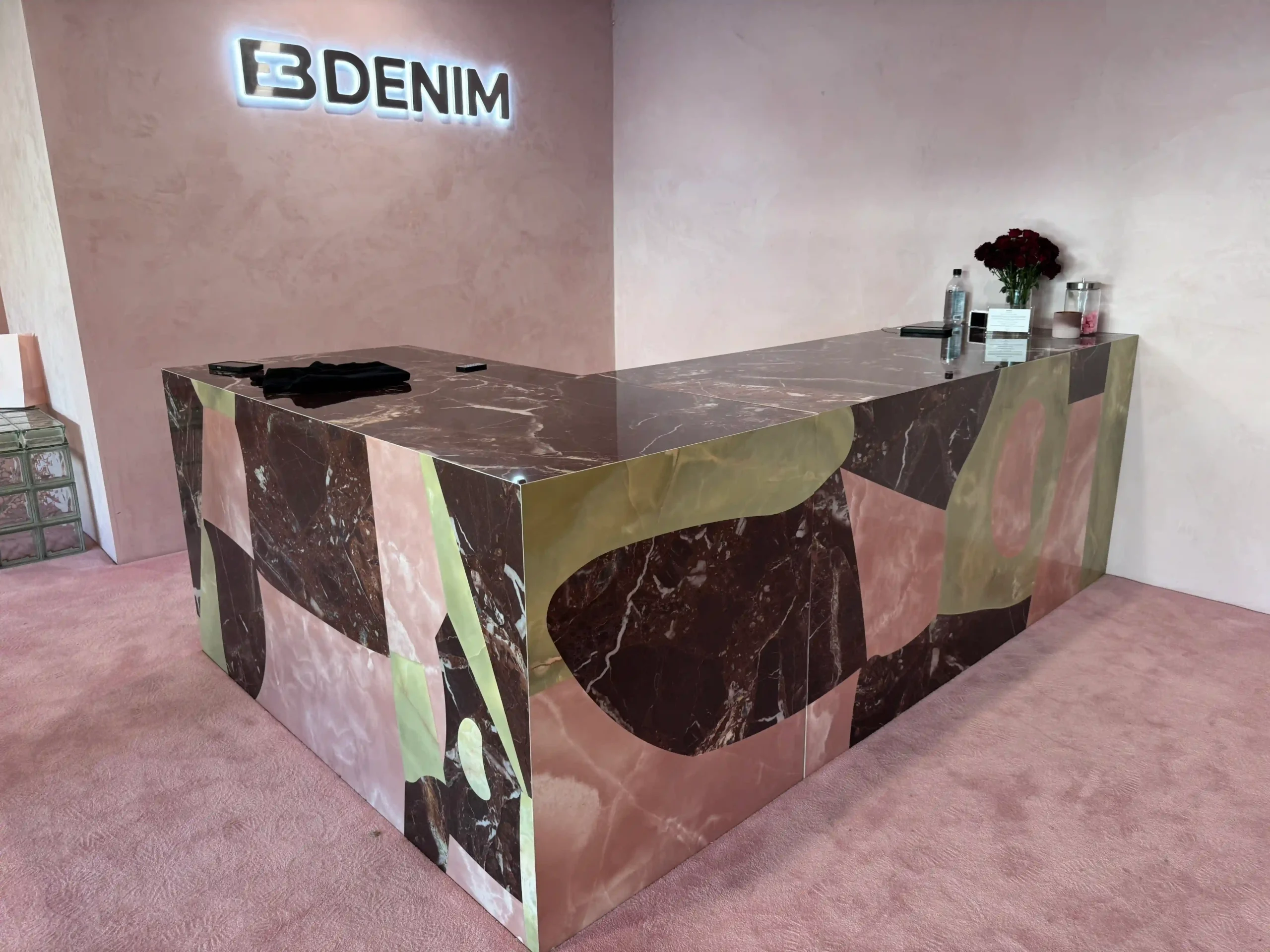
One reason sintered stone is used in B2B projects is that it can be fabricated beyond simple flat panels. Commercial interiors may require reception counters, cashier counters, bar counters, planters, sinks, stair steps, and other project-specific elements. These products require more communication than slab-only supply because visible edges, returns, internal structure, installation interfaces, and packing must be confirmed.


How to Choose Between Sintered Stone and Porcelain Slabs
The best selection method is to start from the project application, not from the material name. Buyers should define the final use first, then confirm the correct slab design, thickness, size, fabrication method, and packing solution.
| Buyer Question | Why It Matters |
| Where will the slab be used? | Countertops, walls, bathrooms, floors, fireplaces, sinks, and counters have different structural and fabrication requirements. |
| What finished size is required? | Finished size affects slab layout, cutting plan, seam location, packing, and transport safety. |
| Are there openings or special edges? | Sink cutouts, cooktop openings, faucet holes, fireplace openings, and mitered edges require fabrication planning. |
| Is the pattern directional? | Vein direction and panel sequence affect the final appearance of islands, backsplashes, feature walls, and fireplaces. |
| How will the material be packed? | Finished surfaces, fragile edges, openings, and large panels need protective packing and secure fixing for export shipment. |
Production Process and Quality Control
Quality control should not be reduced to a simple phrase such as strict inspection. For large-format slab projects, the inspection process should follow the actual production sequence.
| QC Stage | Inspection Focus |
| Material Inspection | Check slab color, pattern, surface condition, finish, and suitability for the intended application. |
| Cutting Inspection | Verify dimensions, cutting direction, panel numbers, opening positions, and layout sequence. |
| Surface and Edge Check | Review visible surface, finished edges, corners, mitered details, and special-shaped processing. |
| Layout Confirmation | For wall panels, fireplaces, and bookmatched projects, check panel sequence and visual continuity before packing. |
| Final QC | Confirm finished sizes, openings, surface condition, piece numbers, and project grouping. |
| Packing Inspection | Check protective materials, crate structure, fixing method, labels, and export packing condition. |
Packaging and Delivery Considerations
Large-format slabs, countertops, wall panels, floors, steps, sinks, counters, and fireplace pieces need proper export packaging. Finished surfaces, polished edges, fragile openings, and long panels should be protected with suitable materials before being fixed inside reinforced packing.
For most custom slab products, reinforced fumigated wooden crates are commonly used. For some heavier or regular-format panel projects, reinforced wooden pallets or crates may be selected according to the product type and shipping plan. The key requirement is that pieces should be separated, protected, and securely fixed to reduce movement during transportation.
For complex projects, packing by piece number or installation group can help contractors identify panels more easily on site. Packing inspection and export documentation support are also important parts of international project supply.
Why Choose Century Star for Sintered Stone and Large-Format Slab Projects?
Project-Based Material Selection
Century Star helps buyers select materials according to application, design direction, slab size, thickness, surface finish, and fabrication requirements.
One-Stop Stone Solutions
Support can cover material sourcing, cut-to-size fabrication, edge processing, openings, layout planning, QC, packing, and export communication.
17+ Years of Industry Experience
With experience in stone and engineered surface projects, Century Star understands the practical concerns of international buyers and project contractors.
Export Packing and Project Support
Finished products can be packed according to project type, piece number, installation group, and shipping requirements for international delivery.
Final Note
Sintered stone and porcelain slabs can both be valuable large-format surface solutions for modern interior projects. The right choice depends on the actual application, thickness, slab size, finish, fabrication requirements, and installation conditions. For project buyers, early drawing confirmation and supplier communication are more important than choosing by material name alone.
FAQ
1. Are sintered stone and porcelain slabs the same material?
They are closely related in many large-format surface applications, but buyers should not assume they are always exactly the same. The name may vary by market, manufacturer, and product category. For project sourcing, it is better to confirm the actual slab size, thickness, surface finish, technical specification, recommended application, and fabrication method before ordering.
2. Is sintered stone good for kitchen countertops?
Sintered stone is widely used for modern kitchen countertops, especially when the project requires large-format surfaces, island tops, waterfall sides, backsplash matching, and a marble-look or stone-look design. Buyers should confirm thickness, edge profile, sink cutout, cooktop opening, cabinet support, and seam position before production.
3. Can porcelain slabs be used for countertops?
Some porcelain slabs can be used for countertop applications, but the exact product must be confirmed. Not every slab thickness or format is suitable for heavy countertop use, cutouts, mitered edges, or unsupported spans. Buyers should ask the supplier whether the selected slab is recommended for the intended countertop design.
4. Which material is better for bathroom wall panels?
Both sintered stone and porcelain slabs can work well for bathroom wall panels when the correct slab size, thickness, installation substrate, and waterproofing system are used. Large-format panels are popular because they reduce joints and create a cleaner shower wall, vanity wall, or bathtub surround appearance.
5. What thickness should I choose for sintered stone slabs?
The correct thickness depends on the application. Thin slabs may be suitable for wall panels and decorative cladding, while thicker slabs are usually preferred for countertops, islands, and heavy-use surfaces. For each project, buyers should confirm the support system, fabrication details, transportation method, and installation conditions.
6. Are large-format slabs difficult to install?
Large-format slabs require experienced handling and installation. Their size can reduce joints and improve design continuity, but proper substrate preparation, adhesive selection, leveling, lifting, and panel alignment are important. For wall panels and bathrooms, installation access and panel weight should be reviewed before ordering.
7. Can sintered stone be used for floors and steps?
Yes, sintered stone can be used for selected floor and step applications when the correct thickness, surface finish, substrate, and installation method are selected. Buyers should confirm traffic level, slip resistance expectations, piece size, edge finishing, and installation environment before placing an order.
8. Can sintered stone be made into sinks, counters, or planters?
Sintered stone can be fabricated into special-shaped products such as sinks, cashier counters, reception counters, decorative planters, and furniture-style elements. These products require detailed drawings because the supplier must confirm dimensions, structure, visible faces, edge returns, openings, and packing method before production.
9. What information is needed before requesting a quotation?
To prepare an accurate quotation, buyers should provide product application, finished dimensions, thickness, surface finish, quantity, drawings if available, edge details, cutout requirements, destination port or delivery address, and packing expectations. For complex projects, CAD drawings are highly recommended before final pricing.
10. How should sintered stone or porcelain slab products be packed?
Finished slabs, countertops, wall panels, sinks, floors, steps, and fireplace pieces should be packed with protective materials and secure fixing. Reinforced fumigated wooden crates are commonly used for export products. Fragile edges, polished surfaces, cutouts, corners, and long panels need special protection before shipment.