


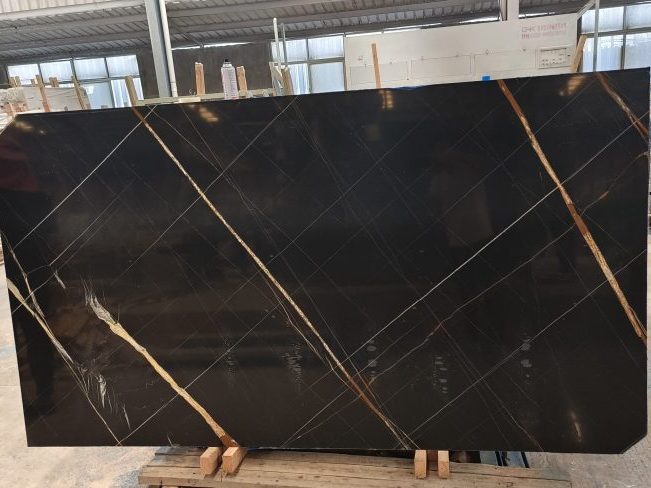

Quick Summary
Large-format stone panels create seamless, dramatic surfaces but require specialized engineering. Key challenges include weight management, vein continuity, and structural safety. The solution combines full-scale layout verification, CNC/waterjet precision cutting, and concealed anchoring systems to ensure both aesthetic perfection and long-term durability.
Contemporary architecture demands not only beauty but also scale and presence. Extra-large stone panels have become a hallmark of high-end design, delivering seamless and dramatic visual impact for both facades and interiors. However, their fabrication and installation go far beyond traditional stone processing, requiring precise engineering, careful planning, and specialized equipment.

This article provides a deep dive into H. Century Star’s approach to large-format stone panels—from full-scale layout verification to CNC precision cutting and engineered anchoring systems—illustrating how to achieve structurally safe, durable, and visually flawless stone installations.
2. Why Large-Format Stone is a Different Discipline
When panel dimensions increase from 600mm to 2–3 meters or more, challenges escalate:
-
Weight multiplies, demanding advanced lifting and handling solutions
-
Natural veins are magnified, making even minor misalignment noticeable
-
Exterior panels are load-sensitive, requiring engineered anchoring rather than adhesive alone
-
Tolerances are minimal, with millimeter-level deviations affecting installation
Large-format stone fabrication is therefore a multi-disciplinary process, blending structural engineering, material science, and precision manufacturing.
3. Three Major Challenges of Extra-Large Stone Panels
A. Weight, Dimensions & Logistics
A single 2.4m × 1.2m × 20mm stone slab can weigh over 160 kg. This requires:
-
Custom transport frames
-
High-capacity vacuum lifting systems
-
Coordinated on-site handling
-
Zero-tolerance safety procedures

B. Stone Continuity & Aesthetic Integrity
The larger the panel, the more pronounced the natural patterns. Any mismatch can compromise the visual effect, especially with high-contrast stones like Calacatta or Verde Alpi. Critical considerations include:
-
Seamless vein matching across panels
-
Book-match and pattern alignment
-
Maintaining continuity on large expanses
C. Structural Safety for Exterior Applications
Exterior stone panels must withstand:
-
Wind load
-
Thermal expansion
-
Seismic vibrations
-
Rainwater and weather exposure
Adhesive alone is insufficient; panels require engineered anchoring systems for structural integrity.
4. Our Engineering-Driven Workflow
H. Century Star implements a workflow designed for precision and safety.
Step 1: Full-Scale Layout & Stone Mapping
Factory-based full-panel layout is essential for quality control:
-
Arrange all panels in their final installation order
-
Adjust natural veins and markings for visual continuity
-
Mark anchor points and precise cut locations

Black Marble background wall

Step 2: CNC Machining & Waterjet Precision Cutting
Non-linear cuts, openings, and complex edges require advanced machinery:
-
5-axis CNC machining
-
High-pressure waterjet cutting
-
Automated edge profiling
This ensures:
-
Stress-free internal corners
-
±0.5 mm cut precision
-
Chamfered or bullnosed edges to prevent chipping
Step 3: Concealed Anchoring & Structural Bonding
Depending on the substrate (concrete, steel, or masonry), we select the optimal concealed anchoring system:
-
Stainless steel undercut anchors
-
Adjustable aluminum track systems
-
Engineered brackets
Combined with:
-
High-performance structural adhesives
-
Elastic anti-fall bonding
-
Weather-resistant sealants
This dual approach provides:
-
Primary load-bearing support (mechanical)
-
Stress distribution and sealing (adhesive)
-
Redundant safety assurance
5. Project Highlight: Luxury Hotel Lobby Wall System
Location: Asia, five-star hotel
Material: 20mm marble panels (2.6m × 1.3m)
Challenges: Continuous vein alignment, recessed lighting integration

Solution:
-
3D scanning to model wall geometry
-
CNC cutting for lighting channels and corner adjustments
-
European-standard concealed anchors for precise vertical alignment
-
On-site micro-adjustment to achieve 95% vein continuity
Result:
A seamless, monolithic lobby wall with natural vein flow and perfect alignment.
6. Anchoring vs Bonding: Engineering Perspective
| Method | Main Function | Advantages | Limitations |
|---|---|---|---|
| Mechanical Anchoring | Load-bearing & safety | Adjustable, high strength, seismic resistance | Requires slots or holes in panel back |
| Structural Bonding | Stress distribution & sealing | Invisible, enhances wind resistance, prevents water penetration | Cannot be sole load-bearing solution |
Best Practice: Combine mechanical and adhesive systems for optimal performance.
7. Global Trends in Large Stone Panels
-
Lightweight stone composites (3–6mm bonded to aluminum honeycomb)
-
Factory-preinstalled anchors to minimize site error
-
AI-driven vein matching software
-
Nano anti-fouling and self-cleaning coatings
-
BIM-integrated digital fabrication processes
The industry is rapidly moving toward precision manufacturing and digitally assisted design.
8. Best Applications for Extra-Large Stone
Facades: Fewer, larger panels minimize seams and create a monolithic effect.
Lobbies & Elevator Walls: Seamless book-matched panels become striking focal points.
Fireplaces & Decorative Walls: Large panels amplify the sense of luxury.
High-End Kitchens & Bathrooms: Clean, continuous surfaces for aesthetics and easy maintenance.
Pro Tip: Always request a sample panel with the actual anchoring and adhesive system for verification.
9. Conclusion
The success of extra-large stone panel projects relies on precision at every stage:
-
Full-scale layout and vein matching
-
CNC and waterjet precision processing
-
Engineered anchoring and structural bonding
-
Quality control throughout factory and site
H. Century Star provides globally trusted solutions for architects, developers, and contractors, ensuring large-format stone installations are both visually flawless and structurally reliable.
For your next large-scale stone project, contact our technical team for consultation.
Field Insight: How Large-Format Stone Panels Achieve Seamless Architectural Impact
Extra-large stone panels deliver dramatic, seamless surfaces for luxury facades and interiors. Beyond traditional stone work, they require precision engineering for structural safety and visual perfection.
• Full-scale layout & vein matching
• CNC & waterjet precision cutting
• Concealed mechanical anchoring
• Structural bonding systems
Each panel undergoes rigorous quality control to ensure both aesthetic continuity and long-term durability—transforming ambitious architectural visions into built reality.
10. FAQ
Q1: What defines an extra-large stone panel?
Typically, panels ≥1.5 m² or those requiring mechanical anchors rather than adhesive alone.
Q2: Why is vein/seam matching important?
It ensures natural patterns flow seamlessly across panels, creating a continuous visual effect.
Q3: Can structural bonding alone support exterior panels?
No, mechanical anchors are always required as the primary load-bearing method.
Q4: How does factory layout save time onsite?
It identifies alignment and vein issues before installation, preventing costly rework.
Q5: What is waterjet cutting used for?
For non-linear cuts, complex openings, and internal corners where precision is critical.
Q6: Are large stone panels suitable for seismic zones?
Yes, with flexible anchoring systems allowing independent panel movement.
References
-
ASTM C1242 – Standard Guide for Selection, Design, and Installation of Dimension Stone Attachment Systems. Read more
-
EN 1469 – Natural Stone Wall Panels. Related safety guidance
-
Industry-recognized best practices regarding stone cladding safety and quality control, highlighting design, testing, and risk mitigation for natural stone exterior panels.
-
Design guides and documentation from reputable stone-cladding engineering resources, including anchor system design, load calculations, material selection, and installation techniques.
-
Case studies and technical literature on modern practices such as factory-preinstalled anchoring, composite stone panels, and BIM-integrated digital fabrication workflows.