


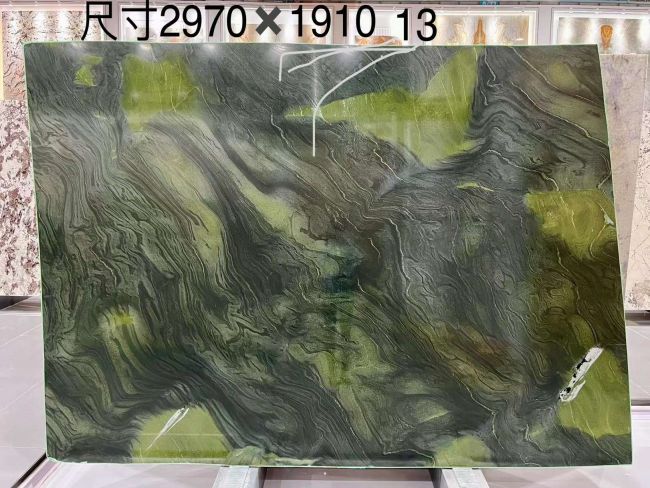

Quick Summary
The Best Natural Stone for Pool Coping depends on much more than color. Travertine, limestone, marble and granite can all be used in pool environments, but they differ in visual character, surface texture, heat response, water absorption, maintenance, climate suitability and fabrication options.
For many residential and villa projects, travertine and selected beige limestone are strong starting points because they combine neutral colors with a natural outdoor appearance. Marble may suit luxury architectural pools, while granite can be attractive where a denser visual and material character is preferred. The final choice should always consider the actual stone, finish, pool chemistry, local climate, installation design and required coping geometry.
How to Choose the Best Natural Stone for Pool Coping
Choosing the Best Natural Stone for Pool Coping is not simply a matter of selecting the stone with the most attractive photograph.
Pool coping sits at one of the most exposed and visually important parts of the swimming pool. It forms the upper perimeter, creates the transition between the water and surrounding deck, and often receives direct sunlight, water splash and regular foot traffic.
A practical material decision should therefore consider several factors together:
- overall architectural style;
- stone color and natural variation;
- surface finish;
- wet-area performance requirements;
- surface temperature in direct sunlight;
- water absorption;
- pool chemistry;
- freeze-thaw exposure where applicable;
- maintenance expectations;
- coping dimensions and thickness;
- bullnose, eased or custom edge profiles;
- straight versus curved pool geometry;
- availability of matching pool-deck stone.
The Best Natural Stone for Pool Coping is therefore the stone that satisfies the complete project specification rather than the material with the strongest marketing claim.
Best Natural Stone for Pool Coping Comparison
| Stone Type | Typical Character | Good Starting Point For |
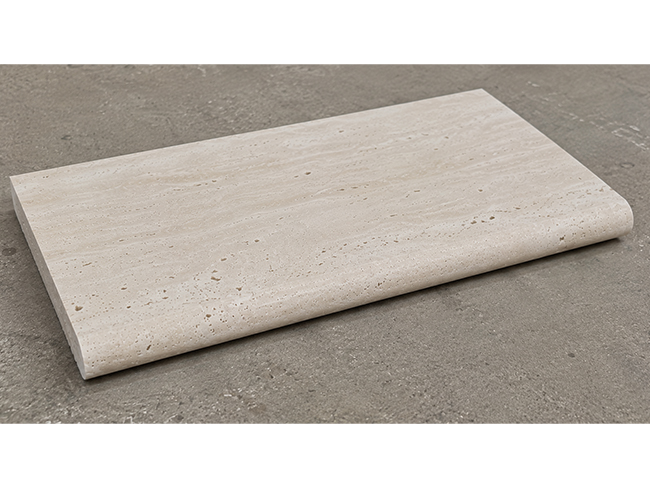
| Travertine | Warm beige tones, visible pores, natural layered texture | Mediterranean pools, villas, resorts and relaxed outdoor landscapes |
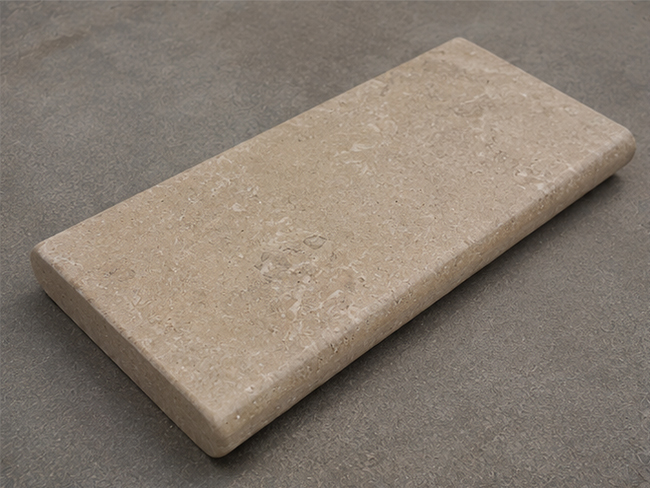
| Limestone | Often quieter grain, soft beige or grey tones and refined natural texture | Contemporary pools, European architecture and minimalist villas |
| Marble | Decorative veining and stronger luxury visual character | High-end architectural pools where appearance is a major design priority |
| Granite | Granular mineral structure and wide color range | Projects requiring a visually solid architectural stone and appropriate exterior finish |
| Quartzite | Crystalline natural structure with varied decorative movement | Premium custom pools where a distinctive natural-stone appearance is required |
This comparison shows why there is no single Best Natural Stone for Pool Coping for every project. The material should be matched to the design direction, climate and technical requirements.
1. Travertine Pool Coping
Travertine is one of the most familiar natural stones used around swimming pools. Its warm coloration and naturally porous appearance make it particularly compatible with outdoor landscapes.
Turkey Roman Travertine, for example, can show cream, ivory and warm beige tones with characteristic cavities and subtle directional mineral movement.
For many Mediterranean, resort and villa projects, travertine may be the Best Natural Stone for Pool Coping when the design calls for visible natural texture rather than a perfectly uniform edge.
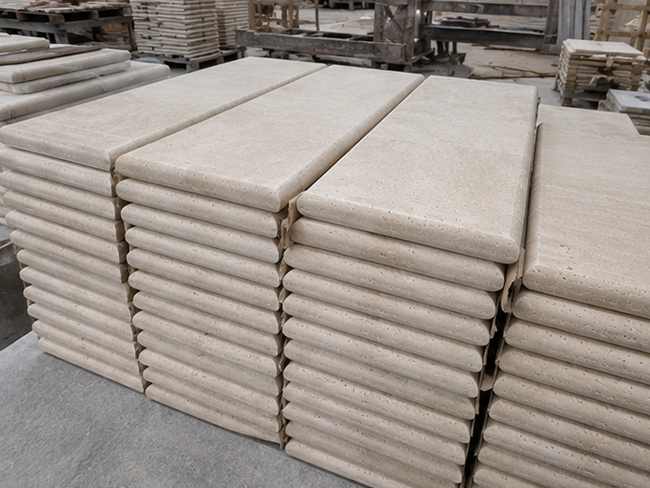
Travertine can be processed in honed, brushed, tumbled and other project-specific finishes. It can also be fabricated into bullnose, eased, straight or custom edge profiles according to thickness and project requirements.
Buyers interested in this material can review Century Star’s
Travertino Romano
for additional material reference.
2. Limestone Pool Coping
Limestone covers a broad family of natural stones, ranging from fine beige materials to grey and fossil-rich selections.
Porto Beige Limestone from Portugal is a good example of a limestone suitable for a cleaner architectural design direction. Its restrained beige appearance can complement contemporary villas, minimalist landscapes and European-style pool environments.
For a designer seeking the Best Natural Stone for Pool Coping with a quieter visual language, selected beige limestone may be a stronger starting point than a visibly porous travertine.

Limestone can be supplied in honed, tumbled or other project-specific finishes, but exterior suitability should always be evaluated for the actual limestone variety.
Century Star’s
limestone collection
provides additional options for buyers comparing beige and architectural limestone materials.
3. Marble Pool Coping
Marble introduces a different design direction. While travertine and many limestones are selected for quieter outdoor integration, marble can become a stronger visual feature.
White, grey, beige or other decorative marbles may be considered where the swimming pool forms part of a luxury architectural composition.
Marble may be the Best Natural Stone for Pool Coping when high visual impact is a central design requirement, but specification should remain cautious.
Marble is a calcium-based natural stone and may react to acidic substances. Pool chemistry, cleaning products, finish selection and maintenance therefore require careful coordination.
A polished decorative marble should not automatically be assumed suitable for a wet pool edge. The proposed finish and stone should be evaluated according to the actual project requirements.
Designers can review Century Star’s
natural marble collection
when exploring marble materials for luxury architectural projects.
4. Granite Pool Coping
Granite is another important natural-stone option for pool coping. It generally has a visibly granular crystalline structure and is available in grey, black, beige, red and other colors depending on the variety.
For projects requiring a strong architectural edge and a textured exterior surface, certain granite varieties can be considered as the Best Natural Stone for Pool Coping.
Typical exterior granite finishes may include flamed, brushed, bush-hammered or other textured surfaces, depending on the stone and specification.
However, “granite” is still a broad commercial category. Surface temperature, slip behavior, absorption, finish and climate suitability should be evaluated for the specific stone rather than assumed from the word granite alone.
5. Quartzite Pool Coping
Natural quartzite can also be used for high-end custom pool designs when the project calls for stronger crystalline structure, unusual color or dramatic natural movement.
Quartzite is typically chosen less often for standard modular pool coping than travertine or beige limestone because many decorative quartzites are premium slab materials. However, for luxury custom pools, they can create a distinctive visual result.
For a statement residence where the pool is part of the main architectural composition, quartzite may become the Best Natural Stone for Pool Coping from a design perspective.
The final decision should still consider fabrication yield, thickness, edge processing, stone structure, availability and project budget.
6. Which Stone Is Best for Hot Pool Areas?
Surface temperature is one of the most common concerns when buyers search for the Best Natural Stone for Pool Coping.
Light-colored stones are often preferred in hot climates because very dark surfaces can absorb more solar energy. However, no natural-stone family can be guaranteed to remain cool simply because of its trade name.
Surface temperature can be influenced by:
- stone color;
- surface finish;
- solar exposure;
- ambient temperature;
- moisture;
- installation construction;
- time of day.
Light Turkey Roman Travertine and Porto Beige Limestone can both be reasonable starting points for warm climates. If barefoot temperature is critical, actual samples should be evaluated under representative outdoor conditions.
7. Which Natural Stone Is Best for Wet Pool Edges?
There is no reliable answer based on stone name alone.
The Best Natural Stone for Pool Coping in a wet environment must combine an appropriate material with an appropriate finish.
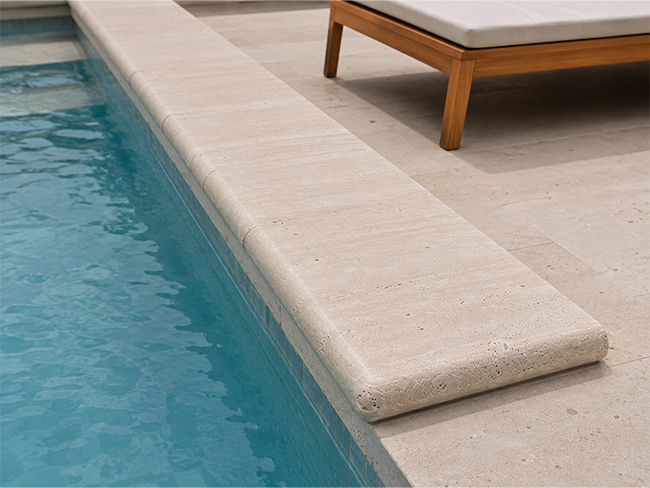
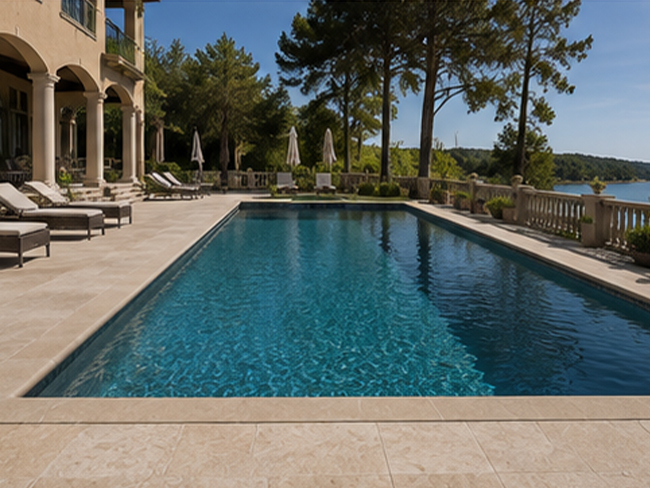
A textured finish may behave differently from a smooth finish on the same stone. Where a project specifies a measurable slip-resistance rating, the actual stone-and-finish combination should be evaluated against the applicable requirement.
Statements such as “all travertine is non-slip” or “all limestone is slippery” are too broad for professional specification.
8. Best Natural Stone for Pool Coping in a Mediterranean Design
Travertine is often one of the strongest choices for Mediterranean and resort-inspired pools.
Warm cream and beige tones, softened edges and visible natural pores work naturally with stucco, timber, traditional masonry and landscape planting.
For this reason, Turkey Roman Travertine may be the Best Natural Stone for Pool Coping where the designer wants an established, relaxed and naturally textured appearance.
Beige limestone can also work extremely well in Mediterranean architecture, particularly when the design is cleaner and more contemporary.
9. Best Natural Stone for Pool Coping in a Modern Villa
For highly contemporary architecture, fine beige limestone is often a strong starting point.
Porto Beige Limestone can complement pale render, architectural concrete, large glass openings, timber and minimalist landscape geometry without competing visually with the pool itself.
In that context, limestone may be the Best Natural Stone for Pool Coping when restraint and precision are more important than visible texture.
Travertine can still work in a modern villa, especially when natural texture is intentionally used as contrast against clean architectural lines.
10. Best Natural Stone for Luxury Pools
A luxury pool does not necessarily require the most expensive stone. It requires material selection that supports the overall architecture.
The Best Natural Stone for Pool Coping in a luxury project could therefore be:
- Roman Travertine for a luxury Mediterranean villa;
- Porto Beige Limestone for a minimalist European residence;
- decorative marble for a highly formal architectural pool;
- granite for a strong contemporary exterior expression;
- quartzite for a bespoke statement pool using premium natural stone.
The word “luxury” should describe the coherence of material, fabrication and detailing rather than only the rarity of the stone.
11. Bullnose Pool Coping
Material selection is only one part of the pool-edge design. The edge profile strongly influences how the coping looks and feels.
Bullnose coping has a rounded exposed edge toward the swimming pool. This profile is frequently used with travertine and other natural stones where a softer visual transition is desired.
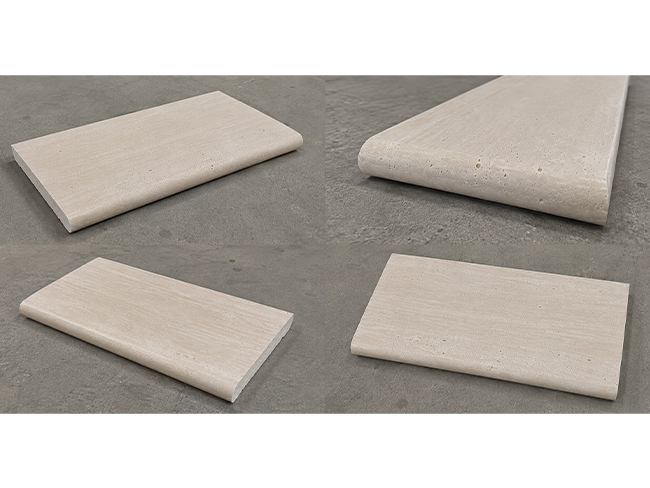
The Best Natural Stone for Pool Coping should also be suitable for the required edge profile and thickness. Edge dimensions and radius should be confirmed before fabrication.
12. Eased and Straight Pool Coping Edges
Modern architectural pools often use simpler edge profiles instead of a pronounced bullnose.
Eased, softened or straight exposed edges can produce a cleaner visual result and may work particularly well with compact beige limestone or precisely fabricated granite.
The edge should still avoid unnecessary sharpness where people may come into contact with the coping. Actual geometry should be coordinated with the design drawings and intended use.
13. Drop Edge Pool Coping
A drop-edge coping design extends the visible stone face downward at the pool perimeter, creating the appearance of a thicker and more substantial stone edge.
This design can be fabricated as a genuinely thicker stone component or as a project-specific assembled/mitered detail depending on material, geometry and engineering requirements.
When selecting the Best Natural Stone for Pool Coping for a drop-edge design, the fabricator should evaluate stone structure, thickness, joints, support and edge processing rather than only visual appearance.
14. Curved and Radius Pool Coping
Freeform pools, spas and rounded pool corners often require custom radius coping rather than standard rectangular pieces.
The Best Natural Stone for Pool Coping for a curved pool is therefore not only the most attractive material but one that can be fabricated efficiently into the required radius pieces.
Useful information for custom production includes:
- inside radius;
- outside radius;
- coping width;
- piece length;
- stone thickness;
- joint width;
- edge profile;
- corner transitions;
- spa and step geometry.
CAD drawings or accurate site templates can reduce ambiguity before cutting begins.
15. Natural Stone Pool Coping Sizes
There is no single universal coping size for every swimming pool.
Common modular formats can be practical for straight residential pools, while custom sizes may produce better joint alignment in architectural projects.
Examples may include 600 × 300 mm, 600 × 400 mm, 1000 × 400 mm or other project-specific dimensions depending on the material and design.
Thickness can also vary. Options such as 30 mm or 40 mm may be requested, but the final specification should consider stone dimensions, support, exposed edge and installation details.
16. Matching Pool Coping with Pool Deck Stone
The Best Natural Stone for Pool Coping should often be considered together with the surrounding deck rather than as an isolated product.
Using the same or a coordinated material for the coping and paving can create a more continuous landscape design.

Travertine coping can continue naturally into a travertine deck, while beige limestone can create a more uniform architectural terrace.
Deck paving should still be evaluated separately for drainage, surface texture, joints and installation requirements.
17. Natural Stone Pool Coping and Water Absorption
Water absorption is frequently discussed when searching for the Best Natural Stone for Pool Coping, but broad material labels do not provide enough information.
Travertine, limestone, marble, granite and quartzite each include many different stone varieties. Absorption can vary significantly within a material category.
For demanding applications, buyers should review information related to the actual stone being supplied rather than relying on generic claims such as “granite does not absorb water” or “travertine always absorbs more.”
18. Pool Chemistry and Natural Stone
Swimming-pool water and cleaning products should be considered during material selection.
Travertine, limestone and marble are calcium-based stones and may be affected by acidic substances. Stone-compatible cleaning and controlled chemical use are therefore important.
Granite and quartzite have different mineral structures, but that does not mean every variety is immune to staining, discoloration or chemical exposure.
The Best Natural Stone for Pool Coping should be maintained according to the properties of the actual material and finish.
19. Does Pool Coping Need Sealing?
Some natural stones may benefit from a suitable penetrating sealer, especially where reduced liquid absorption or staining risk is desired.
However, sealing does not make stone completely waterproof, stain-proof or maintenance-free.
The correct product should be compatible with the stone, surface finish, pool environment and maintenance plan.
A sample application can be useful before treating an entire pool installation because some sealers may subtly affect appearance.
20. Best Natural Stone for Pool Coping in Freeze-Thaw Climates
Cold-climate pool projects require more technical material evaluation.
The Best Natural Stone for Pool Coping in a freeze-thaw environment depends on the individual stone’s properties together with installation and drainage.
Important considerations include:
- actual stone absorption;
- freeze-thaw performance information where required;
- thickness;
- substrate;
- bedding system;
- movement joints;
- drainage;
- local climate;
- construction standards.
No entire natural-stone category should be described as universally freeze-proof without material-specific evidence.
21. Pool Coping Material Cost
Many buyers expect the Best Natural Stone for Pool Coping to be determined partly by price, but raw material cost is only one part of the finished product.
The total quotation can be influenced by:
- stone selection and grade;
- current material availability;
- piece dimensions;
- thickness;
- surface finish;
- bullnose or other edge processing;
- radius pieces;
- corners;
- cutting yield;
- quantity;
- packing;
- shipping destination.
A standard rectangular coping order can have very different fabrication costs from a freeform pool with dozens of unique curved pieces.
22. How to Order Custom Natural Stone Pool Coping
Once the Best Natural Stone for Pool Coping has been selected, the next step is preparing an accurate fabrication request.
| Information | Why It Matters |
| Stone Type | Defines material selection and natural variation range |
| Dimensions & Quantity | Determines material requirement and fabrication quantity |
| Thickness | Coordinates the visible edge and installation detail |
| Surface Finish | Affects appearance, texture and wet-area specification |
| Edge Profile | Defines bullnose, eased, straight, drop edge or custom processing |
| Pool Plan / CAD | Identifies straight pieces, curves, corners, steps and spa transitions |
| Destination | Supports packing and international logistics planning |
For additional stone options, buyers can explore the
Century Star Product Library
before finalizing material selection.
23. Quality Control for Custom Pool Coping
Finding the Best Natural Stone for Pool Coping is only useful if the finished components match the approved specification.
A professional QC workflow can include:
- Material Inspection: review color range, stone condition and natural variation;
- Cutting Inspection: check length, width, thickness and special geometry;
- Surface & Edge Check: inspect finish, edge profile and corners;
- Layout Confirmation: verify radius pieces, custom components and quantities;
- Final QC: check finished dimensions and visible condition;
- Packing Inspection: confirm edge protection, separation, internal support and secure fixing.
Complex pool coping can also be numbered according to drawings to simplify installation identification on site.
24. Natural Stone Pool Coping Packaging
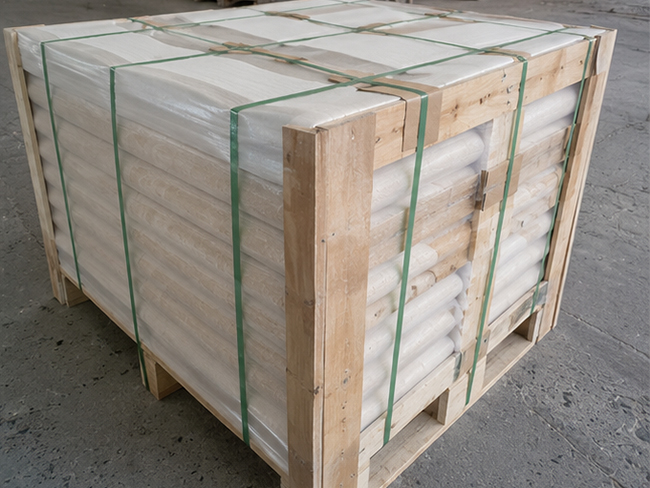
Pool coping pieces often contain finished visible edges, making proper packing especially important for export orders.
Reinforced fumigated wooden crates or suitable reinforced wooden packing can be used with protective separation, edge protection and internal fixing according to the geometry of the finished stone.
Radius pieces, corners and other special components should be identified clearly where multiple custom pieces are included in the same project.
So, What Is the Best Natural Stone for Pool Coping?
There is no single stone that is automatically the Best Natural Stone for Pool Coping in every climate and every architectural style.
| Project Priority | Stone to Consider First |
| Mediterranean texture and warm beige character | Travertine |
| Clean contemporary beige pool edge | Fine beige limestone |
| Decorative luxury visual statement | Selected marble or quartzite |
| Strong granular architectural character | Selected granite |
| Curved or custom pool geometry | Any suitable stone with confirmed fabrication feasibility |
For many residential and hospitality projects, travertine and beige limestone remain practical materials to compare first because they work naturally with outdoor architecture and can be coordinated with matching paving.
Century Star Natural Stone Pool Coping Support
After choosing the Best Natural Stone for Pool Coping, the project still needs to move from material selection to finished fabrication.
Century Star can support custom natural stone pool projects with material selection, cut-to-size production, CAD/shop drawing coordination, bullnose and custom edge processing, radius pieces, corner components, surface finishing, production inspection and reinforced export packing.
Pool coping can also be coordinated with matching deck pavers, wall caps, steps and other landscape components when the project requires a unified natural-stone package.
Final Note
The Best Natural Stone for Pool Coping is the material that balances architecture, surface finish, climate, pool chemistry, maintenance, fabrication and installation requirements. Travertine is a strong choice for warm and naturally textured pools, limestone for clean architectural environments, marble and quartzite for statement luxury designs, and selected granite for projects requiring a different exterior stone character. Always evaluate the actual stone and finish before approving a pool coping specification.
FAQ
1. What is the best natural stone for pool coping?
The Best Natural Stone for Pool Coping depends on the design and technical requirements. Travertine is often selected for warm Mediterranean and resort-style pools, beige limestone for cleaner contemporary architecture, marble or quartzite for luxury statement projects, and selected granite for other exterior architectural applications. The specific stone and finish should always be evaluated.
2. Is travertine good for pool coping?
Travertine is widely considered for natural stone pool coping because its beige tones, visible pores and textured character work naturally with outdoor landscapes. Turkey Roman Travertine can be fabricated into standard or custom coping pieces, but finish, climate, pool chemistry, installation and maintenance requirements should still be reviewed for the actual project.
3. Is limestone good for swimming pool coping?
Selected limestone can be an excellent architectural option for pool coping. Beige materials such as Porto Beige Limestone can create a calm and refined pool edge. Because limestone varieties have different physical characteristics, exterior suitability, surface finish, climate exposure and project-specific performance requirements should be evaluated before approval.
4. Is granite better than travertine for pool coping?
Neither material is universally better. Granite and travertine offer different visual and physical characteristics. Travertine may be preferred for warm natural texture, while granite may suit projects seeking a stronger granular architectural appearance. The Best Natural Stone for Pool Coping depends on the actual stone, finish, climate and design requirements.
5. Can marble be used for pool coping?
Selected marble can be considered for luxury pool coping, but it should be specified carefully. Marble is calcium-based and can be affected by acidic substances, while smooth finishes may not meet every wet-area requirement. The actual marble, finish, pool chemistry, maintenance and project conditions should be reviewed before use.
6. Which natural stone stays coolest around a pool?
No stone family can be guaranteed to remain coolest in every environment. Lighter colors often provide a useful starting point, but surface temperature also depends on sunlight, finish, ambient conditions, moisture and installation. Physical sample testing under representative conditions is the most reliable approach when barefoot comfort is critical.
7. What is the best finish for natural stone pool coping?
The best finish depends on the material and project specification. Honed, brushed, tumbled, flamed and other textured surfaces can produce different visual and wet-area characteristics. Where a specific slip-resistance value is required, the proposed stone-and-finish combination should be tested or evaluated against the relevant requirement.
8. Can natural stone pool coping be customized for curved pools?
Yes. Suitable natural stone can be fabricated into radius pieces, corner components, steps, spa edges and other custom geometries. CAD drawings, accurate dimensions or site templates help define the required curves and joint arrangement before cutting.
9. Can the same stone be used for pool coping and pool deck paving?
Yes. Travertine, limestone and other suitable natural stones can often be coordinated across coping and adjacent deck paving. Using the same material family can create a more unified landscape design, although surface finish, drainage, thickness and wet-area requirements should be evaluated independently for the larger deck area.
10. What information is needed for a custom natural stone pool coping quotation?
After selecting the Best Natural Stone for Pool Coping, provide the material, dimensions, quantities, thickness, surface finish, edge profile and project destination. For custom pools, include CAD drawings, radius dimensions, corners, steps, spa transitions and deck-layout information where possible. These details allow fabrication, packing and logistics requirements to be calculated more accurately.