



Which White Quartzites Should You Shortlist for a Luxury Kitchen?
For architects, interior designers and buyers comparing the best white quartzite for kitchen countertops, a practical starting shortlist is Mont Blanc Quartzite, White Macaubas Quartzite, Cristallo Quartzite, Infinity White Quartzite and Atlantic White Quartzite.
They should not, however, be treated as five interchangeable versions of the same white stone. Their background tone, vein direction, crystalline structure, visual movement and slab-to-slab variation can create very different kitchen results. The correct choice therefore depends on what the countertop needs to accomplish within the complete kitchen design.
Direct Selection Guide
- Mont Blanc Quartzite: for soft white-to-cream luxury kitchens that need restrained natural movement.
- White Macaubas Quartzite: for long islands and contemporary kitchens where directional linear movement is part of the design.
- Cristallo Quartzite: for statement kitchens where crystalline structure, depth and carefully planned translucency are desired.
- Infinity White Quartzite: for brighter interiors requiring a relatively calm white visual direction.
- Atlantic White Quartzite: for kitchens that can accept stronger grey, blue-grey or mineral movement within a white/light background.
What Does a Luxury Kitchen Countertop Actually Require?
A white stone may look ideal in a sample but still be the wrong choice for a particular countertop layout. Before comparing stone names, define the application.
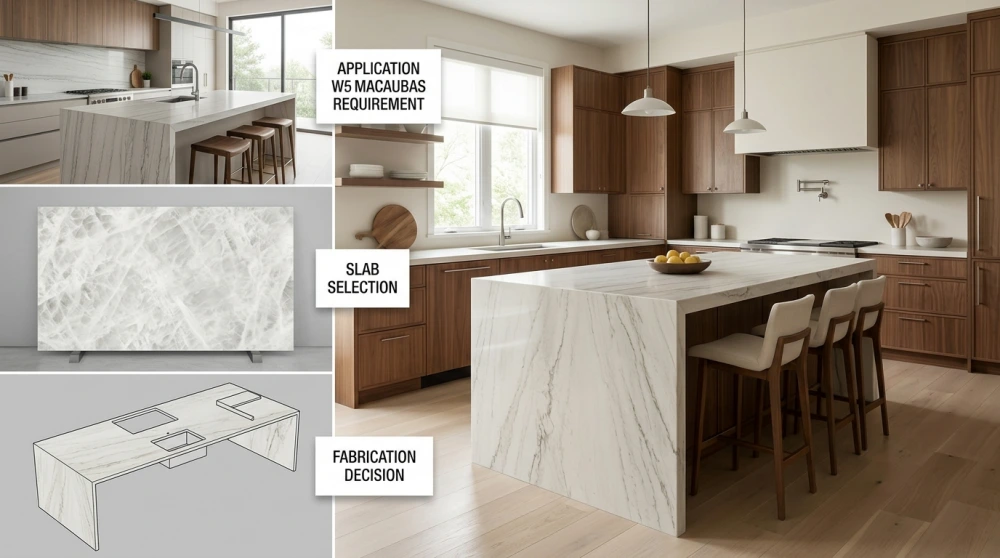
A compact perimeter countertop with limited openings has different material demands from a long kitchen island with a waterfall end, undermount sink, cooktop opening, seating overhang and visible mitered edge. The larger and more visually important the countertop becomes, the more slab dimensions, vein direction and usable yield influence the final result.
For this reason, the selection process should consider five questions together: Does the stone support the intended color palette? Can the selected slabs provide enough visual continuity? Can the required components be positioned efficiently? Are critical cutouts and narrow rails compatible with the proposed fabrication strategy? And is the client comfortable with the maintenance and natural variation of the selected material?
| Stone | Why It Fits | Fabrication Factor | Best Scenario | Buyer Note |
| Mont Blanc | Soft light background with elegant natural movement | Plan vein flow across seams and waterfall transitions | Warm, transitional or understated luxury kitchens | Approve actual consecutive slabs, not a small sample alone |
| White Macaubas | Strong linear movement can visually lengthen an island | Directional layout requires deliberate cutting orientation | Long contemporary islands and linear cabinetry | Check vein direction across every visible component |
| Cristallo | Crystalline structure creates exceptional visual depth | Crystal zones and any lighting concept require early planning | Statement islands and highly customized luxury interiors | Review full slabs and lighting conditions before approval |
| Infinity White | Bright appearance works with restrained interior palettes | Keep tonal changes balanced across large visible surfaces | Minimal, bright and contemporary kitchens | Compare slabs together for color and movement consistency |
| Atlantic White | Light background with more expressive grey or blue-grey movement | Place stronger mineral areas intentionally around openings and seams | Kitchens needing more contrast and natural character | Do not expect every slab to have the same movement |
1. Mont Blanc Quartzite — Soft Luxury Without a Flat White Surface

Mont Blanc White Quartzite is a useful starting point when the design requires a light natural stone without making the kitchen feel stark. Its white-to-creamy visual direction and softer mineral movement can work particularly well with warm timber cabinetry, off-white finishes, brushed metal and other restrained luxury materials.
Its strength in a kitchen is not simply that it is “white.” It is the balance between a relatively light field and enough natural movement to distinguish the countertop from a uniform manufactured surface.
For a large island, buyers should review complete slabs together and map the principal movement before cutting. If a waterfall end is specified, the design team should decide whether the transition should visually continue, turn deliberately, or function as a controlled break. That decision should be made before fabrication rather than during installation.
2. White Macaubas Quartzite — Best When Direction Matters
White Macaubas is particularly relevant to long kitchen islands because its recognizable linear movement can reinforce the geometry of the countertop. Instead of treating the veining as decoration, designers can use its direction to visually extend the island or align the stone with cabinetry and architectural lines.
This also creates a procurement challenge. Rotating a component simply to improve material yield may change the direction of the stone and weaken the design. A cutting plan therefore needs to balance usable slab yield against visual continuity.
3. Cristallo Quartzite — For a Statement Island Rather Than a Quiet Background
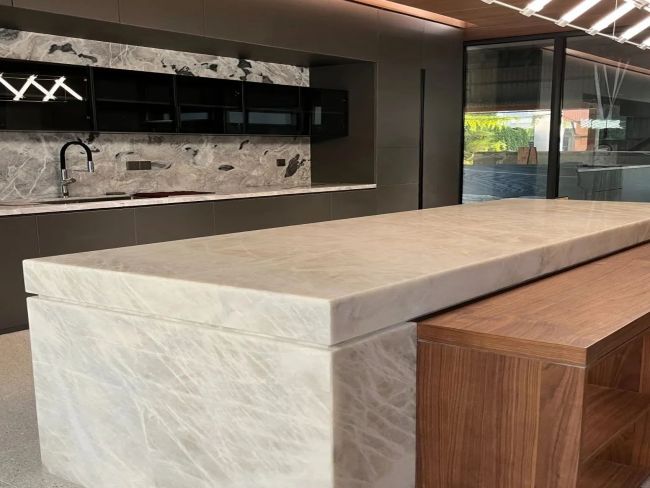
Cristallo Quartzite belongs in a different design category. Its crystalline white-to-pale-grey appearance can create depth that conventional white stones do not provide. In selected slabs, translucent crystalline zones may also become part of a specialized lighting concept.
That does not mean every Cristallo countertop should be backlit. Lighting should only be considered after inspecting the actual slab because crystal density, opaque mineral zones and internal movement vary naturally. The support system, light source, ventilation, access and electrical design must also be coordinated rather than added after the stone has been fabricated.
For a normal non-backlit countertop, Cristallo can still work as a luxury focal material. In that case, slab composition becomes more important than the lighting effect: the strongest crystalline zones should be positioned intentionally around the main visible areas rather than left to chance.
4. Infinity White Quartzite — A Cleaner Direction for Bright Kitchens
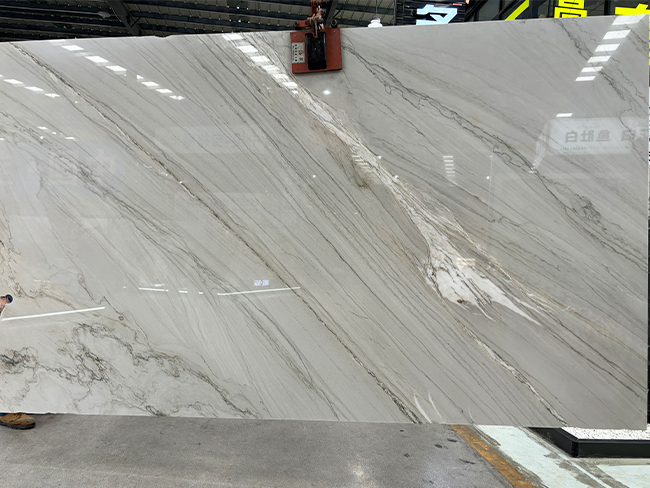
Infinity White Quartzite is worth considering when the project calls for a bright natural surface with a comparatively restrained visual direction. It can support minimalist cabinetry, light oak, soft grey, white lacquer or other palettes where the countertop should contribute natural character without dominating the entire kitchen.
However, “white” should never be approved from a product name. Two natural slabs can differ in background warmth, grey content, vein concentration and mineral distribution. When several slabs are required, they should be reviewed together under reasonably consistent lighting.
This becomes particularly important where an island and perimeter countertops are intended to read as one material composition. Slabs should be allocated by visible importance instead of simply being processed in warehouse order.
5. Atlantic White Quartzite — For More Expressive Natural Movement
Atlantic White Quartzite can be a stronger option when the client wants a light countertop but does not want an almost monochromatic kitchen. Its light background may be accompanied by more noticeable grey, blue-grey or occasional warmer mineral movement, giving the surface a more geological character.
Because stronger areas can become visual focal points, slab selection should determine where those areas appear. A dramatic section might be ideal across an uninterrupted island surface but less desirable through a narrow rail beside a large sink or cooktop opening.
This is why the “best” slab is not necessarily the slab with the strongest pattern. The better slab is the one whose pattern can be successfully distributed across the actual cutting layout.
Slab Size and Visual Continuity Can Change the Final Shortlist
Once the aesthetic shortlist is established, the project should move from stone names to actual slabs. This is where many luxury countertop decisions change.
A long island may require one uninterrupted visible surface, while another project may accept a carefully positioned seam. Waterfall ends consume additional usable slab area. Full-height backsplashes may need to coordinate with the countertop. Large sink and cooktop openings can also reduce flexibility when positioning major veins or crystalline zones.
Before approving material, compare the slab dimensions with the cutting drawings and identify the primary visual surfaces. Consecutive slabs are valuable when continuity matters, but sequence alone does not guarantee a successful layout; the individual pattern and usable areas still need to be reviewed.
Fabrication Details Should Be Decided Before the Stone Is Cut
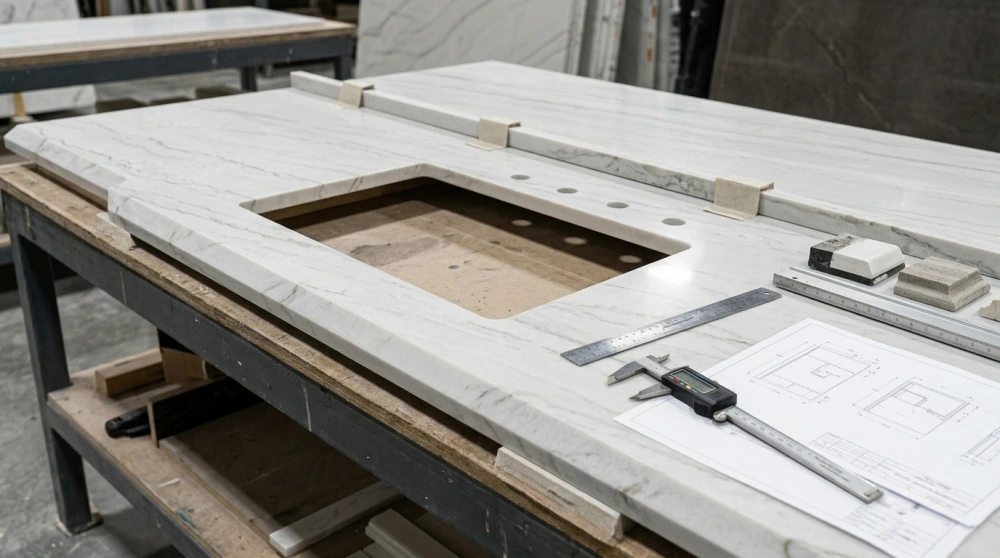
White quartzite countertops often appear visually simple after installation, but the fabrication behind that appearance can be complex. Undermount sinks create narrow stone rails. Large cooktops remove significant material from the slab. Mitered edges require matching strips and accurate assembly. Waterfall panels make vein orientation highly visible. Long overhangs may require structural support determined by the actual design.
These details should be shown on approved fabrication drawings. Critical openings, seam positions, finished edges, backsplash relationships and support interfaces should not be left for interpretation at the workshop.
Quartzite is a material class rather than a guarantee that every commercially named stone will behave identically. Natural Stone Institute guidance also emphasizes understanding the geological classification and physical characteristics of the actual natural stone when setting expectations for countertop fabrication, care and performance.
Maintenance: Do Not Select Quartzite on a “Maintenance-Free” Promise
Natural quartzite can be an excellent countertop material, but no natural stone should be sold to the client as maintenance-free or stain-proof. Cleaning practices, finish, porosity, fabrication, installation and the actual stone all influence long-term performance.
For routine care, neutral or stone-appropriate cleaners are preferable. Spills should be handled promptly, and abrasive or inappropriate acidic cleaning products should be avoided. Whether an impregnating sealer is appropriate should be determined for the actual stone and installation rather than imposed as an identical schedule for every quartzite.
Buyer Checklist Before Approving White Quartzite
- Confirm the material identity. Do not rely only on a commercial stone name.
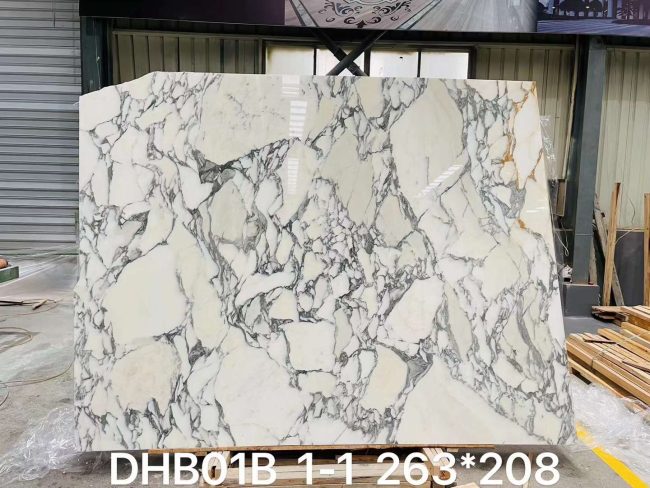
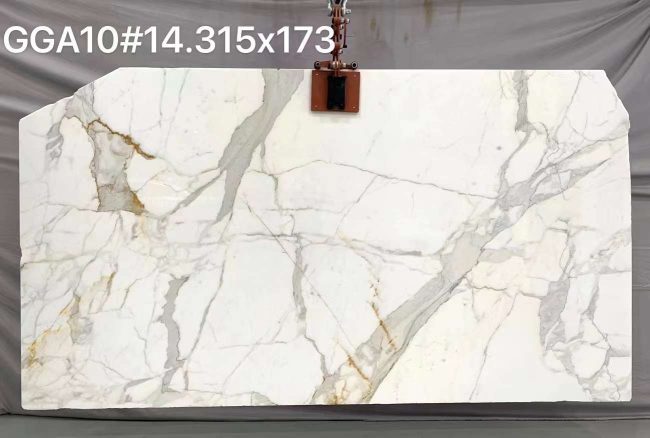
- Review actual full slabs. Small samples cannot show overall movement or slab-to-slab variation.
- Confirm the finish. Evaluate appearance and maintenance expectations under the intended finish.
- Match slabs to drawings. Check whether the usable slab area supports the island, perimeter, backsplash and waterfall components.
- Approve vein direction. Especially important for White Macaubas and other strongly directional materials.
- Review openings and edge details. Sink, cooktop, miter, overhang and support conditions can affect fabrication planning.
- Approve seam positions. A seam is both an engineering and visual decision.
- Plan replacement material. Matching the same natural pattern later may be difficult.
- Confirm QC before packing. Dimensions, finish, edges, cutouts and visible surfaces should be checked before shipment.
How to Choose Among the Five
If the kitchen needs soft warmth and understated movement, begin with Mont Blanc. If the design depends on strong horizontal or directional flow, White Macaubas deserves closer consideration. If the island is intended to become a sculptural focal point, Cristallo offers a very different crystalline character. For a cleaner and brighter composition, Infinity White may fit more naturally. When the client wants a light stone with stronger mineral expression, Atlantic White can provide greater contrast.
The final selection should then be made from actual slabs against the kitchen drawings. This second stage often matters more than the initial ranking because natural stone is purchased as individual geological material, not as a perfectly repeatable surface pattern.
Frequently Asked Questions
1. What is the best white quartzite for kitchen countertops?
There is no single best choice for every kitchen. Mont Blanc suits softer luxury palettes, White Macaubas emphasizes directional movement, Cristallo provides crystalline character, Infinity White supports brighter restrained interiors, and Atlantic White can provide stronger natural movement. The final decision should be based on actual slabs and the countertop layout.
2. Is white quartzite better than white marble for a kitchen?
It depends on the specific stones and the client’s expectations. Genuine quartzite is a different geological material from marble and can offer different performance characteristics, but the exact stone should still be correctly identified and evaluated. Material selection should not be based only on the commercial name or color.
3. Should I select white quartzite from a small sample?
No. A sample is useful for checking general color and finish, but it cannot represent the full vein pattern, crystalline zones or slab-to-slab variation. Full-slab approval is especially important for large islands and waterfall designs.
4. Which white quartzite works best for a long kitchen island?
That depends on the design. White Macaubas can emphasize length through directional movement, while Mont Blanc can create a softer continuous surface. The deciding factor should be whether the available slab dimensions and pattern support the required island geometry.
5. Can Cristallo Quartzite kitchen countertops be backlit?
Selected Cristallo slabs can contain translucent crystalline zones, but backlighting should not be assumed for every slab. The actual material must be inspected, and lighting, support, electrical access and fabrication must be engineered as one system.
6. Does white quartzite need sealing?
Some natural stone countertops may benefit from an appropriate impregnating treatment, but the requirement and maintenance interval should be determined for the actual stone, finish and installation. Sealing should not be presented as making a countertop completely stain-proof.
7. What should architects request before approving quartzite countertops?
Request full-slab images or inspection, confirmed slab allocation, fabrication drawings, vein-orientation planning, proposed seam positions, edge and cutout details, relevant support information, finish approval and a defined pre-packing QC process.
References
- Natural Stone Institute — Care & Cleaning of Natural Stone. Guidance on stone classification, cleaning, spills and sealing considerations.
- Natural Stone Institute — Natural Stone Countertops: Considerations for Marble, Granite, Quartzite, and Soapstone. Industry education covering selection, fabrication, installation, care and maintenance of natural stone countertops.
- Natural Stone Institute — Sandstone and Quartzite. Geological overview and general application guidance for quartzite as dimension stone.