



What Should Buyers Confirm Before Ordering Taj Mahal Quartzite Countertops?
For Taj Mahal Quartzite kitchen countertops, the most important buying decision is not simply whether the material looks attractive. Buyers should confirm whether the actual selected slabs can deliver the intended kitchen composition and work with the fabrication drawings.
This means reviewing the slab background tone and natural variation first, then checking usable slab area, vein movement, seam locations, sink and cooktop openings, waterfall transitions, visible edges, finish and support requirements. A stone can be visually suitable for a kitchen but still require a different slab allocation or fabrication strategy once the drawings are reviewed.
Buyer Check — Before Fabrication Approval
- Confirm that the material is Taj Mahal Quartzite rather than selecting only by a commercial color name.
- Review the exact slabs allocated to the project.
- Compare slab dimensions and usable areas with countertop drawings.
- Approve vein direction and the location of visually important mineral movement.
- Confirm seams, waterfall transitions, sink and cooktop openings.
- Confirm the finish and visible edge construction.
- Review support conditions for large openings or overhangs.
- Define what must be inspected before packing and shipment.
Taj Mahal Quartzite Snapshot

| Factor | What Buyers Should Know |
| Material | Natural Taj Mahal Quartzite; verify the actual material rather than relying only on a commercial name. |
| Visual Direction | Typically selected for its warm cream, beige, taupe and soft grey character with restrained flowing natural movement. |
| Natural Variation | Background warmth, vein concentration, mineral movement and visual contrast vary from slab to slab. |
| Kitchen Role | Well suited to islands, perimeter countertops and coordinated backsplash applications when the selected slabs support the layout. |
| Selection Priority | Approve complete slabs and their allocation to the fabrication drawing, especially for large islands and waterfall ends. |
| Fabrication Priority | Coordinate cutouts, narrow rails, seams, edge details, overhangs and visible vein transitions before cutting. |
Why Taj Mahal Quartzite Works in Luxury Kitchens

The visual strength of Taj Mahal Quartzite is its ability to create a light natural-stone kitchen without producing the colder appearance associated with some white and grey materials. Its characteristic palette generally moves through cream, light beige, warm greige and taupe, with soft grey or warmer mineral movement appearing across the slab.
This restrained character allows it to work particularly well with warm walnut, oak and other natural timber cabinetry. It can also soften white or cream cabinetry and bridge warmer metal finishes, pale floors and neutral architectural surfaces.
For buyers who want to inspect the material itself before moving into project-level planning, the CENTURY STAR Taj Mahal Quartzite page provides a useful material-level reference. The important next step, however, is to move from a representative product image to the actual slabs reserved for the kitchen.
Do Not Approve Taj Mahal Quartzite by Color Sample Alone
A small sample can help establish whether the general color family works with cabinetry, flooring and metal finishes. It cannot reliably show the complete composition of a natural slab.
One Taj Mahal slab may appear quieter and more evenly warm, while another may contain more visible grey movement, stronger warm bands or a different distribution of mineral features. These differences are part of natural stone rather than manufacturing defects.
For a small vanity, that variation may be relatively easy to manage. For a long kitchen island, full-height backsplash or waterfall configuration, the distribution of movement across the entire slab becomes a design input.
Slab Selection Should Start With the Kitchen Drawings
The correct Taj Mahal Quartzite slab is not necessarily the slab with the most dramatic movement. For a countertop project, it is the slab whose usable area and visual composition can be converted successfully into the required pieces.
Begin by identifying the primary visual surfaces. In many kitchens, the island receives the highest priority because it is viewed from several directions and may contain a large uninterrupted stone surface. Perimeter countertops may have more joints, appliances and wall interruptions, while a backsplash creates a different visual relationship with the countertop below it.
If a waterfall end is required, its panel should be considered during slab allocation rather than cut later from whatever material remains. The same applies when the design expects movement to continue from the horizontal countertop down the vertical end.
Check the Actual Cutting Relationship
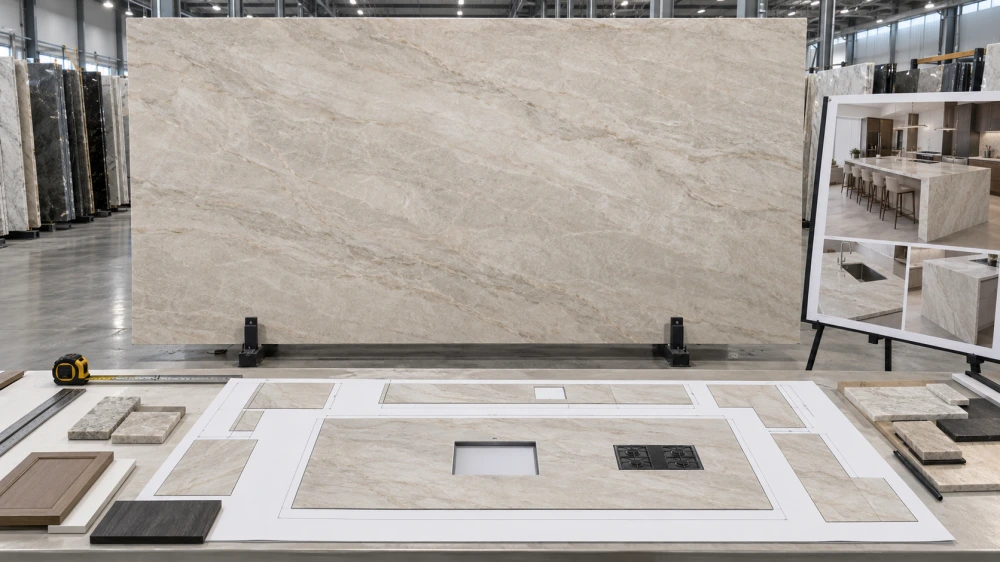
Before cutting, the fabricator should know the countertop dimensions, appliance and sink openings, finished edges, seam positions and visible surfaces. The slab can then be photographed or represented in a cutting-layout drawing so the major pieces can be positioned intentionally.
This process is particularly valuable when the project requires multiple slabs. It helps the buyer distinguish between gross stone quantity and the usable material required to preserve the design.
Vein Direction Matters More on Large Islands
Taj Mahal Quartzite is usually appreciated for comparatively calm movement, but direction still matters. A long mineral band that works beautifully across an island may create an awkward transition if a waterfall panel is rotated without considering the adjoining top.
Likewise, a strong feature running directly through a sink or cooktop opening may be largely removed during fabrication. The project could technically use the same quantity of stone but lose the visual feature that motivated the slab selection.
For this reason, designers should mark which slab areas are visually important before nesting countertop components for yield alone.
Surface Finish Changes the Design Character
Finish selection should be made with an actual stone sample whenever possible. A polished surface can emphasize depth and mineral definition, while a honed or other lower-sheen treatment can create a softer architectural appearance. The exact result depends on the stone itself and the finishing process.
The choice should therefore be connected to the kitchen concept rather than treated as an isolated specification. A polished Taj Mahal surface may suit a brighter, more formal interior, while a softer finish may coordinate well with understated cabinetry and matte architectural materials.
Buyers should also ask how the chosen finish affects appearance around fabricated edges and whether the workshop can reproduce the intended finish consistently across visible components.
Fabrication: Pay Special Attention to Openings and Edges
A finished Taj Mahal Quartzite countertop may look visually simple, but sinks, cooktops, faucet holes, edge build-ups and waterfall joints create concentrated fabrication requirements.
Large openings remove stone from the slab and leave narrower rails around the cutout. Their geometry, position and relationship to natural features should therefore be reviewed before machining. Fabrication decisions should be based on the actual piece geometry and stone condition rather than a generic statement about quartzite strength.
Mitered thick-look edges also require planning. The visible edge strip should be selected with the top so the assembled result does not look disconnected. At a waterfall end, both edge accuracy and visual transition become important.
What About Seams, Overhangs and Support?

Seam planning should balance engineering constraints with visual continuity. Rather than assuming that every countertop must be seamless, determine where a seam can be fabricated, transported, installed and visually integrated most successfully.
The same principle applies to seating overhangs and unsupported areas. Required support depends on the countertop geometry, cabinet structure, openings, installation conditions and other project-specific factors. Buyers should therefore have the fabricator and installer coordinate the support strategy instead of relying on a universal unsupported-span rule.
For projects specifically focused on finished countertop supply, the existing Taj Mahal Quartzite Countertops page can serve as the commercial product reference, while this guide should be used to structure the buyer’s pre-fabrication confirmation process.
QC Should Follow the Approved Drawing and Slab Layout
Quality control is more useful when it checks against something already approved. Before production, the buyer and supplier should establish the drawing revision, slab allocation, finish, visible edge details and any important vein-orientation requirements.
During or after fabrication, inspection can then focus on whether the finished pieces correspond to those approvals. Relevant checks may include overall piece geometry, openings, visible edges, surface condition, finish consistency and piece identification.
For a multi-piece kitchen, dry positioning or another suitable layout review can also help confirm relationships among adjoining components before packing. The exact QC method should reflect the complexity of the project rather than being applied mechanically to every order.
Maintenance Expectations Should Be Confirmed Before Handover
Taj Mahal Quartzite should not be described as maintenance-free, stain-proof or scratch-proof. Natural stone performance depends on the actual material, finish, fabrication, installation, exposure and care practices.
For routine cleaning, stone-appropriate neutral cleaning methods are preferable. Spills should be addressed promptly, and harsh or unsuitable cleaning chemicals should be avoided. Whether an impregnating treatment is appropriate should be assessed for the actual material and finish.
The Natural Stone Institute similarly recommends identifying the stone and understanding its characteristics before establishing care procedures. This is another reason procurement should begin with correct material identification rather than assuming all light-colored natural stones behave identically.
Procurement Checklist for Taj Mahal Quartzite Kitchen Countertops
- Material identity: Confirm what stone is actually being supplied.
- Actual slabs: Request approval images or another appropriate full-slab inspection method.
- Slab grouping: Review slabs together when several will appear in one kitchen.
- Drawings: Confirm current countertop dimensions and fabrication details.
- Slab allocation: Decide which areas become the island, perimeter, backsplash and waterfall pieces.
- Vein orientation: Approve important directional relationships before cutting.
- Cutouts: Confirm sink, cooktop and faucet locations against the actual layout.
- Edges: Identify exposed edges, mitered build-ups and waterfall transitions.
- Finish: Approve the intended surface using representative material where possible.
- Support: Coordinate overhangs and structurally sensitive areas with the fabrication and installation design.
- QC: Define the inspection evidence required before packing.
- Replacement risk: Consider whether spare matching material should be retained when future matching would be difficult.
The Best Approval Sequence
- Confirm Taj Mahal Quartzite fits the kitchen’s design direction.

taj mahal quartzite countertop final installed value - Finalize countertop and appliance geometry.
- Select and reserve the actual slabs.
- Allocate the slabs to visible countertop components.
- Approve vein orientation, seams and waterfall relationships.
- Confirm finish, edges, cutouts and support interfaces.
- Approve the final fabrication drawing and layout.
- Fabricate and inspect against those approvals.
- Confirm packing identification and installation sequence where relevant.
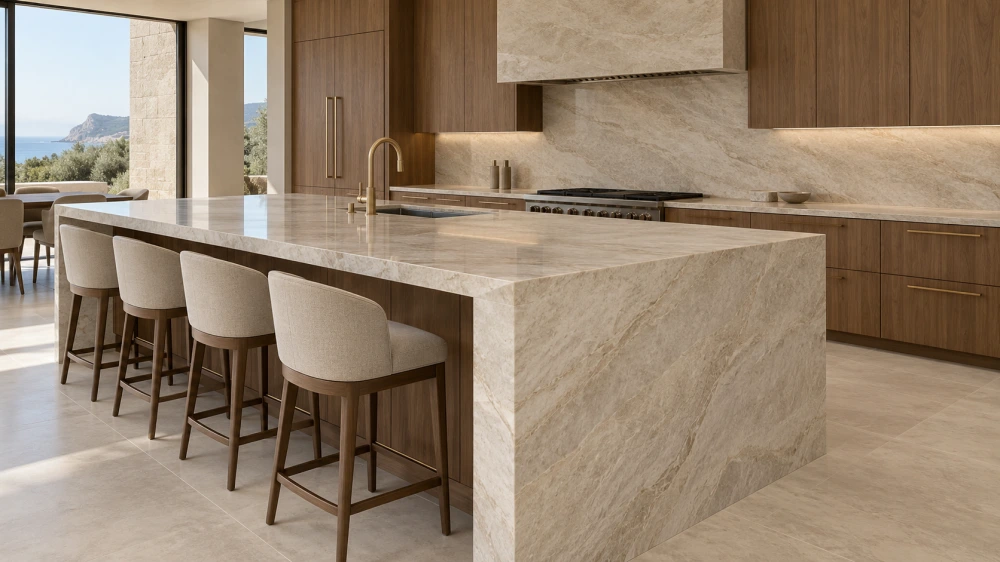
This order reduces the risk of selecting attractive slabs first and discovering later that the planned pieces cannot be arranged as intended.
Frequently Asked Questions
1. Is Taj Mahal Quartzite suitable for kitchen countertops?
Yes, Taj Mahal Quartzite is widely selected for kitchen countertops, particularly where designers want a warm cream-to-beige natural stone appearance. Suitability for a specific project should still be confirmed against the actual slabs, countertop geometry, finish, fabrication details and installation conditions.
2. What color should I expect from Taj Mahal Quartzite?
Taj Mahal Quartzite is generally associated with warm cream, beige, light greige and taupe tones with restrained grey or warmer mineral movement. Because it is natural stone, the balance of these colors and the concentration of movement can vary from slab to slab.
3. Should I approve Taj Mahal Quartzite from a sample?
A sample is useful for evaluating general color and finish, but it should not replace full-slab approval for an important kitchen. Large slabs reveal movement, tonal variation and usable visual areas that cannot be judged from a small sample.
4. What should be checked when selecting slabs for a large kitchen island?
Check usable slab dimensions, background tone, movement distribution, planned cutouts, edge pieces, seam requirements and any waterfall panels. The preferred slab should be evaluated together with the countertop drawing rather than selected only for its overall appearance.
5. Can Taj Mahal Quartzite be used for a waterfall island?
Yes, provided the selected slabs and fabrication plan support the design. The top and waterfall panel should be allocated together so the vein transition, mitered joint and usable slab area can be reviewed before cutting.
6. Which finish is best for Taj Mahal Quartzite countertops?
There is no universal best finish. Polished surfaces can emphasize mineral depth and definition, while lower-sheen finishes can create a softer architectural character. Buyers should review a representative finish sample and consider both the design intent and maintenance expectations.
7. What should be included in pre-shipment QC?
QC should reference the approved project documents and may include piece geometry, cutout positions, visible edges, surface condition, finish consistency, piece identification and relationships between adjoining components. Complex projects may also benefit from layout confirmation before packing.
8. Can replacement Taj Mahal Quartzite be matched exactly later?
Exact matching should not be assumed. Natural slabs vary, and later production may differ in background tone and movement. For projects where future replacement is a significant concern, buyers should discuss retaining suitable matching material during the original procurement stage.
References
- Natural Stone Institute — industry guidance on natural stone identification, selection, fabrication, installation and care.