



Among them, the semi-professional terms of stone tangent and reverse tangent in stone processing were not known until ten years later. The process was very long, basically accounting for 1/7 of my life (calculated based on a life span of 70 years) to understand and comprehend.
The development of China’s stone industry started in the 1990s and has been going on for 30 years. The number of people employed in the industry has increased a lot in the past 30 years, but the systematic and theoretical education in the professional aspects of the stone industry is very poor. There are very few people with systematic and theoretical knowledge because everyone accumulates stone knowledge under the master-apprentice model or in a teacher-free model. This knowledge is very limited. It is necessary to accumulate more knowledge through more media and channels, reduce the learning process, and acquire more knowledge in the shortest time. After all, life is limited, but knowledge is boundless!
Although the two stone processing terms of tangent and reverse cutting are simple for those who understand them, I believe that the number of people who understand them is extremely limited, because those who understand this term are people related to this term, usually people who use gang saws, sand saws, and large cuts. Even among these practitioners, I think there are still many people who may not know the terms of tangent and reverse cutting.
There are very few people who know “tangent” and “reverse tangent” outside these practitioners, because there are almost no books on stone professional knowledge that elaborate on the professional terms of “tangent” and “reverse tangent”. Even if there are, because the number of people reading and buying books is decreasing, it takes a lot of effort to find the four inconspicuous words “tangent” and “reverse tangent” in a thick book, just like finding a needle in a haystack.
It is impossible for everyone to have a book, but in modern society, it has become a reality for everyone to have a mobile phone. Mobile phones have become an important medium and one of the main media for spreading knowledge and technology.
In the public account of spreading stone processing, the two professional terms “tangent” and “reverse tangent” will definitely be seen by thousands of stone people. With the chain effect of one passing on ten and ten passing on a hundred, the article will achieve the purpose of spreading stone knowledge.
Among the many terms of stone knowledge, “tangent” and “reverse tangent” are basic and very important. They are professional terms that stone people must know. If you don’t know these two basic terms, you can’t be considered a qualified stone person. So what is “tangent” and what is “reverse tangent”? To understand two basic terms, we should start with the concepts of “tangent” and “reverse tangent”.
What is “tangent”?
“Tangent” means cutting along the grain surface, also known as cross-cutting; that is, the saw blade or saw blade cuts the stone along the grain surface (see Figure 1), and the cut surface can see regular and complete texture.
When processing many stones, special attention should be paid to the tangent direction. If the tangent direction is wrong, the texture on the decorative surface will be very different, which will greatly affect the decorative quality of the stone surface.
Black gold sand, blue pearl, and green star rough materials have clear sawing directions. When sawing large plates, they must be tangent. If they are cut wrong, there will be fewer gold spots on the surface and smaller spots, which will greatly affect the decorative effect; those stones with straight grain textures must be tangent, such as French wood grain, Roman travertine, Italian black gold flower, Guizhou wood grain and other materials. If they are not cut along the grain, the cut surface will be a messy texture surface. Look carefully at Figure 1, which can more intuitively express the text content and the term “tangent”.

Many blocks imported from abroad are marked with “” on the side; see the red line in Figure 1. These three bars are the direction of the block’s “tangent”.
If the texture and colour of the block do not change too much, it is correct to run the saw blade and circular saw blade along the direction of the three bars when sawing the block slab and cutting the blank.
What is “reverse cutting”?
“Reverse cutting” is to cut perpendicular to the texture surface, which is also longitudinal cutting; that is, the saw blade or saw blade cuts the stone perpendicular to the texture surface (see Figure 2), and the cut surface is basically irregular and chaotic. If the customer does not have special requirements, the stone will generally not be reverse cut, especially for black gold sand, green star, and blue pearl stones.

After the marble is reverse cut, because the surface texture is too different, the stone is generally named by another name. Look carefully at Figure 2, the picture can more intuitively express the text content and the term “reverse cutting”.
Comparison of stone tangent and reverse tangent texture effects
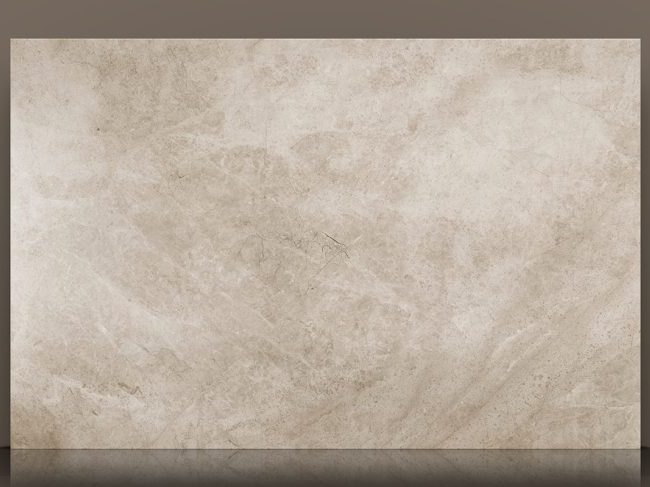
When sawing large slabs from rough materials, if the sawing direction is wrong and the “sawing” is “reverse cutting” when it should be “sawed straight”, the surface texture of the stone slab will be very different, which can be described as “completely unrecognisable”, and the decorative effect of the building will be completely different. Therefore, when sawing large slabs from rough materials, you must carefully see the sawing direction of the rough materials, correctly load the trolley, and confirm the sawing direction of the rough materials before starting the machine. Make sure that the sawing direction is correct before starting the machine processing.
Figure 3 shows a large slab “sawed straight” with grey wood grain. The surface texture is straight, the texture is clear and beautiful, and it is a texture commonly used in building decoration. Figure 4 shows the texture of the large slab when the grey wood grain is “reverse cut”. The contrast between the two slab textures is too different. Although they are the same material, they can be regarded as two materials.

Figure 5 shows a large board made by “cutting” black wood grain. The surface texture is straight and the texture is clear and beautiful. It is a common texture for building decoration. It is used to process countertop products and kitchen cabinet products because the clear and alternating grey and black texture has the effect of wood grain. The processed products are very beautiful. The textures of the two are very different.

Figures 7 and 8 are large boards cut by the two sawing processes of “cutting” and “reverse cutting” of Athens wood grain. The two colours and textures are also very different. They can be treated as two kinds of texture materials and given two names of stone.

Direction and identification of cutting and reverse cutting
Usually, when we carefully observe at work, we will see that there are three bars sprayed on the side of many rough materials, as shown in red in Figure 1. People who understand know that this is the “cutting” sawing direction of rough materials.
When sawing large boards and blanks, just saw in this direction. Reverse-cut rough materials generally have no marked direction. Usually we put the rough materials on the turning machine, rotate the “tangent” direction 90° and load the trolley. In this way, the surface of the sawed large board is the “reverse-cut” sawing surface.
How to determine the tangent and reverse tangent planes from the surface of the rough material
Not all rough materials are marked with tangent planes, especially some granite rough materials. When encountering rough materials without tangent planes, master this method and principle to find the tangent plane of the rough material: the surface with obvious, clear and uniform texture and few stone defects is mostly the texture surface;
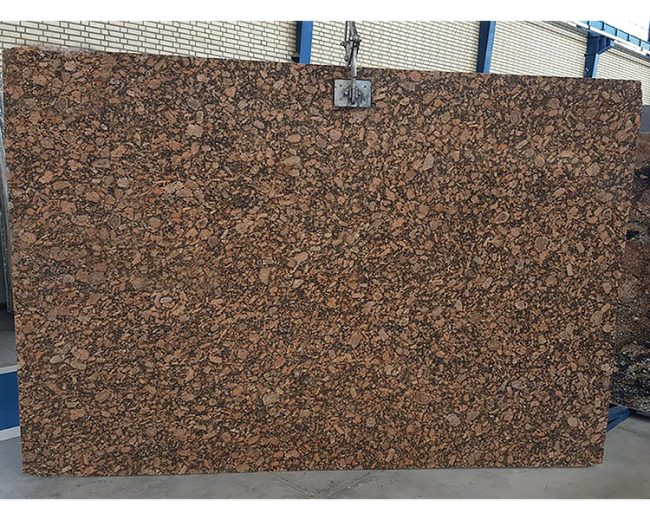
For those stones with textures such as black gold sand, green star, blue hemp gold dots and pearl spots, the surface with many large, dense and shiny gold dots is mostly the sawing surface;
The same is true for blue hemp and green star materials. The pearl spots are large, numerous and dense. The surface with good gloss when the rough material is sampled is the sawing surface;
For some stones with chaotic patterns, such as black and white roots, light brown net, Spanish beige, Pasgo grey and other materials without clear sawing direction, choose the surface with good surface, few stone defects and high yield rate as the sawing direction.
For some rough stones with mud on the surface or blackened over time, the texture of the stone surface cannot be seen clearly. Use a high-pressure water gun to clean the mud and blackened substances on the surface of the rough stone. If it cannot be cleaned, use a steel brush to clean it. Identify the texture direction of the stone surface, see the texture and colour of the stone surface clearly, and determine the cross section of the rough stone. Figure 9 Wash the board to see the sawing surface.

It takes more than one day or two to learn to judge the sawing surface of stone rough stones without markings because there are too many types of stones and the texture changes greatly. It takes a period of practice and training to reach the level of accurately judging the sawing direction of rough stones.