




Italian Silver Moon Marble Slab for Interior Feature Wall Floor Design
Born Under the Moon: A Geological Poetry Deep in Sardinia
The cradle of Silver Moon Marble lies in the folded mountains between the town of Nuxis and the island of Sant’Antioco in southeastern Sardinia, Italy. Formed approximately 190 million years ago during the Jurassic shallow-sea-deep-sea transition zone, the material was formed. Calcium-rich mortar recrystallized under high pressure and low temperature, and later hydrothermal processes incorporated trace amounts of quartz and mica, resulting in a unique texture of silvery-white grains floating on a dark gray base. The ore body strikes at a 30° angle to the regional fault, resulting in a low crack rate of 1.2% in the rough material, allowing for the cutting of flawless slabs measuring 3.0 x 1.8 m, providing the physical prerequisites for high-end, large-format interior applications. The local mining operation utilizes a combination of platform and rope saw technology, combined with rainy season water storage and recycling to achieve 90% industrial water reuse. For every 1 m³ of rough material mined, 0.8 m³ of waste rock is backfilled, minimizing disturbance to the Mediterranean shrub ecosystem. This has earned the company an A rating in the European Ecolabel green certification system for two consecutive years.


Silver Moon Marble: A Flowing Narrative in Dark Gray
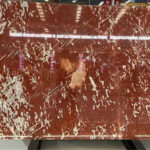
Silver Moon marble features a predominantly dark charcoal gray, with interspersed silvery white, light brown, and subtle blue streaks, reminiscent of the rolling clouds and moonlight in the night sky. Its color progression follows a “three-step gray” pattern: 70% is a neutral dark gray at 18°, providing a stable background; 20% is a bright silver streak at 40-50°, breaking up the dullness; and 10% is a stream of brown or blue-gray, creating a velvety sheen under oblique light. Because calcite grains range in size from 0.2 to 0.5 mm and quartz particles are scattered, polishing results in a high-gloss mirror finish of 85-90 GU, while flamed or litchi-treated, it exhibits a softer matte finish of 25-35 GU, creating a dramatic tension within the same stone species. Designers believe this controllable gray can complement the warmth of wood finishes to create a Nordic minimalist aesthetic, team up with brass and black steel to create an industrial retro aesthetic, and, through lighting programming, transform into an immersive show backdrop, imbuing the space with the ebb and flow of the “moon phases.”
Performance Backed by Elegance: Hard Data
Testing by the Geotechnical Laboratory of the Politecnico di Torino, Italy, reveals that Silver Moon marble has a bulk density of 2.71 g/cm³, a water absorption rate of 0.18%, a compressive strength of 135 MPa, a flexural strength of 12.8 MPa, and a Mohs hardness of 3.5-4. Its acid resistance (10% H₂SO₄ for 48 hours) is ≤0.2% mass loss, and its alkali resistance (10% NaOH for 48 hours) is ≤0.15%, both exceeding the European EN standard for marble. Its frost resistance can withstand F25 cycles without damage, meaning it can be used for curtain walls in mid-latitude coastal areas after dry hanging with backbolts and joint sealing. Its dry coefficient of friction of 0.65 and wet coefficient of friction of 0.45 (ASTM C1028) ensure it meets the R11 slip resistance rating for bathrooms and poolside areas. It’s these seemingly understated yet demanding numbers that have made Silver Moon marble a rare find, appearing simultaneously on the exterior walls of Dubai’s high-rise apartments and at the bottom of a Norwegian fjord hotel’s hot spring pool. They demonstrate that “Elegant Gray” isn’t fragile, but rather possesses structural resilience across climatic zones.

A Theater of Craftsmanship: From Rough to Mirrored, Seven Facets of One Stone
The Carrara processing facility in Italy has developed a “seven-faceted-in-one” process for Silver Moon marble: a mirror-polished finish with a 90 GU sheen, suitable for hotel lobbies and elevator cabs; a satin matte finish with a 35 GU feel, commonly found on office desks; a flamed roughness of 45 μm Ra, providing slip resistance in outdoor plazas; a lychee finish with uniform pitting, providing wear resistance in high-traffic areas at airports; waterjet inlays, combining brass or white marble, can create complex patterns with a precision of 0.2 mm; a 12 mm translucent panel with fiberglass creates a moon-like halo when backlit; and CNC 3D engraving enables the creation of rose window patterns in 30 mm thick panels, weighing only 55% of traditional stone. Leveraging these surface languages, Silver Moon marble is able to simultaneously tell three stories on a single stone slab: modern minimalism, classical relief, and futuristic translucency. This also allows the architect to complete a spatial narrative of “one color, multiple textures” within a single material palette.
Scenes and Case Studies: When Gray Becomes the Star of a Space
The 1,800 square meter lobby of the SLS Hotel in Dubai features 900×900×20 mm polished slabs. The dark gray base and golden dome create a visual metaphor of “moonlight on the desert.” The hot spring pool floor at The Thief Hotel in Norway features 600×600×30 mm flamed slabs with an R11 anti-slip rating and no cracking in winter temperatures of -20°C. The corridors of the conference floor of Qiantan Enterprise World in Shanghai feature 1,200×600×12 mm satin-finish slabs, combined with linear lighting strips, creating a calm and efficient business atmosphere. The guest room bathrooms at the CHAO Hotel in Sanlitun, Beijing, feature 300×600×10 mm translucent slabs, backlit to resemble a floating moon shadow, complementing the brass hardware to create a “cyber retro” aesthetic. The check-in countertops at Cagliari Airport in Italy feature 25 mm satin Silver Moon marble slabs, proven scratch-resistant after 50,000 cycles and only losing 3 GU of gloss. These cases span climates, functions, and scales, yet they all demonstrate the same logic: Silver Moon’s gray is an all-encompassing foundational color that resonates with any design language, making “elegance, robustness, and sustainability” a truly achievable spatial experience.


