




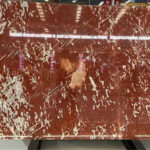

Monica Red Marble Slab Natural Red Marble For Custom Stone Products
Coming from the Trescore Balneario area of Italy, Monica Red Marble is a rare natural marble. This area is part of the province of Lombardia, specifically the province of Bergamo. Monica Red Marble’s outstanding visual qualities and strong physical characteristics enable the geological environment of this area to offer conditions fit for the development of this marble.
From a deep ruby to a soft rose, this specific stone is well-known for its vivid red tones. These several tones of red not only add to the stone’s general beauty but also give designers and builders an almost limitless range of choices throughout the creative process. This helps them to fully use the stone in line with several architectural needs and aesthetic tastes.
One of Monica Red Marble’s most striking features is its pattern. Every slab has a unique design distinguished by the distribution of white and grey veins across its crimson backdrop. Apart from adding to the artistic value of the stone, its natural variances in texture make it a great choice for upscale ornamental purposes. Monica Red Marble’s unique appeal makes it possible for any given space—from a luxury house to a business to a public facility—to centre itself. Anyone that walks into the room will be captivated by it.
Monica Red Marble is often used in key areas of family homes such the worktops of kitchens, bathroom floor and wall covering, fireplace surrounds and entrance hallways. Its rich red hue helps the house to become cosier and better very quickly. Monica Red Marble’s use in commercial buildings—such as hotel lobbies, workplace reception desks, or upscale retail stores—can highlight the image and taste of the company as well as produce a professional yet luxurious atmosphere. Monica Red Marble has the power to bring a sense of seriousness and history to public spaces as museums, libraries, or government buildings.
Establishing itself as a major component in the fields of architecture and design, the Monica Red Marble has come to represent luxury and elegance in many kinds of ornamental undertakings. Its intense red hue and complex texture patterns have helped it to become somewhat well-known. This stone not only meets the needs of the space but also stimulates its artistic potential, so giving each and every project a unique personality and a feeling of vitality. Whether the design is modern and simple or traditional and classic, the Monica Red Marble may be flawlessly fitted into any one. This shows the great use and aesthetic worth of the material.


A Commonly Used Handicraft Marble
A excellent illustration of the harmony that may be attained when traditional and modern design are combined is Monica Red Marble’s use in Florence, Italy, a city renowned for its artistic and handcrafted traditions. The project’s designers carefully chose the best Monica Red Marble raw stones based on their inherent texture and colour variations so as to produce a range of complex patterns and formations. Apart from abstract art, these geometric figures, floral designs, and other patterns and shapes caught attention. To cut the Monica Red Marble into the required forms and sizes in line with the design directions, stone experts used very exact cutting tools. The marble was carefully polished after the cutting operation to guarantee that the surfaces were smooth and that the edges were clean. Subsequently, the Monica Red Marble was painstakingly inlaid on the black onyx foundation using the time-honoured Florentine technique of micro-inlay for gemstones. This was carried out to guarantee flawless marble alignment. Using this technology requires not only a great degree of accuracy but also a lot of patience to guarantee that every single piece of Monica Red Marble can be exactly placed in the originally chosen site. Following the completion of the inlay, the craftspeople will then go on to carefully process their work. This covers polishing the whole surface and grinding the edges’ seams. This approach is being followed to get the intended result of producing a strong contrast between the black onyx and the red and brown tones of the Monica Red Marble. Every single handcrafted piece goes through a last inspection and quality check to make sure it meets the most strict standards for artistic and craftsmanship perfection following all else said and done.

Monica Red Marble’s red and brown tones contrasted with the deep black of black onyx provide an aura of luxury and high-end appeal. This is thus because the area seems to be opulent. Because of the natural texture and colour variety of the stone, which also highlights its inherent beauty and makes every piece unique, each handcrafted object is one of a kind. Monica Red Marble is deftly included into a variety of designs, from basic ornamental objects to complex patterns and decorations, reflecting the exceptional talents and exacting attention to detail of the artist. To reach this aim, much attention is paid to workmanship. Apart from being a sort of decorative art, the application of the micro-inlaying gemstone technique is crucial for Florence’s historical and cultural legacy. Monica Red Marble’s employment helps to emphasise this cultural relevance even more since it turns every individual piece into not merely a decorative object but also a work of art carrying historical and cultural significance. Monica Red Marble’s use helps to produce this change. Monica Red Marble is appropriate for usage in a range of environments, including floor, walls, counters, and areas exposed to the elements at large, because of its great hardness. This makes it possible to be used in a broad spectrum of applications inside the field of crafts and ornamental products, from art installations outside to adornment placed inside. Monica Red Marble is not just a building material but also an artistic medium capable of perfectly combining modern design with traditional workmanship. This is a result of this scenario anything we can notice. This allows one to create not only aesthetically beautiful but also quite culturally significant handicrafts and decorative objects. These artefacts provide new chances for traditional workmanship to be inherited and improved; they also provide modern surroundings some classical appeal.

