




Azul Palomino Quartzite: A Color Epic Across Continental Plates
Whispers from the Deep Crust: A 580-Million-Year History
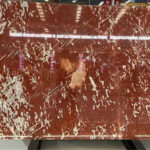
On the eastern plateau of Minas Gerais, Brazil, beneath a folded ridge 1,100 meters above sea level, lies an ancient quartzite vein, less than 40 meters wide, dormant. This region, once the boundary between shallow and deep Precambrian seas, saw sediments rich in quartz, feldspar, and trace hematite squeezed, folded, and recrystallized during 580 million years of mountain building, ultimately solidifying into the Azul Palomino Quartzite we see today—a magnificent quartzite with the textures of both “wood growth rings” and “wave ripples.” Azul Palomino Quartzite base is a warm amber-brown, punctuated by hues of ocean gray-blue and smoky white, reminiscent of the afterglow of a sunset shimmering on a river in a South American rainforest. The white quartz veins resemble wind-rippled waves, forming ribbons of varying widths between brown and blue. The crystals are translucent, giving off a silky, milky halo under 30-degree sidelight. This tri-color symphony of brown, blue, and white makes Azul Palomino one of the easiest quartzite varieties to create a visually appealing experience. Designers can transform an entire wall into a flowing South American painting with just three 3-meter slabs.


The Grammar of Texture: Wood Grain, Water Marks, and the Whisper of Sand Dunes
Azul Palomino’s textural language can be broken down into three imagery: wood grain, water mark, and sand dunes. The wood grain, formed by the interweaving of hematite and quartz, features parallel bands measuring 2–8 mm, resembling century-old teak from a distance. The water mark, shaped by the curvature of the quartz veins, creates an S-shaped pattern, reminiscent of ripples on the beach after the tide recedes. The sand dunes, a hazy gray-blue hue against a brown background, resemble the dunes gently caressed by moonlight at dusk. Even more intriguing is that these textures aren’t static: when backlit, the gray-blue mist appears to float forward, while the wood grain recedes, giving the stone a sense of three-dimensional depth. This is why Azul Palomino is a favorite for “matched-grain parquet”—a parallel-grain collage can stretch to form a seamless 12-meter “wooden scroll,” while a jagged, staggered pattern can create pixelated “digital sand dunes.”
Physics and Chemistry: A Quartzite to Be Heirloomed
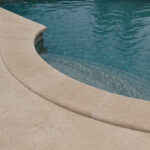
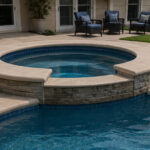
In the laboratory, Azul Palomino demonstrates its toughness: a Mohs hardness of 7, a density of 2.68 g/cm³, a water absorption rate of 0.18%, a compressive strength of 135 MPa, and a flexural strength of 12 MPa—numbers that mean a 20 mm thick slab can safely overhang 800 mm without sagging, and can withstand 50°C sun exposure and -20°C freeze-thaw cycles on an outdoor pool deck. Its acid resistance (10% HCl after 48 hours) has a mass loss of < 0.1%, and its alkali resistance (10% NaOH after 48 hours) has a mass loss of < 0.2%, far exceeding the European EN standard limit for quartzite. Therefore, whether it’s a sky villa on the Sanya beach or a hot spring resort in Harbin, Azul Palomino can accompany the building throughout its life with “zero color change and zero edge collapse.” IV. Craftsmanship: From Mineral Rough to Spatial Artwork

Azul Palomino’s manufacturing process is a precise collaboration spanning three continents:
Rough Cutting: An Italian BM saw can cut 80 pieces at a time, with a thickness tolerance of ±1 mm.
Backing Mesh Lamination: Sheets thinner than 18 mm are laminated with a 2 mm fiberglass mesh, allowing for a bending radius of up to 1.2 m, making them suitable for curved staircases.
Surface Treatment: Polished (90 GU) is suitable for kitchen countertops; Flamed (Ra 45 μm) with an R11 anti-slip rating is suitable for outdoor steps. The leather finish is delicate and fingerprint-resistant, making it a favorite for bathroom cabinets.
Light-Transmitting Treatment: 12 mm sheets are vacuum-infused with epoxy resin, achieving a light transmittance of 15%. Backed with LEDs, they become illuminated wall panels.
Waterjet Inlay: Combined with brass and Carrara White, it can cut sharp angles as small as 0.2 mm, creating complex logos. The entire process is carried out simultaneously across three production bases in Verona, Italy, São Paulo, Brazil, and Xiamen, China, ensuring global project delivery within 45 days.

Design Cases
Beginning at the Chenxi Kitchen in Chengdu’s Luxelakes, Azul Palomino Quartzite quietly incorporates time into every meal: the 4.2-meter-long island resembles a smooth-grained wood valley, its volcanic texture gently pulsing within a 3000K light strip. The steam of coffee and the morning light intertwine to create a fireplace-like warmth. The stacked cloud-like staircase in Beijing transforms a brown-blue gradient into a slide for children to run barefoot. The 800-millimeter-wide steps alternate between the roughness of the burnt surface and the warmth of the leather, making each step feel like treading on the ripples of time. Entering the master bathroom of a Shenzhen Bay private residence, the leather surface of the 2.4-meter double basin resists fingerprints and water droplets, while the mirror-backed light strip pushes the gray-blue mist into infinity, instantly transforming a morning wash into a stroll deep in the rainforest. The pulse of the city beats with it: The 1,200-square-meter promenade at Chengdu SKP resembles a flowing nebula, its lighting shifting between amber and gray-blue with the flow of visitors. The rhythm of high heels and the undulating quartz veins overlap to create an urban symphony. The entire stone wall of the 25th-floor elevator lobby at Shanghai Qiantan gently dialogues with the honeycomb aluminum backing. The moment the door opens, the volcanic texture and metal doorframe create a rift in time and space, as if transporting the elevator car into another geological era. And at the Dubai Museum of the Future, the 120-square-meter folding curtain wall, with 22-degree slanted light penetrating the quartz veins, casts a 5-centimeter-wide milky white band on the folded aluminum panels, resembling sea mist passing over sand dunes and creating a most moving frame in the official promotional video. As the train enters the 200-meter-long wall of Qingdao Metro Line 8, the lighting gradually shifts from amber to gray-blue, giving passengers the illusion of being transported to an underwater tunnel. Three tilted, untouched stones in Shenzhen Binhai Park are illuminated by night, their brown-blue textures interwoven with concrete and seawater to create the illusion of a floating raft. Azul Palomino stitches together the city, nature, and the human heart, allowing every touch, every step, and every glance to be immersed in this 580-million-year-old brown-blue scroll.

Daily routine: Use a neutral detergent and a soft cloth every six months; wipe within 5 minutes of contact with red wine or lemon juice; and reapply a penetrating protective agent every two years. Renovation cycle: Polished surfaces require a crystallization treatment every 5–7 years, while leather surfaces require a fluorine-silicon treatment every three years. In the future, Brazilian mining areas are experimenting with “translucent + photovoltaic” technology: thin-film solar panels bonded to the back of 12mm translucent panels generate electricity during the day and emit light at night. Azul Palomino is poised to continue its blue-brown legacy in zero-carbon architecture.