




Arabescus White Marble Analysis of Origin Characteristics, Applications and Aesthetic Value
A Dialogue Between Art and Industry
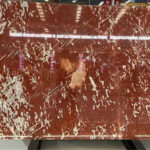
A Visual Epic of Raw Materials In the famous quarries of Carrara, Italy, Vinci White marble is extracted in massive, uncut blocks. Figure 1 presents the spectacular scene of these raw slabs in a warehouse: three slabs, each over 3 meters long, have a uniform texture and a warm, milky white base, like ivory soaked in sunlight. The gray veins distributed on their surface are not chaotic, but rather form brushstrokes similar to the “cunfa” technique in Chinese landscape painting—some like traces left by a gust of wind sweeping across snow, others like the gradual diffusion of ink on rice paper. These textures are evidence of the crystallization of calcite and trace amounts of graphite minerals during the geological metamorphism of the marble.
The juxtaposition of the industrial environment (cement floor, steel frame structure) and the natural stone creates a strong visual metaphor: human craftsmanship and natural creation reach a tacit understanding here. The human-scale figure in the upper right corner contrasts with the enormous size of the slabs, suggesting their suitability for large spaces. It’s worth noting that the high-gloss reflection on the slab’s surface isn’t solely due to polishing; it stems from its dense structure, boasting a calcite crystal content of up to 98%. This characteristic allows it to be processed to achieve a mirror-like finish.


Deconstructing Material Science—From Geological Formation to Physical Properties
The birth of Vinci White marble can be traced back to the Alpine orogeny during the Jurassic period. Limestone in the Apiano Mountains of Italy recrystallized under high temperature and pressure, forming the pure calcareous marble found in the veins today. Its Mohs hardness is approximately 3-4, falling between granite (6-7) and travertine (2-3). This moderate hardness provides sufficient structural strength while retaining the flexibility for easy carving and processing.
Figure 2 shows the side of a single upright slab, revealing a standard thickness of approximately 3cm. This thickness ensures stability for countertop use and is suitable for creating translucent walls. When light passes through a slab thinner than 20mm, Vinci White exhibits a unique “jade-like effect”—a soft light effect produced by the diffuse reflection of light by the calcite crystals. Its water absorption rate remains between 0.08% and 0.12% (lower than the standard of 0.2% for ordinary marble), meaning that in kitchen countertop applications, its resistance to liquids such as wine and olive oil is significantly better than most similar stones. However, as a calcareous marble, direct contact with acidic substances such as lemon juice and vinegar should still be avoided, otherwise it may trigger a corrosive reaction of calcium carbonate.


A Narrative Poem of Spatial Application—From Function to Aesthetics
- A Sensory Revolution in Bathroom Spaces
The washbasin design in Figure 3 is a model of material application. The entire Vinci White countertop uses a “waterfall edge” technique, with the texture flowing naturally from the horizontal to the vertical plane, creating visual continuity. The contrast between the dark walnut cabinet and the stone subtly echoes the “contrast aesthetics” tradition in Italian design. It is worth noting the matching textures of the countertop and the wall—the craftsmen used a “pattern matching” technique to create a narrative feel reminiscent of a landscape scroll by varying the veins on different surfaces. Hidden LED strips create a soft illuminance of 0.5-1.5 lux on the stone surface, perfectly highlighting the three-dimensional texture without being glaring.
- Sculptural Expression of Architectural Components In Figure 4, the load-bearing columns, encased in Vinci White marble, are elevated from functional components to spatial sculptures. The six columns employ a “matching pattern splicing” technique, creating a symmetrical landscape painting effect between adjacent columns. This method requires craftsmen to precisely calculate the grain direction during cutting, resulting in a loss rate more than twice that of conventional processing. Floor lamps create a gradient of light and shadow on the column surface, cleverly mitigating the coldness and hardness of the stone. The alternating effects of natural light from outside the window and indoor lighting at different times create a dynamic effect of “morning and evening glow, ever-changing scenery” in the stone’s texture.
Deep Decoding of Design Philosophy
The essence of Vinci White is “flowing eternity.” Its random texture rejects industrial replication; the texture variation rate per square meter is as high as 87%, meaning that each usage scenario is a unique artistic creation. From a color psychology perspective, its base white tone (Pantone color 11-0602 TPX) has a 10-15% grayscale overlay. This “imperfect white” is more emotionally warm than pure white and lighter than high-grayscale colors.
Contemporary minimalist master Vincent van Duissen once commented: “Finci White is the poet of the marble family; it tells the story of time in the language of geology.” In related cases at Milan Design Week, this material is often combined with brass, dark oak, microcement, and other materials, stimulating the five senses through the juxtaposition of different textures. Its thermal conductivity (2.8 W/m·K) makes it suitable for underfloor heating systems, and the warm feel it conveys when barefoot becomes an important part of the “tactile design” of high-end residences.


