


The collapse of marble wall panels refers to the granular or blocky peeling phenomenon that occurs locally on the surface during the use of stone. It is a kind of stone damage, but this damage is obviously different from the fracture and damage caused by external force. Its cause, in most cases, comes from the inside of the stone, so it has its own special cause analysis method and treatment technology. The difficulty of dealing with collapse is relatively high, and it is even more difficult if it appears on the marble-walled bathroom wall. Defects on the ground can also be solved by repairing and other methods, but what about marble walls?
In this issue, we will use a real case to explain the cause and treatment method of this phenomenon, whether it appears on a modern marble fireplace wall or a standard marble wall.

The cause of marble wall stone problems
internal causes of marble walls, and external causes of marble walls are all analyzed using specialized methods. When external factors are not enough to explain this collapse phenomenon, it is necessary to turn to the inside of the stone to find the cause. In this case, the reason lies inside the stone!
This type of issue can occur in various settings, whether it’s on marble tile walls, marble-look wall panels, or even marble fireplace walls. The inherent challenges are consistent across different applications, including faux marble wall panels, marble wall boards, and marble on wall installations.

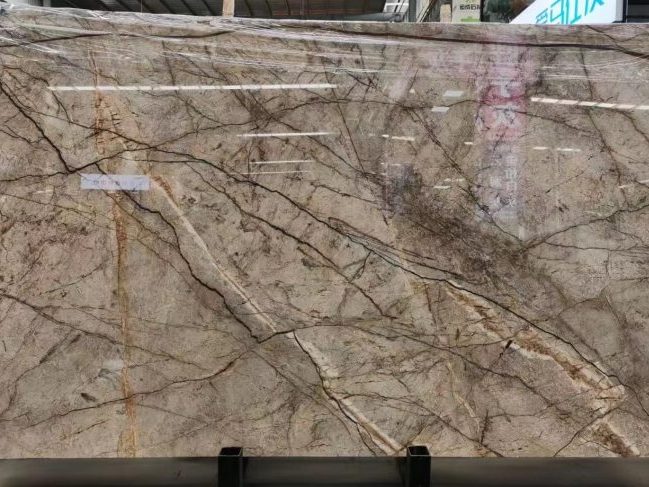
This stone is a beige variety originating from the Mediterranean coastal area, which includes countries like Egypt, Spain, Italy, Greece, and Turkey. Coastal countries are rich in beige stones, such as Egyptian beige, Spanish beige, and Shayana beige (Iran).
As the earth’s crust rose, the stone floated to the surface, but salt from seawater remained inside. These salts may not change much during billions of years of sedimentation. However, once the stone is mined, sawn into slabs, and used in decorations like marble wall panels, marble wall boards, or marble on the wall, these salts may change under new environmental conditions.

For instance, if this type of marble is used in a marble-walled bathroom, or on a marble fireplace wall, it may encounter a lot of water during processing, which reactivates these salts, causing them to enter and exit along the micropores inside the stone. This case, in particular, is in a hot and humid environment like Guangdong, where even marble walls and marble tile walls are always under the influence of water vapor in the air. The circulating water causes salt to precipitate along the micropores of the stone. The phenomenon is often more severe in humid areas like bathrooms and basements, where marble wall panels or marble wall boards are used.
The evaporation and drying of water, along with the dissolution and crystallization of salts, create strong stress on the stone. Dissolved salts can also destroy the cementing structure of the stone, leading to problems such as salt precipitation (similar to alkali return, which is actually salt overflow), pitting, and powdering on marble walls.

Neither protection nor glue repair can cure it. Water-based and oil-based protective agents can reduce the water absorption rate of stone by more than 90%, but not 100%. Even if protection is done, the stone still absorbs water in a long-term humid environment. Dissolved salts also have a strong destructive effect on the molecular chains of the protective agent after solidification, so the protective effect decreases over time.
Glue repair only addresses the surface pits but does not affect the internal salt changes. Other areas of the marble wall, whether it’s a marble fireplace wall or a faux marble wall panel, may continue to collapse, and even the glue repair itself may fall off.
Radical treatment method: Rough surface treatment + surface sealing treatment
To cure this phenomenon, the channels for water and salt to enter and exit the stone should be effectively blocked. This method involves treating the originally smooth marble into a rough surface, followed by applying a surface sealing protective agent. This treatment is applicable whether dealing with marble wall panels, marble on wall installations, or a marble-walled bathroom.
The treatment steps can be divided into three major links:
- Link 1: On-site drying link
Whether it’s an indoor hall, a humid bathroom, or basement, you must create an environment for the stone to dry. For example, open windows for ventilation, turn on the dehumidification function of the air conditioner, or take advantage of the low air humidity seasons such as autumn and winter for construction.

- Link 2: Rough surface treatment
This process involves changing the polished stone into a rough antique effect. During processing, surface powder and peeling layers are removed.
- Materials and tools: Adjustable speed hand polishing machine, round antique grinding brush, marble antique singeing agent (also known as antique water), roller, plastic protective film, mask, rubber gloves, cotton yarn, masking paper, blade, etc. Marble glue, knife, etc. are prepared for use.
- Steps: These include sealing gaps with marble glue, applying protective films, using a roller to apply marble antique singeing agent, and then drying and cleaning the surface with a hand-polished machine and antique grinding brush. These steps are crucial in dealing with marble walls, marble on wall installations, and marble wall panels.
- Link 3: Surface sealing treatment
After the rough surface treatment is completed, the surface sealing treatment is relatively simple. Use a roller or brush to apply the VD stone touch-up protective agent evenly and sufficiently to the stone surface.


- Steps: Apply the first coat, cure for 4 hours, apply the second coat, and ensure no contact with water or other substances for 4 hours. Remove the finished product protection, clean the site, and the treated marble walls are ready for use.
III. Summary
This “rough surface treatment + sealing treatment” is one of the technologies used in marble wall treatments. When discussing “marble wall treatment,” people often think of common methods like crystallization and glaze sealing. However, there are many processes for treating marble wall panels, such as changing glossy surfaces to rough or matte surfaces, enhancing surface gloss, or polishing. This approach applies whether dealing with marble fireplace walls, marble-look wall panels, or marble-walled bathrooms.