


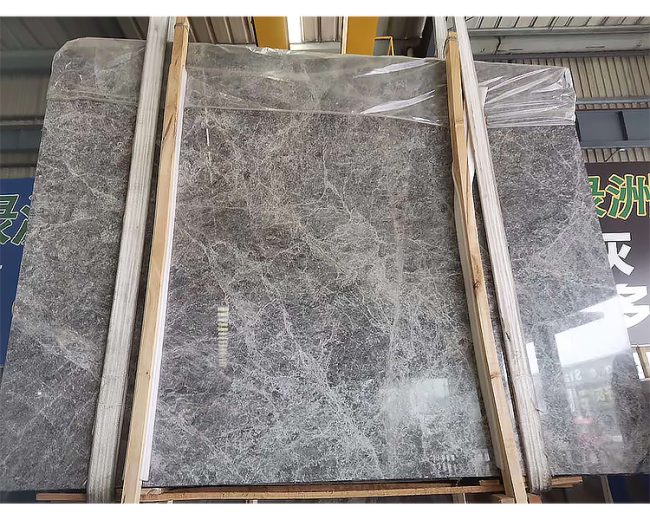


How to Keep Veins Continuous When Joining Marble for Curved Surfaces

Many curved marble installations fail visually for one simple reason: the curve is technically correct, but the stone pattern looks interrupted. Even when the radius is smooth and fabrication is precise, poor vein alignment immediately reveals where one segment ends and the next begins.
This is why high-end curved marble work depends heavily on marble vein matching. The goal is not to eliminate joints completely, because joints are often unavoidable, but to place and align them so the eye continues reading the stone naturally.
In luxury interiors, reception desks, curved feature walls, and cylindrical wraps all rely on this principle. A technically acceptable curve becomes premium only when the visual rhythm of the marble remains calm and continuous.
Why Vein Continuity Matters More in Curved Stone Than Flat Panels Marble Vein Matching
On flat surfaces, the eye often accepts joints more easily because the geometry is predictable. On curved surfaces, every seam becomes more noticeable because the eye is already tracking movement across the radius.
If vein direction changes suddenly, if seam lines cut aggressively across major patterns, or if adjacent pieces come from poorly selected slab areas, the finished curve immediately looks fragmented.
This is why curved stone projects usually require slab planning before cutting begins. Once pieces are cut without grain logic, correction becomes difficult.
The Three Core Rules for Marble Vein Matching on Curved Surfaces Marble Vein Matching
1. Always sequence slab sections before cutting Marble Vein Matching
Fabricators should identify which slab zones will form each curved section before production starts. Random cutting creates visual jumps that cannot be corrected later.
2. Major veins should cross joints naturally Marble Vein Matching
The strongest veins should not stop abruptly at seam lines. If a vein reaches a joint, it should continue with similar direction and density in the adjacent segment.
3. Joint lines should avoid visual tension zones
Joints placed directly in high-contrast areas attract attention. In premium work, seams are often moved toward quieter zones of the pattern.
Vein Matching Comparison Table
| Condition | Visual Result | Risk Level | Recommended Action |
|---|---|---|---|
| Continuous vein crossing seam | Natural visual flow | Low | Preferred layout |
| Vein interruption at joint | Visible segmentation | High | Re-select slab area |
| Opposite grain direction | Artificial appearance | Very high | Avoid in visible zones |
| Quiet seam in low-pattern zone | Minimal seam visibility | Low | Strong solution for large curves |

Expert Interpretation: Why Good Fabrication Still Fails Without Vein Logic
Expert answer 1: Precision cutting cannot correct poor slab planning
Even highly accurate cutting machines cannot improve visual continuity if slab selection was wrong from the beginning. Vein logic starts before machining.
Expert answer 2: Smaller joints do not automatically look better
Many assume thinner joints solve everything. In reality, badly positioned thin joints often remain more obvious than wider seams placed intelligently.
Common Mistakes in Curved Marble Seam Control
- Using leftover slab pieces without grain planning
- Cutting each segment independently
- Matching only colour while ignoring directional movement
- Placing seams at the centre of strong veining
- Approving fabrication from isolated piece photos
How Century Star Approaches Vein Matching for Marble Vein Matching Curved Marble
At Century Star, curved marble planning begins before cutting. Slab orientation, vein direction, seam rhythm, and installation viewpoint are considered together. The purpose is not to force perfect symmetry, but to ensure the finished curve reads as one composed surface rather than assembled fragments.

Marble Vein Matching FAQ
1) Why are joints more visible on curved marble?
Because curvature naturally guides the eye along the surface, making interruptions easier to notice.
2) Can all marble types achieve good vein matching?
No. Some marbles with chaotic patterns are naturally harder to align across multiple segments.
3) Should joints always follow vein direction?
Not always, but seam placement should respect dominant pattern movement.
4) Is bookmatching useful in curved marble fabrication?
Sometimes, but curved surfaces often require sequential continuity more than mirrored symmetry.
5) What matters more: seam width or seam location?
Location usually matters more than width in visual control.