



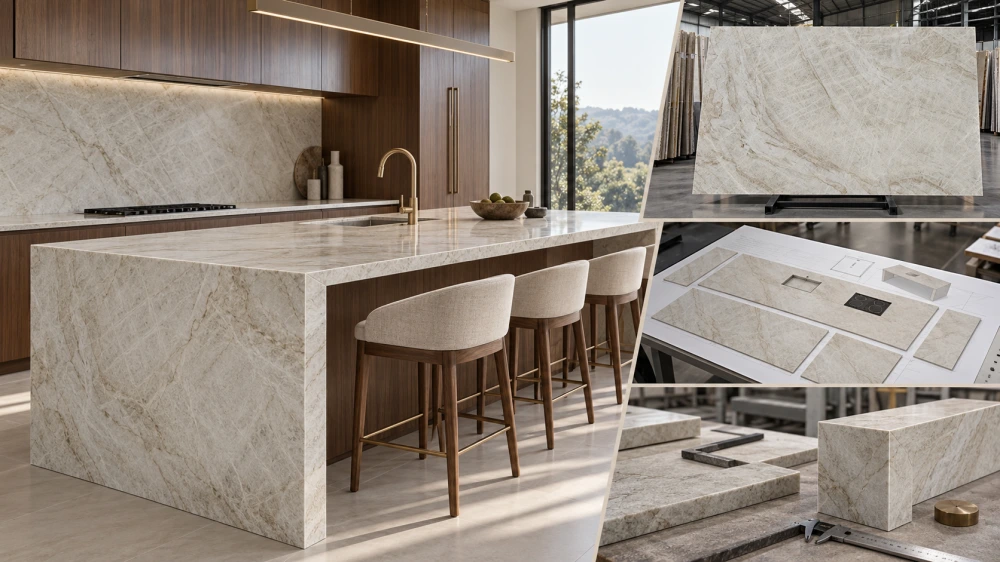
クォーツァイト製キッチンアイランドの費用はどれくらい?
クォーツァイト製キッチンアイランドのコストは、アイランドの仕上り面積だけでは決まりません。現実的な予算には以下を考慮する必要があります: 実際の天然クォーツァイトスラブ、使用可能なカット収率、加工、開口部、エッジの詳細、ウォーターフォールパネル、必要に応じた補強、品質管理、梱包および物流.
そのため、仕上り寸法が似ている二つのアイランドでも、全体の調達コストは大きく異なることがあります。一つは比較的落ち着いたクォーツァイトを使用し、効率的なスラブ収率とシンプルなエッジ仕上げを採用している場合があります。もう一つは、厳選されたスラブ、方向性のある模様合わせ、両端のウォーターフォール、大型シンク開口部、複雑なミッティング、追加の取り扱い、強化された輸送梱包を必要とする場合もあります。.
直接的な予算回答
クォーツァイト製キッチンアイランドの予算を仕上り面積だけで立ててはいけません。まずアイランドの形状を定義し、実際に必要なスラブの数、どれほど効率的にカットできるか、どのような加工が必要か、そして納品範囲が何を含むのかを決定してください。サプライヤーは「クォーツァイトアイランド」という言葉とおおよその寸法だけから有意義なプロジェクト見積もりを提供することはできません。.
主なコストドライバー
| コストドライバー | なぜコストが変わるのか | バイヤーの管理 |
| クォーツァイトの選択 | 名前が異なる石材やブロック、見た目のグレードによって、材料価値が異なることがあります。. | 視覚的な目標を明確にし、実際に入手可能なスラブを比較してください。. |
| スラブグレードとマッチング | よりクリーンな背景や好まれるムーブメント、または密接に調整されたスラブは、許容可能な在庫を減らす可能性があります。. | 不必要な均一性を求めず、許容できる色と模様の範囲を設定してください。. |
| 使用可能なスラブ収率 | 仕上りアイランド面積と購入したスラブ面積はほとんど同じではありません。. | 最終数量を確定する前に、CADまたはデジタルカットレイアウトを承認してください。. |
| ウォーターフォールパネル | 垂直な端部は追加のスラブ面積を消費し、模様の向きやミッティングを合わせる必要がある場合があります。. | アイランドにゼロ、一つ、または二つのウォーターフォール端が必要かを早めに決めてください。. |
| 開口部と機械加工 | シンク、コンロ、蛇口、アクセサリーの開口部は、狭い石材部分周辺で機械加工とリスクを増加させます。. | 機器のモデルとテンプレートを加工前に確定してください。. |
| エッジの構造 | シンプルな仕上りエッジと厚みのある見せかけのミッティングは、労働と材料の要求が異なります。. | 見積書の図面に見えるエッジの詳細を明記してください。. |
| QCと乾式レイアウト | 複雑な複数ピースのアイランドは、追加の視覚的・寸法確認を必要とする場合があります。. | 不要な検査段階を追加するのではなく、必要な証拠を明確に定義してください。. |
| 梱包と運送 | ケースサイズ、パーツの形状、重量、経路、取引条件、目的地が納入コストに影響します。. | 材料、加工、梱包、物流を別々の見積項目として請求してください。. |
1. 材料グレードは予算の最初の層にすぎません
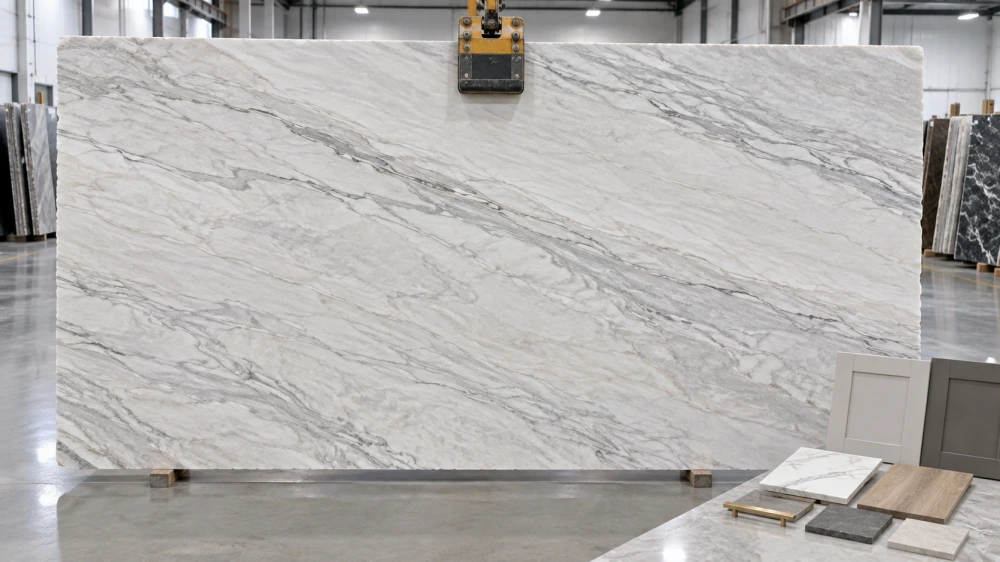
モンブランクォーツァイトスラブグレードキッチンアイランド予算天然クォーツァイトは、世界共通の価格を持つ標準化された製品ではありません。タージマハル、モンブラン、クリスタロ、パタゴニア、ブルーローマなど、商業的な種類は見た目の特徴、入手可能性、スラブ構造、加工要件において大きく異なることがあります。.
一つの石材名の中でも、購入者は背景の色調、模様の濃度、結晶領域、自然な割れ目、樹脂処理、全体的な見た目のグレードに違いを見ることができます。大規模なグループからプレミアムスラブのみを選択すると、承認された見た目の範囲を満たすスラブが少なくなるため、実質的な材料コストが高くなることがあります。.
まだ材料の種類を決めている購入者は、CENTURY STARから始めることができます 石英岩素材コレクション, が、最終的なコスト見積りは、一般的なクォーツァイトカテゴリーではなく、プロジェクトに提案される実際のスラブを参照すべきです。.
2. 仕上りアイランド面積は購入した石材面積と同じではありません
これは初期のクォーツァイト予算が正確でない最も一般的な理由の一つです。.
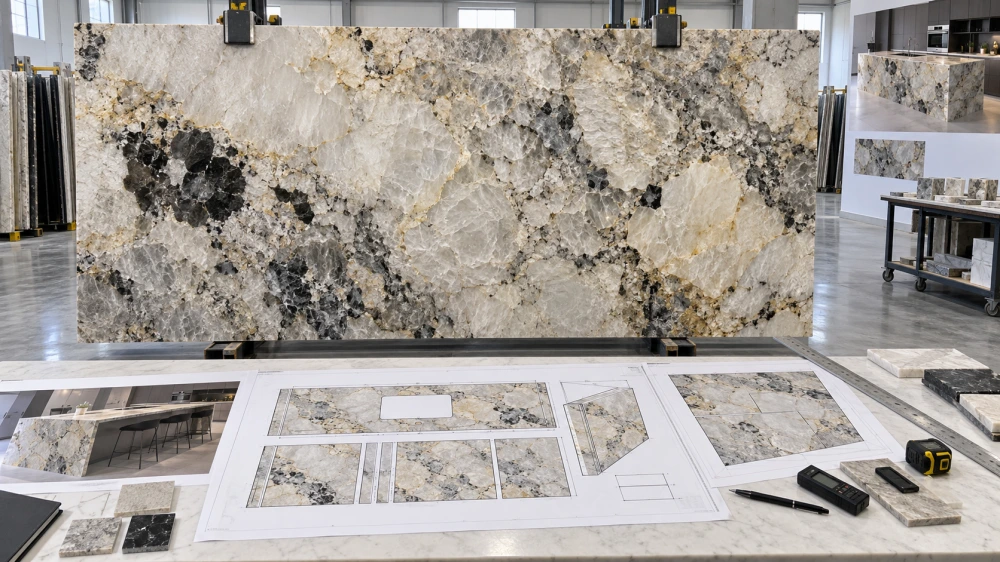
平面的にはシンプルに見えるアイランドトップを想像してみてください。購入者は仕上り表面積を計算し、ほぼ同じ量の石材を購入すると期待するかもしれません。しかし実際には、ファブリケーターはスラブの寸法、模様の方向、自然な特徴、シンクやコンロの開口部、継ぎ目、ミッティングストリップ、ウォーターフォールパネルなどを考慮しながら、矩形の天然スラブ内にアイランドを配置する必要があります。.
その結果は 総スラブ消費量 対して 純粋な仕上り面積. です。この差がカット収率となります。.
なぜ収率がすぐに変わるのか
比較的柔軟な方向性を持つ静かな石材は効率的な配置が可能です。強い方向性を持つスラブは、回転させた方が材料を節約できる場合でも、アイランドトップを縦方向に配置する必要があります。結晶が豊富なエリアや割れ目のあるゾーンは見た目には魅力的ですが、開口部周辺の細い帯状部分には不向きです。ウォーターフォールデザインの場合も、視覚的な連続性を保つためにスラブの広い隣接部分が必要になることがあります。.
This is why professional sourcing should include slab allocation and cutting-layout review. CENTURY STAR’s guide on how procurement teams source Quartzite Kitchen Island projects also treats gross slab quantity and CAD layout as core purchasing controls rather than secondary fabrication details.
3. Island Geometry Determines Fabrication Cost
A rectangular island top with simple finished edges is different from a sculptural island containing miters, waterfalls, large appliance openings and seating overhangs.
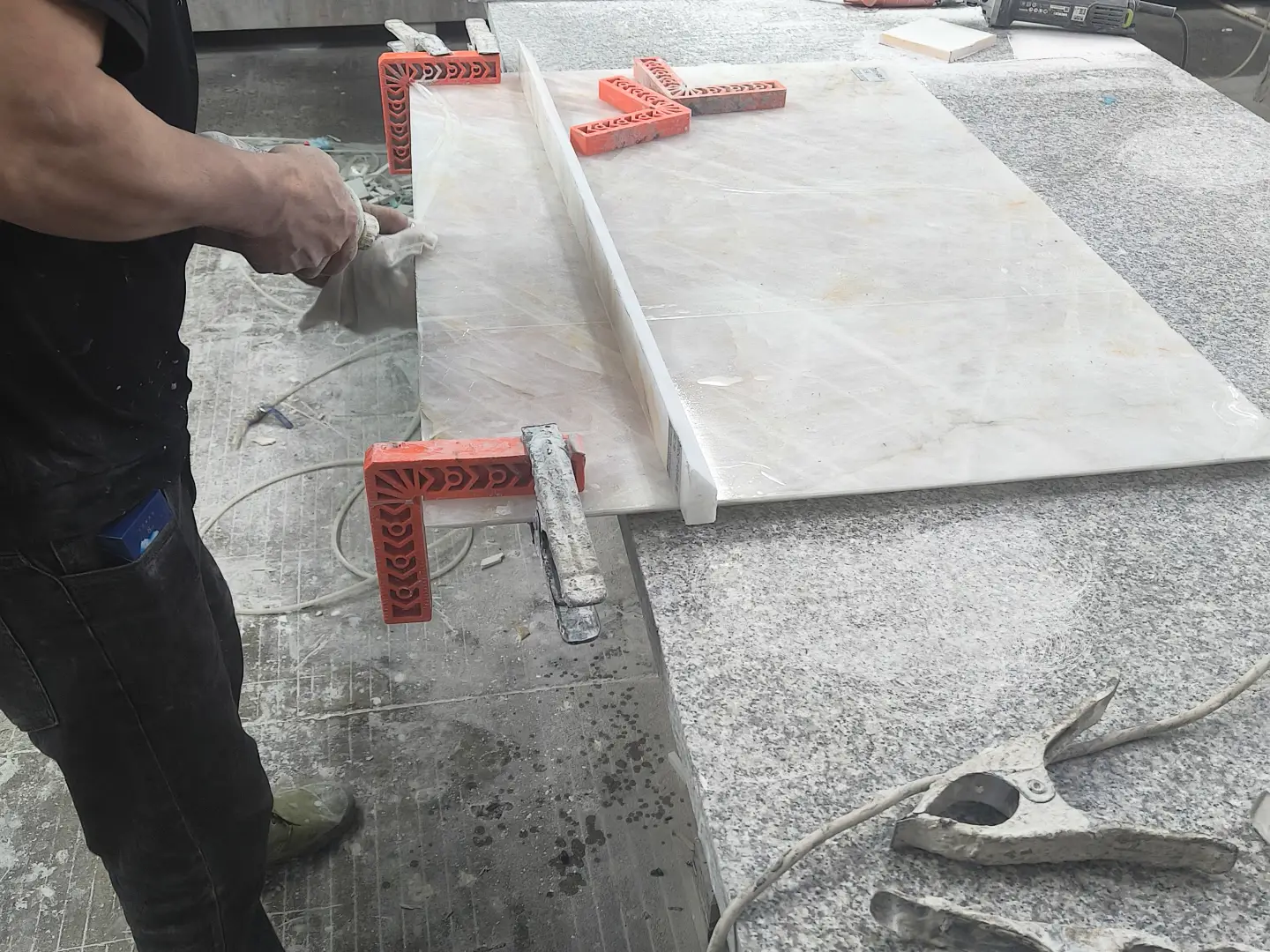
Common fabrication cost drivers include bridge-saw cutting, CNC or waterjet work where required, undermount sink openings, cooktop cutouts, faucet holes, mitered edge construction, polished exposed edges, waterfall joints and local reinforcement or handling measures appropriate to the geometry.
Quartzite can also contain natural fissures, mineral transitions and crystalline zones. These are not automatically defects, but their location can affect the cutting plan. A visually dramatic area that is appropriate across the center of an island may be less desirable beside a large opening where only a narrow stone rail remains.
Mitered Edges and Waterfalls Affect Both Material and Labor
A thick-look miter does more than add edge-polishing labor. It also requires strips from the slab and careful visual coordination with the top. Waterfall panels add full vertical surfaces and make seam accuracy and vein transition more visible.
Therefore, a buyer requesting a “thick island with waterfalls” should specify what that actually means before comparing supplier quotations.
4. Finish, Thickness and Special Design Details Also Matter
The quotation should identify the required finish and stone thickness rather than leaving them assumed. Polished, honed or other specified finishes may involve different processing requirements depending on the actual Quartzite.
Likewise, the visible thickness of the completed island may come from the slab itself or from fabricated edge construction. These are not the same production approach and should not be compared as if they were identical.
Special elements such as integrated stone sinks, curved profiles, complex radii or highly customized edge details move the project further away from standard countertop fabrication and should be priced from drawings.
5. QC and Dry Layout Are Part of the Real Project Cost
Quality control should not be treated as an invisible free service. A simple island may need standard dimensional and surface inspection, while a complex multi-piece project may justify additional dry-layout review, vein-transition checks, piece identification and packing documentation.
The objective is not to add as many inspection steps as possible. It is to establish the evidence necessary to verify that the fabricated pieces match the approved slab layout and drawings before they are packed.
For large international projects, correcting an issue before shipment is usually much more manageable than discovering it after the stone arrives on site.
6. Packing Can Be a Significant Budget Variable
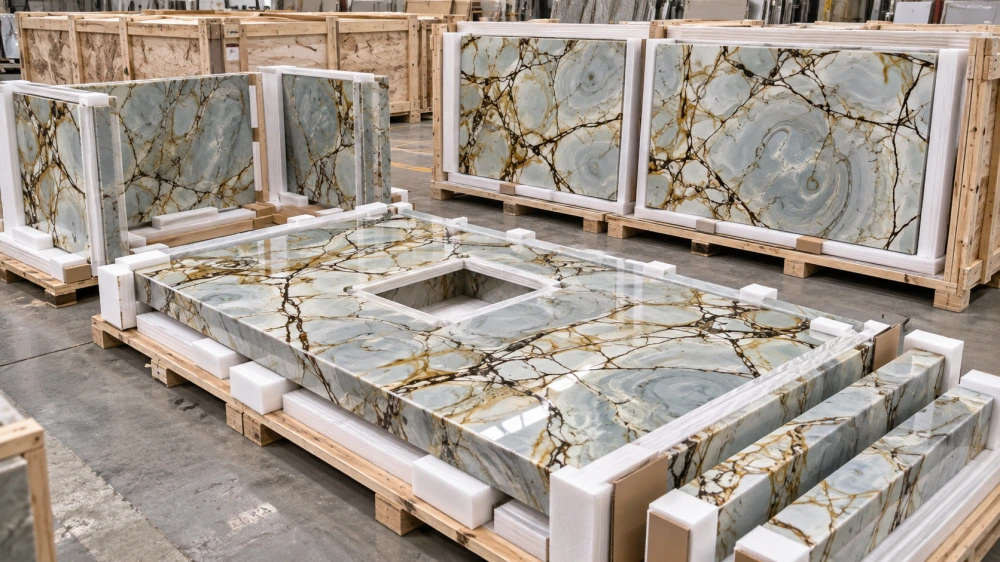
A fabricated Quartzite island cannot be packed like an unprocessed slab. Sink openings, long narrow sections, miters and waterfall pieces require protection designed around the finished geometry.
Export packing may require reinforced wooden crates, internal supports, cushioning, edge protection, waterproof protection and secure fixing. The correct packing design depends on the number of pieces, their dimensions, openings and transport method.
Reducing packing simply to lower the quotation can transfer cost into a much larger damage and replacement risk.
7. Freight and Trade Terms Must Be Separated From Stone Cost
Freight is another reason fixed online Quartzite island prices can be misleading. Logistics depend on origin, destination, crate dimensions, shipment weight, transport mode, trade term and current market conditions.
EXW, FOB, CFR/CIF and delivered quotations do not contain the same scope. Two suppliers can therefore show very different totals even if their actual stone and fabrication costs are similar.
How Can Buyers Control a Quartzite Kitchen Island Budget?
Budget control does not necessarily mean choosing the cheapest stone. It means controlling the variables that create unnecessary cost without weakening the design.
- Finalize the island geometry early. Changing dimensions after slab reservation can destroy an efficient layout.
- Set a realistic visual range. Requiring every slab to look almost identical may unnecessarily restrict available material.
- Review slab yield before purchase. Compare how the actual components fit onto the actual slabs.
- Use waterfalls deliberately. One or two waterfall ends can materially change slab consumption.
- Finalize appliances before cutting. Late sink or cooktop changes can require re-fabrication.
- Specify edge details clearly. Do not compare a basic edge quotation with a full mitered build-up quotation.
- Define QC scope. Use the inspection stages required by the project rather than vague “full QC” language.
- Compare delivered scope. Separate packing and freight so supplier quotes are commercially comparable.
What Information Is Needed for an Accurate Quartzite Island Quote?
A professional supplier should be able to quote more accurately when the buyer provides a complete brief. At minimum, the quotation request should identify the material direction, dimensions, fabrication scope and delivery basis.
| Quote Input | Why It Is Needed | Cost Risk if Missing |
| Stone / Visual Target | Defines the material group and slab-selection level. | Quotation may use an unsuitable grade or different stone. |
| Finished Dimensions | Required for slab quantity and fabrication planning. | Material quantity may be materially wrong. |
| Thickness & Finish | Defines material and processing scope. | Suppliers may quote different specifications. |
| Sink / Cooktop Details | Affects openings, machining and layout. | Fabrication cost and risk can be understated. |
| Edge / Waterfall Scope | Determines extra pieces, miters and slab consumption. | A basic countertop may be quoted instead of the actual island design. |
| Destination & Trade Term | Defines logistics responsibility. | Delivered totals cannot be compared accurately. |
For buyers managing an international supply package rather than only selecting a material, the CENTURY STAR guide to Quartzite Kitchen Island procurement explains how actual slabs, CAD layouts, fabrication approvals, QC, packing and delivery documentation fit together.
Material Cost vs Total Project Cost
One of the most useful distinctions in Quartzite budgeting is between the cost of the raw slabs and the cost of delivering a completed island package.
The raw slab is only the starting material. Once the project requires selection, layout, cutting, openings, finishing, edge assembly, waterfall matching, inspection, packing and logistics, the commercial scope changes.
This is why an apparently expensive slab can sometimes produce an efficient finished project if it fits the island well, while a cheaper slab may generate poor yield and require more material. Budget decisions should therefore be made using the approved fabrication solution, not a raw square-meter comparison.
よくある質問
1. Why is there no single price for a Quartzite Kitchen Island?
Because natural Quartzite varies by stone, slab grade, dimensions and availability, while every island can have different dimensions, waterfalls, cutouts, edges, finishes, packing and delivery requirements. A meaningful price requires a defined project scope.
2. Is Quartzite priced by finished island area or by slab?
Material may be commercially quoted in different ways, but procurement quantity has to reflect the actual slabs required. Finished island area does not automatically equal purchased stone area because cutting yield, vein direction, natural features and additional components affect gross slab consumption.
3. Do waterfall ends make a Quartzite island more expensive?
They normally increase project scope because vertical panels require additional material, fabrication and mitered joints. They can also reduce slab yield if the design requires visual continuity between the top and side.
4. Why can two suppliers quote very different prices for the same Quartzite?
The quotations may not contain the same slab grade or project scope. One may include selected slabs, fabrication, miters, openings, QC, packing and delivery while another may quote mainly raw material. Compare the specifications and inclusions before comparing totals.
5. Does a larger slab always reduce kitchen island cost?
No. A larger slab can improve yield or reduce seams in some layouts, but its value depends on the actual island geometry, pattern direction and usable areas. The cutting layout is more important than slab size alone.
6. How do sink and cooktop openings affect the budget?
They add machining and influence the cutting layout. Large openings also create narrower surrounding stone sections that may require more careful placement, handling or project-specific reinforcement considerations.
7. Should freight be included when comparing Quartzite island prices?
Yes, if the commercial decision is based on delivered project cost. However, freight should be shown separately because rates, routes, shipment dimensions and trade terms can change. A slab or factory price should not be confused with delivered cost.
8. What should I send to get an accurate quotation?
Provide the preferred Quartzite or visual direction, finished drawings or dimensions, quantity, thickness, finish, sink and cooktop information, edge profile, waterfall scope, other fabrication requirements, destination and requested trade term. Actual slab selection can then be coordinated as the quotation progresses.
参考文献
- Natural Stone Institute — Dimension Stone Design Manual Resource Library. The current manual includes guidance on stone selection, quartz-based stones and countertop fabrication and installation considerations.