


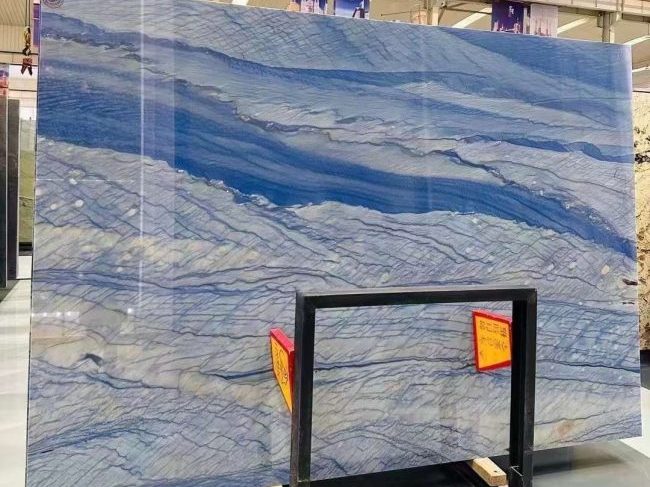
How Flat Marble Slabs Are Turned into Curved Panels: Methods, Principles and Applications

Curved stone surfaces look effortless when they are done well. A reception desk wraps smoothly around a corner, a feature wall flows without visual interruption, or a round column appears to have been carved from a single block. The finished effect feels natural, but the fabrication process behind it is highly controlled.
One of the most common misunderstandings is that natural marble can simply be bent into shape. In reality, most curved marble panels are created from flat slabs through cutting, segmentation, backing treatment, precise joining, and careful surface finishing. The goal is not just to create curvature, but to achieve visual continuity, structural stability, and a clean final appearance.
For architects, designers, and project buyers, understanding how flat slabs become curved panels helps clarify what is technically realistic, what affects cost, and what separates premium fabrication from obvious patchwork.
How Flat Marble Slabs Become Curved in Real Projects
In real fabrication, curved stone is usually an assembly problem rather than a bending problem. Fabricators begin with flat slabs, then divide the intended curved form into manageable sections based on radius, thickness, stone type, and installation requirements.
Depending on the design, the finished result may be achieved through segmented joining, thin-slab radius assembly, or shaped backing techniques that help the stone follow a controlled curve. Each method changes the relationship between joint visibility, production difficulty, and long-term stability.
This is why two curved marble installations can look completely different in quality, even when they use the same stone. The difference usually lies in how the curve was planned, how the grain was aligned, and where the joints were placed.
Why Natural Marble Cannot Simply Be Bent
Natural marble is a rigid material with internal crystalline structure. Unlike metal, wood veneer, or certain composites, it does not tolerate direct bending once the slab reaches normal architectural thickness. If fabricators try to force a slab into a curve without the correct method, the stone is likely to crack, fracture along weak veins, or develop stress that later appears during transport or installation.
The challenge becomes greater when the marble has bold veining, natural fissures, or directional grain. These visual features may look beautiful on a flat slab, but they can also create vulnerable points if the curve design ignores the stone’s internal behaviour.
For this reason, curved marble fabrication is really about converting flat geometry into controlled segments that visually read as a continuous curved surface. Premium results depend less on “bending” and more on accurate planning, fabrication discipline, and finishing control.

The Three Main Methods Used to Create Curved Marble Panels
1. Segmented joining
This is the most common method used in commercial interiors and custom furniture-style stone applications. The curve is divided into multiple narrow flat or slightly angled segments. These pieces are then joined together so the finished face reads as curved when viewed from a normal distance.
Segmented joining works well for reception desks, cylindrical wraps, feature walls, and larger radius applications. Its biggest advantage is practicality: it can be produced from standard slabs, controlled in the workshop, and adjusted based on material yield. The biggest risk is visible joint lines if segmentation is too coarse or grain continuity is poorly managed.
2. Thin slab radius assembly
When the design requires a smoother radius, fabricators may use thinner cut pieces supported by a prepared substrate. Instead of forcing a full-thickness slab into a curve, they build the curve using thinner marble elements that are easier to position along a controlled radius. This method is often used when the designer wants a softer visual line and tighter curvature than segmented joining can deliver cleanly.
The success of this method depends heavily on substrate accuracy, adhesive selection, reinforcement, and polishing consistency. It can create a refined appearance, but it demands tighter process control and experienced installation teams.
3. CNC shaped back cutting and relief processing Curved Marble Panels
In some cases, the back of the stone is processed to reduce thickness in selected areas or to shape the panel so it integrates with a curved base structure. This does not mean the stone is freely bent like a flexible sheet. Instead, controlled machining helps the visible face sit more naturally on a prepared curved support or allows a profile to transition more smoothly.
This method is often combined with the first two techniques rather than used alone. It is useful for more customised architectural details, but it requires strict quality control because removing material from the back can weaken the panel if done carelessly.
Comparison of Curved Marble Fabrication Methods Curved Marble Panels
The table below shows why different curved marble methods produce different visual and technical results. Choosing the wrong method does not just affect appearance; it can also increase breakage risk, polishing inconsistency, and installation difficulty.
| Method | Best For | Visual Effect | Main Advantage | Main Risk |
|---|---|---|---|---|
| Segmented joining | Large radius walls, desks, column wraps | Good if joints are controlled well | Practical and cost-effective | Visible seams if segment planning is poor |
| Thin slab radius assembly | Smoother curves, tighter radius features | More fluid and refined | Cleaner curved effect | Higher fabrication and installation sensitivity |
| CNC shaped back cutting | Custom profiles, detailed transitions | Highly tailored appearance | Supports complex geometry | Structural weakening if over-processed |

Expert Interpretation: What Determines Whether Curved Marble Looks Premium
In curved stone projects, clients often focus first on the radius. In practice, premium appearance is determined by a different set of priorities. These two points matter more than most buyers expect.
Expert answer 1: Grain continuity matters more than the curve itself Curved Marble Panels
Many curved marble installations look expensive not because the radius is technically difficult, but because the grain flows naturally across the assembled surface. When veining direction is ignored, even a well-made curve can look broken or artificial. On the other hand, when the grain is selected and aligned carefully, a segmented surface can still feel calm and continuous.
Expert answer 2: Joint placement decides whether the curve reads as natural Curved Marble Panels
Joints are not automatically a problem. Poorly placed joints are the problem. If seam lines fall in visually aggressive zones, cross major veins awkwardly, or repeat at obvious intervals, the installation looks mechanical. Good fabrication hides the logic of segmentation by placing joints where the eye is less likely to stop.

Where Curved Marble Panels Are Most Commonly Used
The popularity of curved stone has grown because modern interiors increasingly favour softer geometry and more sculptural focal points. Curved marble panels are commonly used in projects where designers want natural stone to feel more fluid and architectural rather than flat and repetitive.
- Reception desks: a curved face makes the front elevation feel more welcoming and custom-made.
- Feature walls: curved stone breaks the rigid visual rhythm of flat cladding and creates spatial depth.
- Column wraps: segmented or radius-assembled marble helps round structural elements feel intentional and elegant.
- Kitchen islands: curved stone bases or waterfall transitions create a softer luxury aesthetic.
- Retail and hospitality counters: rounded forms often photograph better and feel more bespoke in brand-focused spaces.
In all these applications, the quality of the final result depends on whether the curvature has been designed for fabrication reality, rather than only for renderings.
Common Problems When Flat Slabs Are Turned into Curved Stone Curved Marble Panels
Curved marble looks simple in finished photos, but several technical problems can appear if the fabrication process is rushed or badly coordinated.
Visible joints Curved Marble Panels
This is the most common issue. If segmentation is too obvious or the seam lines cut aggressively across the pattern, the curve loses its premium effect. A “curved” wall can end up looking like a faceted surface with decorative stone pieces attached to it.
Cracking during handling or installation
Stone may crack when sections are too thin, unsupported, badly packed, or forced onto an inaccurate substrate. Materials with strong directional veins require additional caution.
Uneven polishing or reflective inconsistency
Even when the geometry is correct, curved surfaces can look poor if polishing pressure or finishing quality varies across segments. Under direct lighting, slight differences in reflectivity become much more obvious.
Pattern disruption
If slabs are not selected with grain continuity in mind, the finished curve may look visually broken. This is especially noticeable with marbles that have strong linear movement or dramatic bookmatch character.
A Practical Checklist Before Approving Curved Marble Fabrication Curved Marble Panels
- Has the fabricator confirmed which curve method is being used?
- Are joint positions shown clearly on shop drawings or approval visuals?
- Has grain direction been reviewed across the full curved elevation?
- Is the substrate or supporting structure dimensionally accurate?
- Have thickness, reinforcement, and edge details been confirmed?
- Has polishing consistency been considered under actual project lighting?
How Century Star Approaches Curved Marble Projects Curved Marble Panels
At Century Star, curved marble is approached as a coordination exercise between material behaviour, visual continuity, and fabrication control. We do not treat the curve as a purely decorative detail. The decision starts with the stone itself: grain direction, thickness, structural behaviour, and how the finished surface will be viewed in the space.
From there, the fabrication approach is matched to the design intent. In some cases, segmented joining offers the cleanest and most reliable path. In others, tighter radius detailing requires more refined assembly and stricter control over support and finishing. The objective is always the same: make the curved surface look composed, stable, and intentional rather than assembled in a hurry.
Curved Marble Panels FAQ
The following questions reflect the most common concerns raised by designers, buyers, and project teams when planning curved marble installations.
1) Can marble really be bent into a curved shape?
Not in the way many people imagine. Standard architectural marble is not simply bent like metal or flexible board. In most projects, flat slabs are cut and assembled into curved marble panels through segmented joining, thin-piece radius work, or shaped backing methods.
2) What is the best thickness for curved marble panels?
There is no single universal thickness because the answer depends on the curve radius, stone type, support structure, and application. Thinner pieces are often easier to adapt to curved forms, but they also require better reinforcement and more careful handling.
3) Why do joints become visible in curved marble installations?
Joints become obvious when the curve is divided too aggressively, when seam positions ignore the stone pattern, or when polishing and alignment are inconsistent. The problem is usually not the existence of joints, but poor joint planning.
4) Are curved marble panels better than solid carved stone?
In many interior and cladding applications, yes. Curved panels are often more practical, lighter, and more material-efficient than solid carved pieces. Solid carved stone can be appropriate for certain sculptural elements, but it is usually heavier, more expensive, and less flexible in production.
5) Which types of marble are easier to use for curved applications?
Marbles with more stable structure, calmer pattern movement, and fewer open fissures are generally easier to fabricate into curved forms. Highly fractured or strongly directional materials can still be used, but they require more careful slab selection and layout control.
6) Can quartzite also be made into curved panels?
Yes, but the fabrication difficulty is often higher because quartzite is generally harder and may respond differently to cutting, shaping, and finishing. The chosen method must reflect the specific material behaviour rather than assume all natural stone performs the same way.
7) What matters most in making curved stone look high-end?
The premium effect usually comes from grain continuity, smart joint placement, accurate support structure, and consistent finishing. A dramatic radius alone does not create a luxury result if the visual flow is broken.
Final Note / Practical Takeaway
References
- Natural Stone Institute – Industry Standards & Resources
- ASTM International – Standards Reference
- ArchDaily – Architecture Materials & Project References