


A Complete Analysis of the Craftsmanship, Pros, and Cons of Natural Stone Countertops


Stone Countertops: Opening with the Theme: Why “Earth’s Original” Still Captivates
Amidst the overwhelming advertising for rock slabs and quartz, natural stone remains firmly at the center of high-end kitchens and commercial spaces. The reasons are simple: its unique natural texture, a lifespan spanning half a century, and its eco-friendly label of zero resin. The hazy hues of marble, the star-like speckles of granite, and the pristine pores of sandstone are all “fingerprints” left by millions of years of Earth’s pressure. Its Mohs hardness of 4-7, compressive strength of 60-220 MPa, and a wear resistance index of 0.1-0.4 g/cm² make it durable enough to withstand the rigors of Chinese stir-fries, Western-style baking, and even parent-child baking classes. In 2025, when “low carbon, long lifespan” became the key word in renovations, a natural stone with unlimited renovations and a lifespan of over 50 years perfectly hits the “sustainability” mark, making it a top choice for luxury homes, hipster B&Bs, and celebrity restaurants.
Stone Countertops: The First Breath of Mining – How Diamond Wire Saws Gently Remove Blocks
In the past, fire chiseling and blasting left the rock masses riddled with microcracks. Now, mainstream mines are using a “diamond wire saw combined with water-cooled cutting” method to cut blocks into regular cubes measuring 2 x 1.2 x 1.8 m. This has increased the yield by 18% and reduced the crack index by 40%. The wire saw rotates at a linear speed of 25 meters per second, and cooling water is injected to lower the cutting temperature, reducing dust and preventing thermal shock that can darken the pattern. Carrara, Italy’s white ore, is also cut at night, taking advantage of the valley’s low temperatures to further reduce stress release and prevent hidden cracking during subsequent transportation and processing. Before leaving the mine, the blocks undergo a first “physical examination”: an ultrasonic flaw detector scans for internal cracks. Blocks with a crack rate greater than 5% are painted red and relegated to curbstone or landscape stone. Only “healthy” stones make their way to kitchen countertops.

Stone Countertops: Factory Transformation: The Three Key Stages from Rough Board to Finished Board
Upon arrival, rough boards are first milled to four stock thicknesses: 12/15/18/20mm, with a tolerance of ±0.3mm. They then enter the vacuum gluing line, where negative pressure draws epoxy glue into hairline cracks. A fiberglass mesh is then bonded to the backside, instantly increasing flexural strength by 30%. This is a crucial step in ensuring high-end countertops resist oil seepage and chipping. Next, infrared bridge cutting and five-axis CNC machining are combined: bridge cutting completes length and width trimming, while CNC positioning processes the stove, sink, and faucet holes. Simultaneously, 6mm bevels, French edges, and duckbill edges are created, achieving a gloss finish of at least 800#, in sync with the board, eliminating on-site secondary sanding. Finally, the boards enter a drying-protection-curing tunnel, where penetrating fluorocarbon resin is cured at 120°C for 24 hours. Water contact angles must be ≥110°, and no soy sauce or red wine penetration is observed within 72 hours before they can be packaged and shipped.
Stone Countertops: A material competition: a triangular showdown between marble, granite, and sandstone.
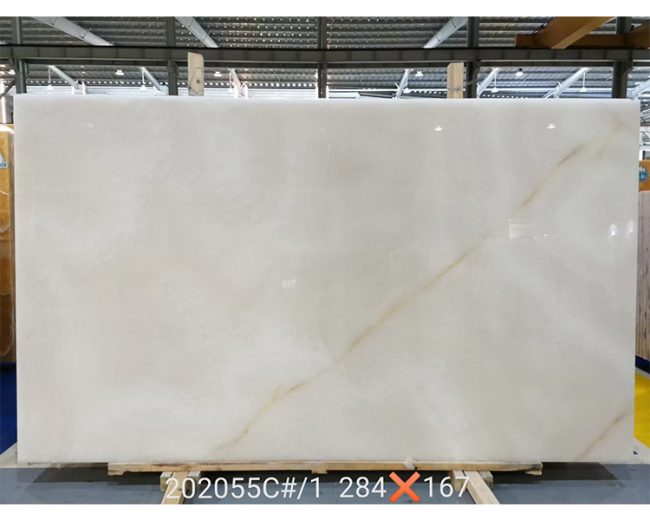
Marble: Ranked 3-4 on the Mohs hardness scale, it offers a flowing texture, a soft sheen, and excellent heat conduction, making it a non-sticky surface for baked dough. However, its porosity is 0.4-1.2%, allowing red wine to penetrate after 15 minutes. Carrara White and Jazz White are the mainstream options, priced between 280 and 450 yuan per square meter.
Granite: Ranked 6-7 on the Mohs scale, it leaves no marks, has a water absorption rate of 0.1-0.2%, is highly stain-resistant, and offers stable color. Prices range from 250 to 350 yuan per square meter for Shanxi Black and Indian Red. However, its drawback is that it cannot achieve continuous grain, resulting in noticeable visual splicing.
Sandstone/Limestone: Ranked 2-3 on the Mohs scale, it offers a large porosity and pristine texture, allowing for a “desert-style” finish. Prices range from 120 to 180 yuan per square meter. However, its flexural strength is only 8-12 MPa, making it unsuitable for overhangs. It requires monthly application of oil and wax for maintenance. In short: choose marble for light meals, granite for stir-fries, and sandstone for wabi-sabi. Align your budget with the setting first, then consider aesthetics.


Stone Countertops: Advanced Craftsmanship – Four Trending Black Technologies for 2025
1. Nano-Fluoro-Crystal Glaze: After gluing, a 1200°C vacuum crystal coating is applied, resulting in a surface contact angle >130° and no soy sauce penetration for 72 hours. ② Slim Composite Panels: 3mm granite + 10mm aluminum honeycomb, reducing weight to 16kg/m², and eliminating the need for steel frame installation. ③ Recycled Stone Assembly: Waterjet-cut offcuts into 300mm hexagonal pieces, then epoxy-assembled to create terrazzo countertops, reducing carbon emissions by 42%. ④ Light and Shadow Engraving: A five-axis laser engraves 0.3mm deep and shallow textures on the panel, creating a “luminous stone” for hotel reception desks. These new technologies are not gimmicks; rather, they reunite the beauty and performance of natural stone, allowing traditional materials to adapt to the aesthetics of minimalism, wabi-sabi, and even cyberpunk.
Stone Countertops: Installation site—Seven minutes of dust-free, quick installation footage.
The cabinet is first leveled using a laser rotator, with a level difference of ≤1mm/2m. Upon arrival, the countertop undergoes a dry test assembly to confirm the pattern orientation. Openings are ≥15mm wide to avoid stress concentration. The back of the joints is fully epoxy-coated and vacuum-sealed, with a gap of ≤0.2mm. A 2mm flexible adhesive gap is left between the rear retaining and the wall to prevent wall settlement and cracking. The finished product is then covered with film and protected with 3mm plywood. No one is allowed to step on it for 48 hours. The entire process, from arrival to delivery, takes an average of three hours, and dust levels are less than 1mg/m³, truly achieving the goal of “installing at noon and cooking at night.”

Maintenance Calendar – A Timetable for Keeping Your Countertops Looking Like New for 20 Years
Daily: Use the 30-Second Rule with a mild dish soap and warm water. Weekly: Remove scale from faucet bases to prevent the whitening of the calcium film. Monthly: Apply food-grade mineral oil to sandstone countertops. Quarterly: Perform a “splash test.” If the edges of the water droplets darken, apply protective agent. Annually: Resurface and brighten marble once, and granite once every two years. Every five years: Repolish joints to make cracks invisible again. First-Aid Cracks: For cracks <0.3mm, use low-viscosity epoxy vacuum sealant. For cracks >0.5mm, cut and insert rebar before reassembling. Remember: Stone is most vulnerable to bleach, high-temperature cooking, and prolonged exposure to water. Avoid these three, and its lifespan will easily outlast your mortgage.
Case Studies and Conclusions – Bringing Data and Aesthetics Together
Shanghai’s Old House: 20mm Calacatta Gold marble with brass inlays, 0.2mm joints, still glossy >85GU after one year; Chengdu’s Open Kitchen: 25mm Shanxi Black Granite stir-fried 8 hours daily, no visible scratches for six months; Sanya’s B&B: Thin composite granite with a 1.8m cantilever, passing a 12-force typhoon shake test. Natural stone is not a flawless industrial product, but an organism that breathes the earth’s rhythm: it grows more mellow with careful care, yet flaws can also be revealed with careless neglect. When you understand the scientific logic behind mining, vacuum sealing, and nano-protection, and accept the inherent constraints of splicing, weight, and protection cycles, you can find the stone that best suits your needs, balancing aesthetics, performance, and budget. Let it shine in the ethereal atmosphere and the spotlight—from mine to kitchen, from first touch to the tenth anniversary celebration, the story continues.