


Best Marble Types for Curved Panels: Which Stones Work Best and Which Fail Easily

In curved marble fabrication, the material choice often determines whether the project feels smooth and premium or becomes difficult before installation even begins. Two stones may look equally attractive in slab form, yet behave completely differently once cut into narrow segments, wrapped around a radius, or assembled into a curved feature.
This is because curved fabrication places more technical demands on stone than flat applications. Structural compactness, vein behaviour, hidden fissures, polishing response, and edge strength all become more important when geometry changes.
For this reason, choosing the best marble for curved panels is not simply an aesthetic decision. It is a fabrication decision, a risk decision, and often a cost decision as well.
Why Material Choice Matters More in Curved Marble Than Flat Surfaces (best marble for curved panels)
Flat marble panels can often tolerate visual variation, minor internal weakness, or local polishing differences because the geometry remains stable. Curved panels behave differently. Once the slab is segmented or thinned, any hidden weakness becomes more exposed.
Materials with unstable veining, open fissures, or brittle crystal behaviour may perform well in standard cladding but fail when asked to follow a curved geometry.
This is why some premium-looking stones become difficult in curved fabrication, while calmer materials often produce more reliable high-end results.
The Three Material Characteristics That Matter Most (best marble for curved panels)
1. Internal compactness
Dense and structurally stable marble generally performs better when cut into curved segments. Compact stones reduce the chance of edge fracture and improve machining consistency.
2. Vein behaviour
Linear and controlled veining usually makes seam planning easier. Chaotic or highly fractured patterns increase visual and structural difficulty.
3. Polishing consistency
Curved surfaces reflect light differently from flat panels, so materials with uneven polishing response can reveal more defects after installation.
Best Marble Types for Curved Panels
Italian Carrara
Italian Carrara remains one of the most practical stones for curved applications because its relatively calm background and moderate vein movement allow easier seam control. Its visual softness also helps joints appear less aggressive.
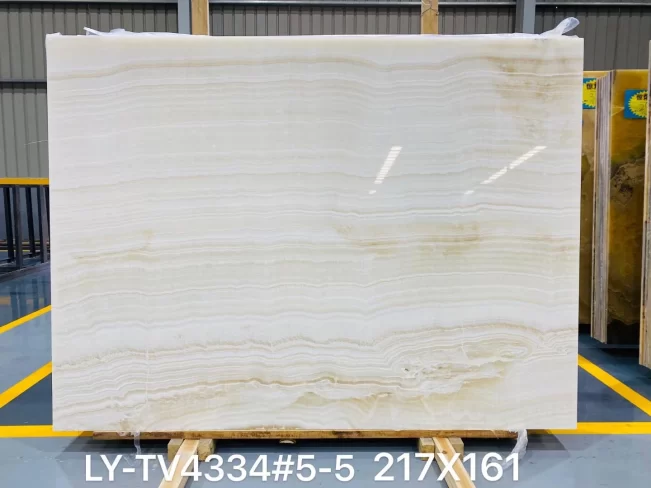
White Wooden Marble
The directional grain of Wooden White Marble works especially well when the curve follows the natural flow of the material. It can produce elegant continuity if slab orientation is planned correctly.
Dover White Marble
Dover White offers stable structure and controlled visual rhythm, making it suitable for commercial curved wall systems and reception features.
Selected Beige Marbles
Many beige marbles perform well because they often contain calmer pattern movement and lower visual contrast, which helps reduce seam visibility.
Marble Types That Require Extra Caution
Highly fractured dramatic marbles
Strong dramatic veins may look impressive but often create stress points when segments become narrow.
Open-fissure decorative stones
Materials with visible natural fissures can become unstable during edge handling and transport.
Strong-contrast directional marbles
When major veins cross seams aggressively, curved continuity becomes harder to control.
Material Comparison Table for Curved Fabrication
| Material | Fabrication Stability | Vein Matching Difficulty | Crack Risk | Recommended Use |
|---|---|---|---|---|
| Italian Carrara | High | Low to medium | Low | Walls, desks, curved panels |
| White Wooden Marble | High | Medium | Low to medium | Feature walls, columns |
| Dover White Marble | High | Low | Low | Commercial interiors |
| Dramatic veined marble | Medium | High | Medium to high | Visible statement zones only |
| Open fissure decorative marble | Low to medium | High | High | Requires strict control |

Expert Interpretation: Why Expensive Marble Is Not Always Better for Curves
Expert answer 1: Strong visual drama often increases fabrication difficulty
The more dramatic the vein, the harder it becomes to keep continuity across joints and reduce visual interruption.
Expert answer 2: Stable quiet stones often look more premium after installation
In curved applications, calm visual rhythm usually performs better than extreme contrast because the eye follows the surface continuously.
How to Select Marble for Curved Projects Before Cutting (best marble for curved panels)
- Check multiple slabs, not one sample
- Review vein direction in relation to curve radius
- Avoid weak slab corners for narrow segments
- Match material choice to installation visibility
- Confirm polishing behaviour under project lighting
How Century Star Evaluates Marble for Curved Fabrication (best marble for curved panels)
At Century Star, curved material selection begins by evaluating how the stone behaves under segmentation, not only how it looks in slab form. Internal compactness, grain rhythm, seam tolerance, and edge stability are reviewed before deciding whether a material suits curved fabrication.

Best Marble for Curved Panels FAQ
1) What is the best marble for curved panels?
Calm, structurally stable marbles such as Italian Carrara, Dover White, and selected white materials usually perform best.
2) Why do dramatic marbles fail more easily in curves?
Because strong veins often create weak stress lines and make seam continuity harder.
3) Can quartzite be better than marble for curves?
Sometimes structurally yes, but fabrication difficulty can increase because quartzite is harder.
4) Is white marble easier for curved walls?
Often yes, because softer patterns help seam control.
5) Should expensive marble always be chosen for luxury curves?
No. Stability often matters more than price.
6) Can beige marble perform better than bold marble?
Yes. Beige stones often hide seams more naturally.