


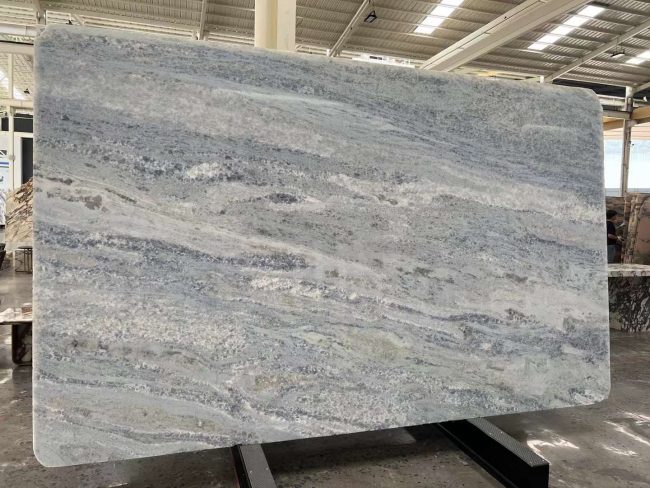
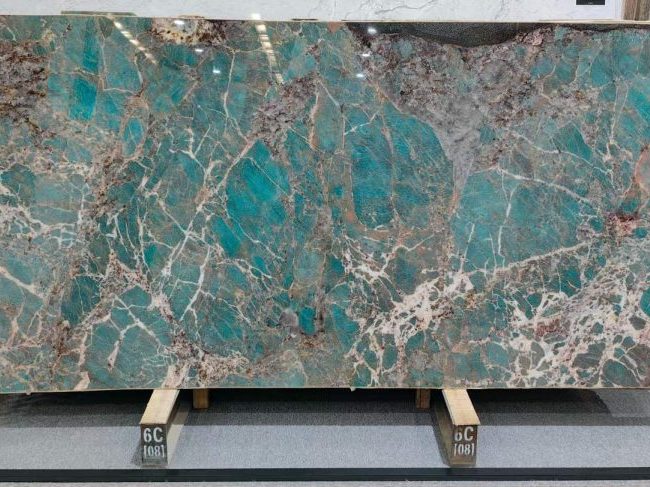
Grain chasing is a type of stone processing art in which the stone line is deliberately arranged and cut such that the grain of the stone produces a consistent and coherent visual impression throughout the internal design. Because of their adaptability, stones with a range of textures—from marble to granite and others—are perfect choices for this approach. Grain chasing aims to preserve the inherent beauty of the stone while simultaneously improving the way the texture of the stone line is exhibited in the space by use of creative and synthetic arranging methods.
Grain chasing considers the color, texture, and pattern of the stone line throughout the procedure. This guarantees that every stone could be precisely synchronized with the stones around it. Workers must be very gifted and deeply aware of stone texture if this approach is to be successful. This is so because different parts of the stone line may have varied textures even from the same stone.


“一” Shape Design
A “一” pattern is one classic method of setting stones. The stone’s texture’s straight line configuration lends the work visual homogeneity and cohesiveness. Chinese symbol which stands for the directness and clarity of the line, gives the pattern its name. It could highlight the textural features of the stone line, so giving the room an impression of being more orderly and roomy.
In practical terms, the “one”-shaped pattern fits stones such as star white and straight white jade, whose textures are obviously defined by straight lines. One star white stone line is one with clearly white stripes. These “一” shaped stripes can be a strong visual cue that directs the eye toward the texture and increases the sensation of depth and space flow.

The pale color and soft luster of straight white jade are well-known. Like a great piece of music where every note fits precisely in sequence, these textures can produce a lovely rhythm across the whole wall or floor by grouping themselves in a “one” shape, therefore improving the general beauty of the place.
Modern minimalist designs also sometimes feature the “I”-shaped tracing pattern. It can improve the basic forms and lines and give the room more cleanliness and order. In business areas, offices, or modern homes, this tracing pattern approach is ideal for producing a modern and professional atmosphere.
The stone pieces must be exactly measured and cut for the “I”-shaped tracing pattern to show during building such that the textures may be linked properly. The careful positioning of the stone line will also help to ensure a flawless transition and natural integration of textures all over the area.
“Z” Shaped Design
By duplicating the form of the letter “Z,” “Z”-shaped tracing is a dynamic and aesthetically pleasing stone line layout method that arranges the texture of the stone line such as to create a visual impression akin to waves. Perfect candidates for this tracing procedure are stones with obvious wavy or diagonal characteristics, such fine-grained snowflake white and diagonal French wood grain, since it helps to accentuate these features.
Snowflake white stone’s gray texture and white background set it apart most especially. The texture of the pattern seems to flow on the wall or ground whenever the “Z”-shaped tracing is used, therefore giving the region vibrant and continuous dynamic activity. By using this layout design, which can guide the line of sight to travel inside the area, one may improve the visual fluidity and the sense of depth of the space.
Twill French wood grain stone has generally the same texture as wood grain, and the colors usually alternate between dark and light. Arranging these textures in a “Z”-shaped pattern produces a strong visual impact that helps them to be more apparent. Apart from enhancing the expressiveness of the stone texture, this tracing technique can provide the region with dynamic beauty and rhythm.
Regarding the design and construction process, using a “Z”-shaped trace calls for correct computation and fine workmanship. The designer’s initial task is to create a suitable layout plan considering the characteristics of the stone line together with the direction of its texture. The employees should then properly cut and polish the stone line in line with the design plan. This guarantees that every stone’s texture could exactly match the one of the stone line next to it.
Moreover, the stones have to be numbered and tagged all through the construction process to ensure the general impact of the “Z”-shaped chase pattern. This guarantees that, throughout the installation process, they could be spliced together in the suitable sequence. Like a flowing river, which will naturally and vibrantly beautify the space, this method of chasing patterns will eventually provide a uniform texture flow throughout the whole wall or floor.
Twill Design
Twill chasing is one of the most often used techniques for layout in the field of stone line embellishment. Regarding stones, this approach is especially successful for those with either a clear directionality or naturally occurring textures. Apart from accentuating the dynamic texture by arranging the stones in a diagonal pattern, this sort of chasing may also give the decorative surface great directionality and dynamic beauty, so visually creating a straight and upward momentum. This is so due to the diagonal arrangement of the stones.


Using twill chasing in useful applications allows one to create a flowing effect in the texture on the wall or ground. One can relate this effect to the flow of a waterfall or to the way wheat waves ripple under the influence of the wind across a field. This impact is especially appropriate for use in commercial spaces, hotel lobbies, modern art galleries, and other contexts calling for a concentration on height and movement. For this kind of settings, it is the ideal pick. This helps one to achieve the aim of visually improving the sense of height in the room and concurrently direct people’s attention to travel upward. One can achieve this by giving the location life.
For example, the use of twill chasing for stair ornamentation helps people to focus their eye into one direction as the steps climb, so improving the dynamic and guiding character of the staircase. One might achieve wall decorations by means of a technique called will chasing. By breaking the conventional vertical or horizontal lines, one can enable the addition of a novel visual impression as well as a dynamic rhythm to the wall.
To get the impact of diagonal tracing, the designer has to closely review and evaluate the grain direction of the stone line to decide the most effective layout plan. This is crucial if the designer is to achieve the desired result via diagonal tracing. Accurate workmanship is essential during the cutting and installation of the stone to ensure that every individual piece may be exactly ordered in the indicated direction. This is done to provide the observer an overall impression as well as a seamless change in texture.
Book Matched Design
The layout approach known as symmetrical pattern chasing, which is often referred to as matching pattern, is utilized extensively in the field of stone line ornamentation. Creating a visual balance and harmony is accomplished by the utilization of the symmetry of stone texture. Stones that have naturally symmetrical textures or visible reflecting properties, such as some types of marble and granite, are ideal candidates for this process which is particularly suitable for these types of stones.

A beautiful symmetrical artwork is created through the process of symmetrical pattern chasing, in which the textures of the stone are meticulously carved and arranged in such a way that they produce mirror symmetry in the left-right or up-down directions. In traditional or classical interior design, where symmetrical pattern chasing can enhance the formal and solemn ambiance of the space, this layout strategy can add a sense of order and classic beauty to the space. This is especially true in the case of the space.
For instance, a stone line wall with symmetrical pattern chasing can be used to create a welcoming ambiance in the entrance hall of a luxury property or in the reception area of a hotel. This allows guests to immediately feel the sophistication and elegance of the space at the same time. The use of symmetrical pattern chasing in the design of stairs and corridors may also be used to lead people’s eye and pace, which can enhance the sense of direction and rhythm of the space.

The designer needs to carefully study and analyze the texture of the stone in order to produce the impression of symmetrical grain chasing. This is done to ensure that the texture of each stone line can be accurately matched to one another. In addition, a high degree of precision and skilled craftsmanship are required during the process of cutting and installing the material in order to guarantee that the texture will be symmetrical and that the overall effect will be visually pleasing.
It is common practice in contemporary interior design to blend symmetrical grain chasing with other design components, like as lighting, furniture, and artworks, in order to provide a spatial effect that is more opulent and three-dimensional. Using symmetrical grain chasing, designers are able to merge the natural beauty of stone with the artistic ingenuity of humans, so creating a one-of-a-kind visual enjoyment and artistic value to the area.
Folding Pattern Design
A distinctive and strikingly beautiful stone line arrangement technique is the “Hui”-shaped pattern chasing one. By organizing the stone texture into a form like the Chinese character “Hui,” it generates a cyclical and constant visual experience. This pattern chasing technique can not only raise the attention of the area but also direct the viewer’s sight to move in a circle in the pattern, so producing a dynamic visual impression.

Particularly in cases trying to produce a unique visual rhythm and sense of space, this pattern chasing technique is appropriate for particular design requirements. For instance, the “Hui”-shaped pattern chase pattern can provide the interior design of a modern art gallery or a fashion brand store an avant-garde and creative ambiance to the space. High-end establishments such hotels and clubs could also display their own design language and artistic style using it.
The designer must carefully arrange the cutting and layout of the stone line to guarantee that the texture of every stone may exactly link with the surrounding stones to make a smooth “Hui”-shaped pattern when applying the “Hui”-shaped pattern chasing pattern. Usually, this calls for a thorough investigation and computation of the stone’s texture direction and pattern to guarantee that the last decorative impact is both elegant and coordinated.

Every stone line component must be carefully cut and numbered during production so that it may be spliced as per the planned design during installation. Excellent talents are also required of the installers so that every texture may be precisely docked to fulfill the design goal.
Visually highly appealing, the “Hui”-shaped pattern pursuing pattern can provide the room with an original artistic atmosphere and design sense. By use of this pattern chasing technique, the designer can convert the inherent texture of the stone line into a stunning landscape in the space, therefore augmenting the viewer’s visual experience and spatial sense.
Other Shape Design
This method arranges the stone line texture into a “Human” form, which is ideal for creating an effect staggered and lively. This kind of tracing is rich in color and might provide the space vitality and dynamism.


This type of tracing, “Mountain” shaped, arranges the texture into a “mountain” form and replics the slopes and contours of real mountains. This approach is perfect for creating a natural and calm surroundings. This tracing technique is great for places that need to create a natural sense and can help guests remember of the mountains’ constant ups and downs.
For stones with more irregular textures, such Taiwan Big Flower Green and Perth High Gray, a “chaotic” form is a technique that works well. Using a technique called “chaotic” shaped tracing, apparently chaotic textures can be transformed into a unique creative impact fit for settings aiming at a natural and primitive environment.
When dealing with stones with distinctive patterns, such those found in luxury stone line materials, particular graphic tracing is a technique that can be applied. Dependent on the distinctive characteristics of the stone’s texture as well as the designer’s originality, this technique has the potential to offer a unique ornamental look.