


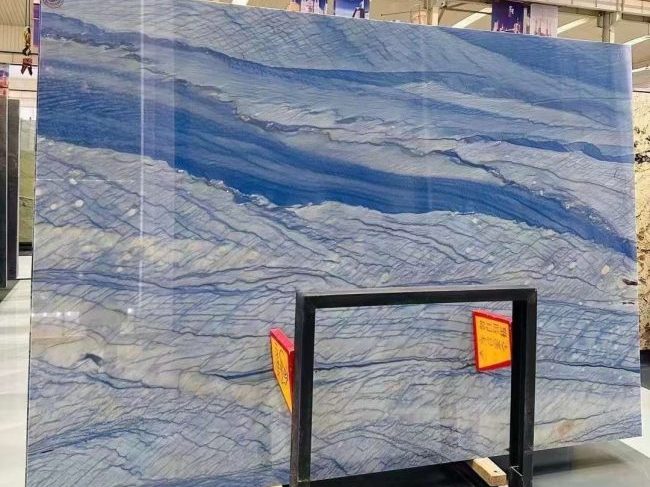


Resumo RápidoA useful stone quotation starts with a complete RFQ package. Buyers should provide the project application, material or visual direction, dimensions or drawings, quantity, thickness, finish, fabrication requirements, visible edges and openings, quality expectations, packing requirements, destination, requested trade scope and schedule information that is currently known. Information that is still preliminary should be clearly marked as preliminary. The objective is not to make the buyer prepare final shop drawings before asking for a price; it is to give the supplier enough evidence to price the same scope that competing suppliers are being asked to quote.
What Information Should a Buyer Provide Before Requesting a Stone Quote?
Before requesting a natural stone quotation, provide enough information for the supplier to understand what is being supplied, how it will be fabricated, how much is required and where the supplier’s commercial responsibility ends.
For most B2B stone projects, the RFQ package should identify the project application, material or visual target, relevant dimensions, quantity, thickness, finish, fabrication details, drawings where available, packing expectations, destination and requested commercial scope.
The buyer does not need to wait until every project detail is final. Early-stage quotations are normal. However, uncertain information should be identified as preliminary so that assumptions do not silently become production requirements later.
Lista de Verificação de Aquisição Direta
- Project type and stone application
- Material name or visual / performance direction
- Dimensions, drawings or enough geometry for quantity takeoff
- Quantity, BOQ or piece schedule
- Thickness and surface finish where known
- Edges, miters, returns, joints, openings and special fabrication
- Visual approval requirements for natural stone
- QC and pre-shipment evidence expected
- Packing requirements
- Destination and requested commercial / trade scope
- Required schedule or project milestone where relevant
- Clear identification of all preliminary information
Why Incomplete RFQs Produce Quotes That Cannot Be Compared
A quotation total is meaningful only when the scope behind it is understood.
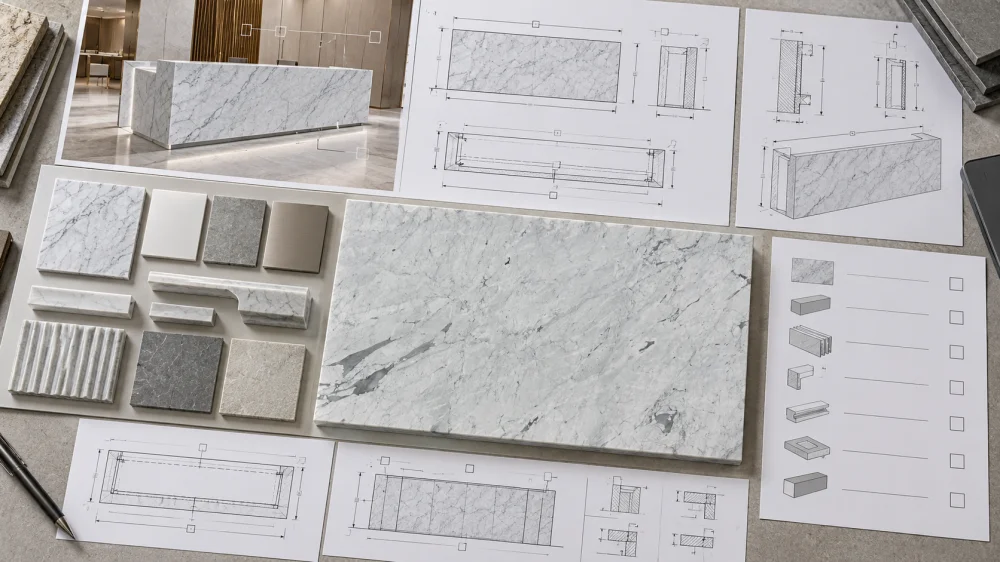
Imagine that three suppliers receive only a material name and a total square-meter quantity. Supplier A may assume standard tiles. Supplier B may include cut-to-size pieces and polished edges. Supplier C may include miters, cutouts, numbered pieces and reinforced export packing.
The three prices may look very different, but they are not actually quotations for the same supply package.
This is one reason stone quotation requirements should be treated as procurement controls rather than administrative paperwork. A stronger RFQ reduces hidden assumptions before the buyer begins comparing prices.
1. Start with the Project Application and Scope
The first requirement is simple: tell the supplier what the stone is for.
A kitchen island, hotel lobby floor, bathroom vanity, exterior paving package and bookmatched feature wall can all use natural stone, but their fabrication and approval requirements are different.
The RFQ should therefore identify the application and the scope boundary. For example, clarify whether the supplier is being asked to quote raw slabs, cut-to-size material, fully fabricated countertops, wall panels, stairs, custom furniture or another finished stone package.
For multi-material or multi-area projects, a simple room or application schedule can prevent major ambiguity.
2. Define the Material—or Define the Selection Problem
If the material is already selected, provide its commercial name and any approved reference information available.
If it is not selected, do not force an arbitrary stone name simply to obtain a quotation. Instead, describe the requirement: desired color family, visual movement, application, finish direction and any performance or maintenance considerations that materially affect selection.
Natural stone varies from slab to slab. A website image or small sample can establish a direction, but it does not automatically define the exact material that will later be fabricated.
For larger sourcing decisions, CENTURY STAR’s guide on sourcing natural and engineered stone for architectural projects explains why application, visual expectations, fabrication, QC and logistics should be treated as one coordinated procurement process.
3. Provide Dimensions, Quantity and Drawings at the Right Level
For standard products, dimensions and quantities may be enough to begin quotation. For custom work, drawings become much more important.
The supplier needs sufficient geometry to understand what components are being priced. This can include plans, elevations, sections, schedules, sketches or CAD/PDF drawings depending on the stage of the project.
If final fabrication drawings do not yet exist, clearly mark preliminary dimensions and unresolved details. A supplier can often price from design-stage information, but quotation assumptions should remain visible.
CENTURY STAR’s guide to drawings required for a stone fabrication quotation goes deeper into plans, elevations, sections, edges, openings, stone schedules and the distinction between quotation drawings and production drawings.
Quantity Should Be More Specific Than a Total Area When Possible
A single total square-meter figure may be sufficient for an early material inquiry, but it is weak input for a fabricated project quotation.
Where available, provide a BOQ, piece schedule, room schedule or drawing-based quantity breakdown. This helps the supplier distinguish large panels from small pieces, identify repeated components and understand whether the stated quantity includes spares or additional material.
4. State Thickness, Finish and Visible Surface Requirements
Thickness and surface finish directly affect what the supplier is being asked to quote, so these should be included whenever they are already specified.

If they remain undecided, say so. The quotation can then identify the assumption used rather than presenting it as a confirmed specification.
Visual expectations should also be communicated for natural stone. A buyer may need consistent background tone across a hotel bathroom package, sequential slabs for a wall, or deliberate vein movement across a kitchen island.
The supplier cannot price or reserve material intelligently if those requirements appear only after the quotation has been approved.
5. Describe Fabrication, Not Just Finished Dimensions
Two components with the same outside dimensions may require very different processing.
The RFQ should identify fabrication details that materially affect production, including where applicable:
- finished or exposed edges;
- miters and waterfall joints;
- laminated or built-up edges;
- sink, cooktop or fixture openings;
- furos para torneiras e acessórios;
- returns and backsplashes;
- curves or special-shaped pieces;
- waterjet or decorative cutting;
- piece numbering or sequence requirements;
- dry-layout or pattern-control requirements.
If these details are unknown, the quotation should state which standard assumption is being used. Otherwise, a low initial price can become a series of additions later.
6. Tell the Supplier What Must Be Approved Before Production
A strong RFQ should also establish the expected approval path.
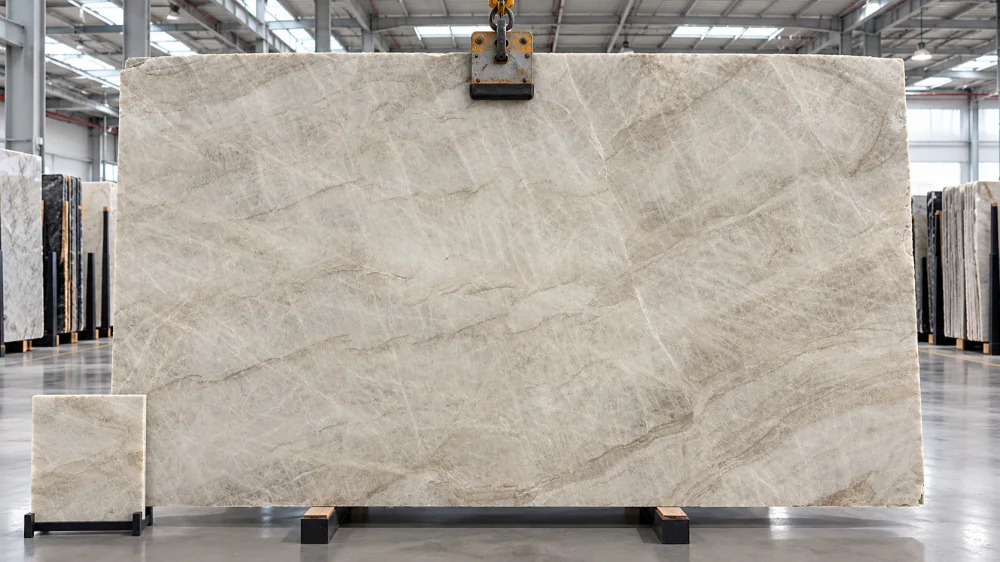
For highly variable natural stone, the buyer may require current slab photographs, slab numbering or a video review before material is released for fabrication. For custom pieces, shop drawings may require approval after dimensions are finalized. For visually sensitive work, a cutting layout or dry-lay review may also be appropriate.
The exact approval process depends on the order, but it should not be invented after production begins.
Approval Gate
The quotation should separate what is priced now from what still requires approval before production. Examples include final slab selection, final shop drawings, cutting layouts, finish samples or revised quantities. This prevents a preliminary RFQ assumption from silently becoming a production instruction.
7. Define the QC Evidence You Expect
“Good quality” is not a useful RFQ requirement by itself. The buyer should identify the evidence needed to confirm that the order matches the agreed specification.
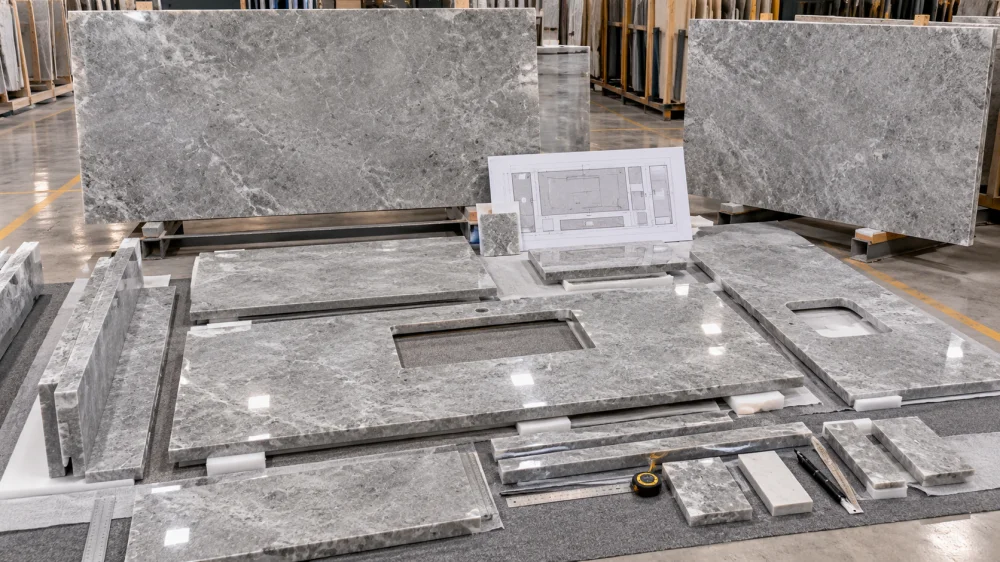
Depending on the project, evidence may include current slab photographs, finish references, dimensional checks, edge and cutout photographs, piece-number records, dry-layout photographs or videos, packing photographs and pre-shipment inspection records.
This does not mean every order needs every type of evidence. A standard tile shipment and a complex bookmatched wall require different QC controls.
When comparing potential suppliers, CENTURY STAR’s guide on how to evaluate a natural stone supplier and fabrication factory shows why current material evidence, marked drawings, project-relevant production evidence, QC records and packing examples are more useful than generic factory claims.
Procurement Stage Control: What to Confirm and What Evidence to Request
| Etapa de Aquisição | What to Confirm | Evidências a Solicitar |
| RFQ Issue | Project scope, material, dimensions, quantity, fabrication and commercial basis are identifiable. | RFQ package, BOQ, drawings and written scope notes. |
| Supplier Review | Supplier has reviewed missing information rather than silently assumed it. | Clarification list, marked drawing or written assumptions. |
| Material Approval | Quoted material and actual production material are connected. | Current slab, batch, sample or finish evidence where relevant. |
| Drawing / PO | Final commercial scope and production information are aligned. | Approved PO, specification, shop drawings and revision record where applicable. |
| Production / QC | Critical dimensions, finish, edges, openings and visual requirements are being controlled. | Inspection records, measurements, photographs, videos or dry-layout evidence appropriate to the order. |
| Packing / Shipping | Products are protected and commercial delivery scope is understood. | Packing photographs, crate identification, shipment information and applicable commercial documents. |
8. Include Packing Requirements Before the Quote Is Final
Packing should not be treated as a minor decision made after fabrication.
Large slabs, countertops with openings, thin wall panels, stairs and small cut-to-size tiles may require different support and protection methods. Packing also affects shipment volume and handling.
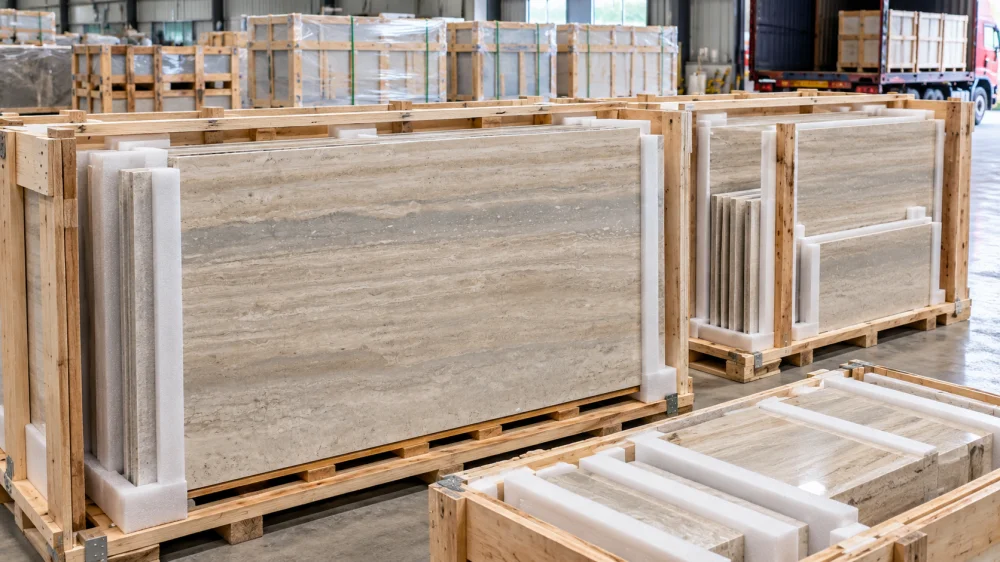
Where export packing is part of the supplier’s scope, the RFQ should state the expected destination and any known handling constraints so that the quotation does not assume a packaging method unsuitable for the product or transport route.
9. Destination and Trade Scope Are Part of the Quotation Requirements
A buyer requesting international delivery should state the destination as precisely as the current project allows and identify the requested commercial basis.
EXW, FOB, CFR, CIF, DDP and other trade arrangements do not represent the same seller responsibility. Buyers should therefore avoid comparing an EXW fabrication quotation directly with a delivered quotation without first normalizing the scope.
If the buyer does not yet know which trade term is preferred, request separate material/fabrication and logistics options rather than leaving delivery responsibility undefined.
10. State the Schedule—but Do Not Force a False Lead-Time Promise
If the project has a required delivery milestone, tender deadline, site sequence or approval date, include it in the RFQ.
However, a supplier should not be expected to guarantee a final production date before material availability, drawings, approval requirements and quantity are sufficiently defined.
A useful quotation can distinguish estimated timing assumptions from the later confirmed production schedule.
What Should the Supplier Return with the Quotation?
The buyer’s RFQ is only half of the information exchange. The quotation itself should show whether the supplier actually reviewed the request.
A useful response should make clear:
- material and finish being quoted;
- quantities and unit basis;
- fabrication included;
- packing included;
- commercial / trade scope;
- important exclusions;
- assumptions based on preliminary information;
- items still requiring clarification or approval;
- quotation validity where stated;
- next information required before order or production.
A supplier that asks precise questions may be demonstrating stronger project review than one that immediately gives a final number without asking about material, drawings, quantity, fabrication or destination.
From Quotation to Purchase Order: Close the Assumptions
The RFQ package and quotation are not production authorization.
Before a purchase order moves into manufacturing, assumptions made during the quotation stage should be reviewed and either confirmed, revised or replaced by final approved information.
This may involve final slab approval, revised quantity, approved shop drawings, confirmed cutouts, finish confirmation, packing requirements and delivery instructions.
The purchase order should reference the agreed specification and current documents rather than relying only on email history or verbal discussions.
Common Red Flags in a Stone Quotation
- Immediate final pricing from almost no project information: ask what assumptions were used.
- No drawing questions on complex custom work: verify that the fabrication scope has actually been reviewed.
- Material description is vague: clarify what stone, grade, finish or visual basis is being quoted.
- Natural stone is promised to be perfectly identical: request actual material evidence instead.
- Packing is not mentioned: confirm whether it is included and appropriate for the product.
- Freight is quoted without a clear destination or commercial basis: ask what route and responsibility the number represents.
- Important scope remains verbal: convert final material, dimensions, finish, drawings and commercial decisions into controlled written records.
Buyer Checklist Before Sending the RFQ
- Define the stone application and supplier scope.
- State the material or visual direction.
- Attach the latest available dimensions, drawings and BOQ.
- Identify quantities and any spare requirements.
- State thickness and finish if already specified.
- Show edges, openings, miters, returns and special fabrication.
- Identify what is preliminary.
- State which material, drawing or visual approvals will be required.
- Define relevant QC evidence.
- State packing expectations where applicable.
- Provide destination and requested quotation scope.
- Include project schedule information that materially affects the order.
- Ask the supplier to list assumptions, exclusions and clarification questions.
Conclusões práticas
Good stone quotation requirements do not mean sending every project document you possess. They mean giving the supplier enough controlled information to price the correct material, quantity, fabrication and delivery scope—and clearly marking what is still unresolved. A strong RFQ creates a traceable path from quotation to material approval, drawing approval, purchase order, production, QC, packing and shipment. That makes supplier comparisons more reliable and reduces the chance that missing information becomes an expensive change after the order is placed.
Perguntas Frequentes
1. What information is essential when requesting a stone quotation?
At minimum, provide the project application, material or visual direction, dimensions or available drawings, quantity, required fabrication scope and destination or commercial scope. Include thickness, finish, openings, edges and packing requirements when these are already known.
2. Do I need final shop drawings before requesting a stone quote?
No. Preliminary architectural or design drawings can often support an early quotation. However, uncertain dimensions and details should be clearly identified, and the quotation should not be treated as final production approval until the relevant fabrication information is confirmed.
3. Can I request a quote if the natural stone has not been selected yet?
Yes. Explain the application, visual target, finish direction and other relevant requirements, and ask the supplier to quote or propose suitable options. The quotation should identify the material assumption used.
4. Why should I provide a BOQ or piece schedule instead of only total square meters?
A BOQ or piece schedule helps the supplier understand component sizes, quantities and fabrication differences. Total area alone can hide large panels, small repeated pieces, special shapes, openings and other work that affects material use and processing.
5. Should QC requirements be included in the RFQ?
For project orders, it is useful to state the evidence that matters before shipment. Depending on the order, this may include slab approval, dimensional checks, finish review, edge and cutout inspection, dry-layout evidence, piece numbering or packing photographs.
6. Why does the supplier need the delivery destination before quoting?
The destination affects packing and logistics planning and is necessary when freight or delivered commercial terms are requested. Without a destination and defined trade scope, delivered quotations may not be commercially comparable.
7. What if some project information is still uncertain?
Mark it as preliminary and ask the supplier to state the assumption used for pricing. The assumption should then be closed before production rather than silently carried into the purchase order or shop drawings.
8. How can I compare quotations from different stone suppliers fairly?
Normalize the scope first. Confirm that each supplier is quoting the same material basis, quantity, thickness, finish, fabrication, QC, packing and delivery responsibility. Then compare the commercial totals, assumptions, exclusions and evidence rather than comparing unit prices alone.
Referências
- Natural Stone Institute — Dimension Stone Design Manual 2024, for general natural-stone design, fabrication and installation guidance.
- International Chamber of Commerce — Incoterms® 2020, for internationally recognized trade terms defining selected buyer and seller delivery responsibilities, costs and risks.