


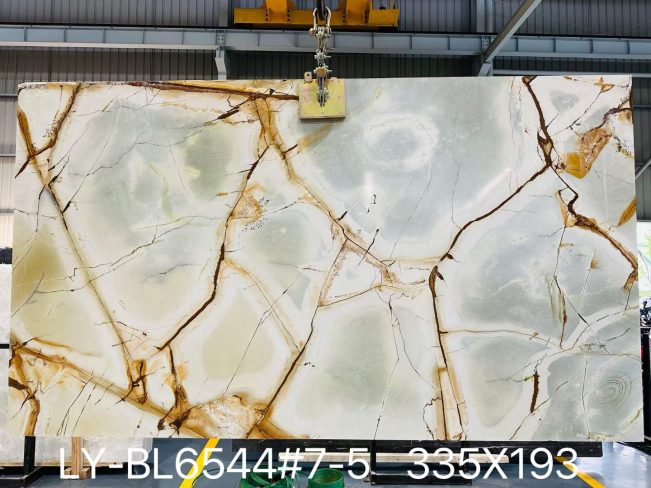
1. Quick Overview
The global stone industry is shifting towards “Lightweight Luxury.” This article explores the sophisticated processing technology behind extremely thin stone compound slabs. By combining natural stone aesthetics with advanced backings like aluminium honeycomb or glass fibre, these products reduce weight by up to 70%, slash logistics costs, and meet stringent EU/US building standards.

2. The “Heavy” Problem with Natural Stone
Imagine you are an architect in London or a developer in New York. You love the timeless elegance of Italian Carrara marble, but your structural engineer is having a nightmare about the building’s load-bearing capacity. Traditional 20mm slabs are heavy, fragile, and expensive to ship across the Atlantic.
This is where the magic of the compound slab comes in. It’s the “iPad Air” of the masonry world—thinner, stronger, and significantly smarter.
3. User Pain Points in Stone Export
-
Logistics Nightmares: Traditional stone is heavy. Shipping costs often rival the material cost itself, especially with rising fuel surcharges.
-
Structural Limitations: High-rise buildings or renovation projects often cannot support the dead load of thick natural stone cladding.
-
Fragility Issues: Thinly cut natural stone (under 10mm) without reinforcement is notoriously prone to cracking during transit and installation.
4. Technical Solutions & Recommendations
To solve these issues, the industry has perfected the processing technology for ultra-thin composites:
-
Reinforced Substrates: Utilising aluminium honeycomb or ceramic backings to provide structural integrity to 3mm-5mm stone veneers.
-
Vacuum High-Pressure Bonding: Ensuring zero delamination by using industrial-grade, low-VOC adhesives under high-pressure conditions.
-
Precision Calibration: Using multi-head gauging machines to ensure the final compound slab has a thickness tolerance of less than ±0.5mm.
5. Core Definition: What are Stone Compound Slabs?
A compound slab is a composite material consisting of a thin layer of natural stone (typically 3mm to 7mm) bonded to a functional backing material. In the UK and European markets, these must adhere to EN 1469 standards for natural stone products.
The Anatomy of a High-Performance Slab:
-
The Face: Natural Marble, Granite, or Limestone.
-
The Core: Aluminium honeycomb, glass fibre mesh, or high-density ceramic.
-
The Bond: Epoxy resins or polyurethane adhesives that meet REACH regulations for chemical safety.
| Feature | Traditional Stone (20mm) | Compound Slab (12mm Total) |
| Weight | ~55 kg/m² | ~15-20 kg/m² |
| Flexural Strength | Moderate | Very High |
| Installation Speed | Slow (requires heavy anchors) | Fast (adhesive or light clips) |
| Eco-Impact | High Resource Consumption | High Resource Efficiency |
6. Processing Technology: Step-by-Step
The manufacturing of a high-quality compound slab is a feat of engineering that requires precision at every stage.

Stage 1: Block Selection and Ultra-Thin Slicing
Not every block is suitable. For thin processing technology, the stone must have minimal internal micro-fissures. Modern diamond wire saws or circular saws with laser guidance slice the stone into “skins.”
Stage 2: Substrate Preparation & Bonding
The choice of substrate depends on the application. For external facades in the UK, aluminum honeycomb is preferred for its fire rating and rigidity. The bonding process occurs in a dust-free environment where temperature and humidity are controlled to ensure the compound slab does not warp.
Stage 3: Cutting and Edge Treatment
Unlike solid stone, cutting a compound slab requires specialized water-jet or bridge saw blades to prevent chipping the stone veneer while cutting through the tougher backing.
7. European & American Market Insights
The demand for compound slabs is skyrocketing in the West due to the Circular Economy initiatives. By using 1 m³ of raw stone to produce 3x the surface area of traditional slabs, manufacturers are significantly reducing the environmental footprint.

Furthermore, low-VOC (Volatile Organic Compounds) adhesives are no longer optional. To enter the US market, products often need to be “GreenGuard” certified, ensuring they don’t off-gas harmful chemicals in luxury residential interiors.
Style & Usage Suggestions:
-
High-Rise Facades: Use honeycomb-backed granite for wind resistance.
-
Luxury Yacht Interiors: Every kilogram counts; ultra-thin marble compound slabs are the industry standard here.
-
Kitchen Splashbacks: Large-format thin slabs provide a seamless look without the weight of a full-thickness stone.
8. Case Study: The London Penthouse Project
A recent renovation of a Victorian-era penthouse in London required marble walls in the master ensuite. The original floor joists could not support 20mm marble. By utilising processing technology for 5mm marble bonded to 6mm ceramic backings, the team reduced the weight by 60%. The project was completed ahead of schedule because the compound slabs were easier to manoeuvre in the lift.
9. Conclusion
The evolution of processing technology has transformed stone from a heavy, cumbersome material into a versatile, high-tech solution. For exporters and developers, the compound slab represents the perfect intersection of aesthetic beauty and mechanical performance. It reduces shipping costs, simplifies installation, and meets the rigorous safety standards of the modern world.
Are you looking to integrate lightweight stone into your next project?
Explore our range of compound slabs at Century Star or contact our technical team for bespoke specifications.
10. FAQ (Frequently Asked Questions)
Q1: Can compound slabs be used for outdoor flooring?

Yes, provided the substrate is suitable (like high-density ceramic) and the stone is treated with the correct sealants to handle freeze-thaw cycles common in Northern Europe.
Q2: Are these slabs fireproof?
Most compound slabs using aluminum honeycomb backings meet Class A fire ratings, making them ideal for commercial high-rise cladding.
Q3: How do you handle the edges?
We typically use “L-shaped” mitered edges or edge-banding with matching natural stone strips to give the appearance of a solid block.
Q4: Is the bond between the stone and backing permanent?
When using high-quality processing technology and epoxy resins, the bond strength often exceeds the internal strength of the stone itself.
Q5: How do I clean a compound slab?
Treat the surface just like natural stone. Use pH-neutral cleaners and avoid harsh acids, especially on marble surfaces.
Q6: What is the maximum size available?
Depending on the stone type, we can produce compound slabs up to 1500 mm x 3000 mm.