


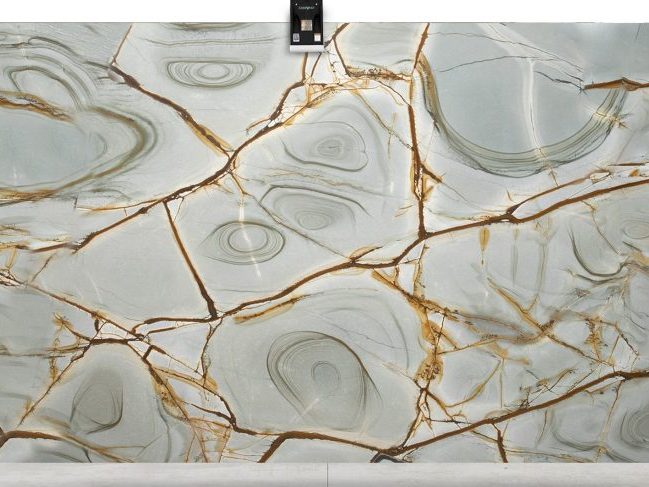
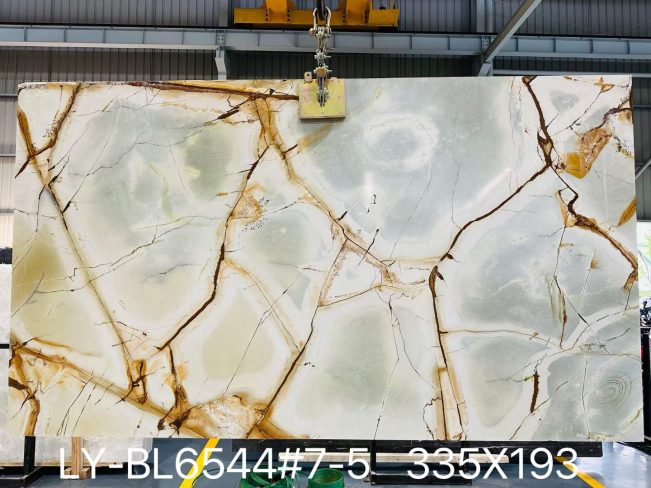
Résumé rapide
White marble is often the right choice for feature wall projects in North America when the design calls for brightness, architectural focus, and a more timeless luxury effect than darker or busier materials can provide. It works best in projects where slab tone, panel scale, lighting, and full-room coordination are considered early. A successful white marble feature wall should feel calm, premium, and spatially uplifting rather than cold, fragmented, or overly dramatic.

Feature walls now play a larger role in North American interior design than they did a decade ago. In premium residential spaces, they often define the visual hierarchy of a living room, entry, fireplace zone, or stair hall. In hospitality and developer-led projects, they help establish atmosphere immediately, often before furniture or decorative elements have a chance to speak. Because of that, the material chosen for a feature wall is rarely just decorative. It shapes how the whole space is perceived.
White marble remains one of the strongest options when the goal is to create a feature wall that feels elevated without becoming visually heavy. It can make a room feel brighter, more expansive, and more architecturally refined. At the same time, not every project benefits from it. Some interiors need more warmth, more depth, or more textural restraint than white marble naturally brings. That is why the real question is not whether white marble is beautiful. The real question is when it is the right design decision.
This is where a good feature wall stone guide becomes useful. White marble should not be selected only because it is luxurious in principle. It should be chosen when its brightness, undertone, movement, and panel logic support the room’s emotional direction and project reality. The most successful walls are not simply made from expensive slabs. They are made from correct design decisions.
Why Designers Still Choose White Marble for Feature Walls
Designers usually choose white marble when they want a feature wall to introduce light, clarity, and a premium sense of order. Compared with darker stone, white marble often creates stronger contrast without making the room feel smaller. Compared with more heavily textured stone, it often reads as cleaner and more timeless. That balance is especially valuable in interiors where the wall should be the focal point but not the entire story.
Another reason is visual hierarchy. White marble can act like architecture rather than decoration when it is used well. It can define a fireplace wall, strengthen a double-height entry, or organize a living room composition without needing extra ornament. This is one of the reasons it remains such a strong choice in both contemporary and transitional North American interiors.
Owners also respond to it because it feels like a material investment rather than just a finish. Even buyers who do not know stone categories in detail usually understand the emotional value of white marble. It signals permanence, refinement, and a higher level of design intention. That said, it only delivers those qualities fully when the room around it supports them.
When White Marble Is Usually the Right Choice
When the Room Needs More Light and Lift
White marble is often an excellent choice when a space needs visual brightness without relying only on paint or lighting. In entry walls, living room focal walls, and fireplace surrounds, it can lift the center of the composition and help the whole room feel more open.
When the Design Direction Is Quiet Luxury
If the project is aiming for understated luxury rather than high contrast or heavy mood, white marble often fits naturally. It can feel expensive and calm at the same time, especially when the slab has controlled movement and the room avoids too many competing materials.
When the Wall Needs Architectural Clarity
White marble works especially well when the wall should feel like part of the architecture rather than a decorative insert. Large-format panels with clean terminations can make the wall feel monolithic and resolved.
When the Palette Around It Is Layered but Restrained
White marble often performs best when paired with oak, walnut, warm whites, pale greiges, soft blacks, bronze, or brushed brass. In these palettes, it acts as a bright anchor rather than a harsh contrast element.
When White Marble May Not Be the Best Answer
White marble is not always the strongest choice. In interiors that already feel cold, very minimal, or overly high-contrast, it can push the room too far toward hardness unless the undertone is softened. In some spaces, a warm beige marble, greige stone, or even quartzite may create a more comfortable and more project-correct result.
It may also be less effective when the project needs a stronger sense of depth or mood. Some rooms benefit from darker material gravity or more textural natural character. In those cases, white marble can feel too clean or too visually polite.
This does not reduce its value. It simply means white marble works best when the project wants brightness, clarity, and premium calm. The more accurately that goal is defined, the better the final wall usually becomes.

Ce qui fonctionne le mieux en Amérique du Nord
In North America, the strongest white marble feature walls usually lean toward softer, more balanced whites rather than very blue-white or extremely sharp slab families. This is because many premium interiors in this market now mix warm wood, layered neutral upholstery, brushed metals, and softer natural light. White marble that is too cold can feel disconnected in those settings.
Large-format slab application also tends to work best. Designers in this region usually want fewer joints, cleaner vertical reads, and a wall that feels more like one architectural gesture than a collage of stone pieces. White marble performs especially well when it is allowed that kind of scale and simplicity.
Another regional preference is livable refinement. North American buyers often want a wall that looks exceptional in photographs but still feels welcoming in real life. That usually means controlled movement, warm or neutral undertones, and integration with the rest of the palette rather than extreme drama.
How to Judge Whether White Marble Fits the Space
| État du projet | Why White Marble Works | À quoi faire attention | Meilleure réponse de design |
|---|---|---|---|
| Living room focal wall | Adds brightness and premium hierarchy | Too much movement can overpower furniture | Use calm slabs with strong full-wall readability |
| Fireplace feature wall | Creates architectural emphasis and timeless luxury | Poor joint planning weakens the effect | Use large panels and disciplined edge logic |
| Entry wall | Delivers immediate light and first-impression value | Too-cool undertones can feel severe | Choose softer white or gray-white tones |
| Hospitality-inspired interior | Feels premium and broadly recognizable | Overly graphic slabs can feel generic at scale | Favor elegant, controlled movement |
| Warm residential palette | Provides contrast without darkness | Crisp white may feel too sharp | Use warm white or balanced neutral white marble |
Logique des concepteurs : pourquoi ils la spécifient
Designers usually specify white marble for feature walls when they want the room to feel more resolved rather than more decorated. A good wall is not simply noticeable. It gives structure to the entire composition. White marble can do that especially well because it combines light reflectivity with enough natural movement to avoid flatness.
They also choose it when they want flexibility across style categories. In one room, white marble can feel contemporary and sculptural. In another, it can feel classic and softly luxurious. This flexibility is commercially useful because it supports broad appeal while still feeling premium.
Another reason is client perception. Owners often understand white marble immediately. It carries emotional familiarity and a strong sense of prestige. That makes it easier to justify as a focal investment, especially when the project needs one clearly premium gesture.

Quels tons, mouvements et finitions fonctionnent généralement le mieux
Soft White and Gray-White
Ces dalles fonctionnent généralement mieux en Amérique du Nord, car elles équilibrent la luminosité avec une ambiance plus vivable et plus riche en couches. Elles s'intègrent mieux dans des palettes résidentielles chaudes que les dalles blanches très froides.
Veinage contrôlé
Un mouvement large et élégant ou un flux plus directionnel fonctionne généralement mieux qu'un veinage dramatique très fragmenté. Les murs d'accentuation sont vus de loin, donc la composition sur toute la hauteur du mur compte davantage que le spectacle vu de près.
Finition polie
Le marbre blanc poli peut être très puissant sur les murs d'accentuation, car il accentue la profondeur et confère au mur une présence plus lumineuse. Il convient souvent à des intérieurs plus formels ou inspirés de l'hôtellerie.
Honed Finish
Le marbre blanc brossé paraît généralement plus doux et plus architectural. Il fonctionne particulièrement bien dans des projets résidentiels modernes chaleureux où le mur doit avoir une allure actuelle et sobre plutôt que brillante.
Réalité du projet : le détail compte toujours
Même la bonne dalle peut échouer si le détail est faible. La rupture des panneaux, les découpes pour cheminées, les interruptions de rayonnages, les transitions d'angles et les lignes de plafond influencent tous l'impression finale du mur. Le marbre blanc, en particulier, révèle rapidement une composition faible, car l'œil le perçoit comme une surface nette et intentionnelle.
La logique des joints doit être résolue tôt. Le mur ne devrait pas dépendre de l'hypothèse que toutes les ruptures de panneau disparaîtront visuellement. Tout comme les projets d'îlots ou les panneaux de douche, les murs d'accentuation bénéficient d'une planification soignée. L'emplacement des joints peut faire la différence entre un luxe architectural et un revêtement d'apparence coûteuse.
C'est aussi pourquoi les meilleurs murs en marbre blanc semblent souvent simples. Cette simplicité résulte généralement de décisions plus difficiles prises plus tôt, et non de l'absence de réflexion conceptuelle.
Comment équilibrer la valeur design, la perception de l'entretien et le budget
Le marbre blanc est souvent choisi parce que son rendu visuel est exceptionnellement élevé. Il peut transformer une pièce plus rapidement que beaucoup d'autres matériaux. D'un point de vue design, il apporte luminosité, luxe et clarté focale en un seul geste. Du point de vue du client, il est souvent immédiatement perçu comme un choix premium.
En même temps, les prescripteurs et acheteurs doivent rester réaliste. La valeur n'est pas seulement dans la dalle elle-même, mais dans la disposition, le détail, la qualité de pose et la manière dont le matériau soutient l'espace. Dans certains projets, cela fait que le marbre blanc vaut entièrement le surcoût. Dans d'autres, une autre catégorie de pierre pourrait offrir un résultat plus équilibré pour le budget et la palette.
La meilleure utilisation du budget n'est pas toujours la dalle la plus célèbre. C'est généralement la dalle qui convient le mieux au projet et qui peut être réalisée proprement à l'échelle prévue.
Erreurs courantes à éviter
La première erreur est de choisir la dalle la plus lumineuse plutôt que la bonne dalle. Le marbre blanc devient luxueux grâce à l'équilibre, pas seulement par sa blancheur. La deuxième erreur est d'ignorer la teinte sous-jacente. Une dalle froide peut sembler inappropriée très vite dans une pièce construite autour de bois plus chaud, de tissus d'ameublement plus doux et d'accessoires en bronze ou laiton.
Une autre problématique courante est de sélectionner un mouvement trop dramatique par rapport à l'échelle du mur. Ce qui semble impressionnant dans une carrière de dalles peut sembler agité une fois installé verticalement sur une grande surface. Les acheteurs sous-estiment parfois aussi à quel point la disposition des panneaux influence le résultat. Même un excellent marbre blanc peut perdre beaucoup de son impact si les joints et les interruptions ne sont pas bien gérés.
Enfin, certains projets traitent le mur comme s'il existait séparément de la pièce. Un mur d'accentuation ne fonctionne à un niveau vraiment premium que lorsque les meubles, la lumière, le sol et le mur lui-même soutiennent tous la même direction de design.

Comment CENTURY STAR accompagne les projets de murs d'accentuation en marbre blanc
Pour les acheteurs venant de Chine, l'accompagnement est essentiel, car les murs d'accentuation en marbre blanc nécessitent plus que de belles dalles brutes. Ils exigent un jugement sur les dalles, une réflexion sur toute la surface, une coordination de fabrication et une évaluation pratique de la manière dont le matériau choisi se comportera une fois transformé en surface architecturale finie. CENTURY STAR peut accompagner ce processus en aidant les acheteurs à comparer les orientations du marbre blanc, à évaluer la pertinence des dalles pour l'échelle du mur et à réfléchir à la logique des panneaux, aux terminaisons et à l'harmonie visuelle globale.
Pour les designers, promoteurs, architectes et acheteurs de projets haut de gamme, cet accompagnement est essentiel, car les meilleurs murs d'accentuation en marbre blanc ne sont pas improvisés. Ils résultent généralement de décisions antérieures et meilleures concernant l'ambiance, l'échelle, le contrôle des motifs et la manière dont le mur doit réellement fonctionner à l'intérieur de la pièce.
FAQ
1. Quand dois-je utiliser du marbre blanc pour un mur d'accentuation ?
Le marbre blanc est généralement un choix judicieux lorsque le projet requiert luminosité, accentuation architecturale et un effet premium intemporel sans la lourdeur visuelle des pierres plus foncées.
2. Le marbre blanc est-il une bonne option pour les intérieurs de luxe en Amérique du Nord ?
Oui. Cela peut fonctionner extrêmement bien dans les intérieurs de luxe, surtout lorsque le design privilégie une hiérarchie apaisante, des matériaux d'appui chauds et neutres, et une atmosphère visuelle plus spacieuse.
3. Quelles teintes de marbre blanc conviennent le mieux aux murs d'accentuation ?
Soft white, gray-white, and balanced neutral white marbles usually work best because they integrate more easily into common North American interior palettes.
4. Le marbre blanc est-il toujours meilleur que la pierre plus foncée pour un mur d'accentuation ?
No. It is better when the project needs light, clarity, and quieter luxury. Darker stone may still be stronger when the room needs more depth, contrast, or mood.
5. Les murs d'accentuation en marbre blanc doivent-ils être polis ou brossés ?
Both can work. Polished marble feels more luminous and formal, while honed marble often feels softer and more architectural. The best choice depends on the room style and lighting.
6. Quelle est l'erreur la plus fréquente lors de la spécification du marbre blanc pour un mur d'accentuation ?
Choosing a slab that is too cold or too dramatic for the room. Full-wall readability and undertone compatibility matter much more than isolated slab impact.
Note finale / Conseil pratique
En Amérique du Nord, le marbre blanc est généralement le bon choix pour les murs d'accentuation lorsque le projet valorise la luminosité, la hiérarchie et le calme intemporel. Il fonctionne mieux lorsque les concepteurs et acheteurs le considèrent comme une surface architecturale avec une véritable logique de panneaux et une discipline de palette, et non simplement comme une belle dalle.