



Resumen rápidoTo verify whether a stone factory can handle a complex project, do not judge only by machine ownership, factory size or attractive finished-project photographs. Verify whether the supplier can control the complete project chain: RFQ review, drawing revisions, material and slab approvals, production planning, fabrication evidence, staged QC, piece traceability, completed export packing and shipment handover. Complex-project capability is the ability to keep many related decisions controlled at the same time.
How Can Buyers Verify Stone Factory Capability for Complex Projects?
Test the factory as a project-delivery system, not only as a fabrication workshop. A supplier may be capable of producing one countertop, vanity or wall panel but still struggle with a hotel, villa, commercial interior or multi-material package that contains hundreds of related components, several drawing revisions, multiple natural-stone batches and phased deliveries.
For complex projects, the useful verification chain is:
RFQ Review → Technical Questions → Material / Slab Approval → Drawing Control → Production Planning → Fabrication Evidence → QC → Packing Allocation → Shipment Handover.
Lista de verificación de adquisición directa
- Give the supplier a representative project package, not only a product inquiry.
- Check whether the factory identifies missing information and technical interfaces.
- Verify how material approvals are connected to drawings and production pieces.
- Ask how drawing revisions are controlled after production begins.
- Request staged production and QC evidence rather than only final photographs.
- Check whether piece IDs remain traceable through packing and shipment.
- Verify how different rooms, areas or installation phases are allocated to crates.
- Confirm who takes responsibility when fabrication, material, packing or logistics involve different facilities.
Complex Project Capability Is Different From Basic Fabrication Capability
A factory can fabricate an accurate stone component and still be the wrong supplier for a complex project.
The reason is that project execution requires coordination between many systems:
- material sourcing and batch control;
- design drawings and shop drawings;
- piece schedules and quantities;
- slab allocation;
- fabrication sequencing;
- visual approvals;
- dimensional QC;
- replacement-piece control;
- packing by area or phase;
- shipping documentation and handover.
A supplier that performs one of those activities well is not automatically capable of controlling all of them together.
CENTURY STAR’s broader guide on evaluating a natural stone supplier and fabrication factory treats material access, drawings, fabrication, quality control, packaging and export coordination as parts of one delivery system. For a complex project, buyers need to verify whether those individual capabilities remain connected throughout the order.
Step 1 — Use a Real RFQ to Test the Supplier’s Project Understanding
A generic question such as “Can you make hotel stone?” proves very little.
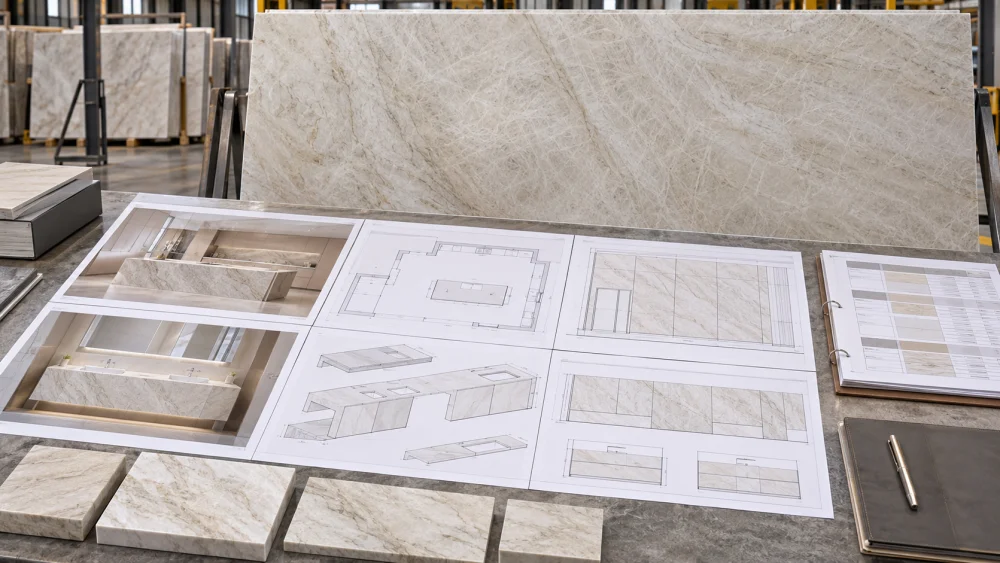
Instead, provide a representative RFQ package showing the type of information the factory will actually need to manage. Depending on the project, this may include plans, elevations, a BOQ or stone schedule, material direction, finish, quantities, typical details, openings, joints and destination requirements.
The first capability test is the supplier’s response.
Look for questions such as:
- Which drawing revision controls the quotation?
- Are the dimensions final or preliminary?
- Which stone areas require full-slab approval?
- Which pieces need dry layout or vein sequencing?
- Are fixture openings finalized?
- Are packing groups organized by room, floor or installation phase?
- Which requirements still need architect or contractor confirmation?
A supplier that asks relevant questions is demonstrating that the RFQ has been reviewed rather than merely priced.
En CENTURY STAR stone fabricator quotation drawing guide explains what plans, elevations, dimensions, openings, edges and scope information are useful at RFQ stage and why preliminary assumptions should not silently become production information.
Complex Project Capability Verification Table
| Procurement Stage | What to Confirm | Pruebas a solicitar | Risk if Missed |
| RFQ Review | Supplier understands scope, applications and unresolved information. | Clarification list, marked drawings or structured quotation assumptions. | Project is priced from incomplete or incorrect assumptions. |
| Material Approval | Approved samples or slabs can be linked to the required project areas. | Current slab photos, material IDs, sample approvals and area allocation. | Correct stone name is supplied but visual project consistency is lost. |
| Control de dibujos | One current production revision controls each component family. | Revision register, approved shop drawings and piece schedules. | Old dimensions or details enter fabrication. |
| Producción | Different component groups are planned and traceable. | Production plan, piece IDs, slab allocation or first-piece evidence. | Mixed batches, missing pieces or uncontrolled substitutions. |
| QC | Inspection points correspond to actual project risks. | Dimensional, finish, edge, opening, dry-layout and visual QC evidence. | Problems become visible only after packing or installation. |
| Packing / Shipment | Crates preserve project identity and installation sequence. | Packing list, crate allocation and completed closed-crate evidence. | Correct products arrive but cannot be located, sequenced or installed efficiently. |
Step 2 — Verify Material Control Across Multiple Areas
Complex natural-stone projects often involve more than selecting one attractive slab.
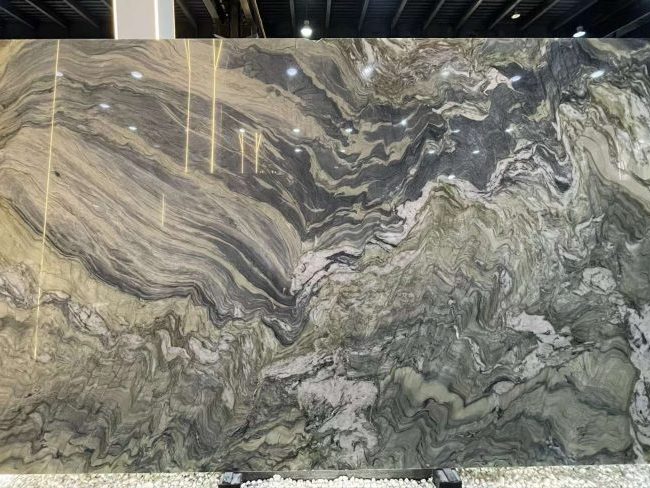
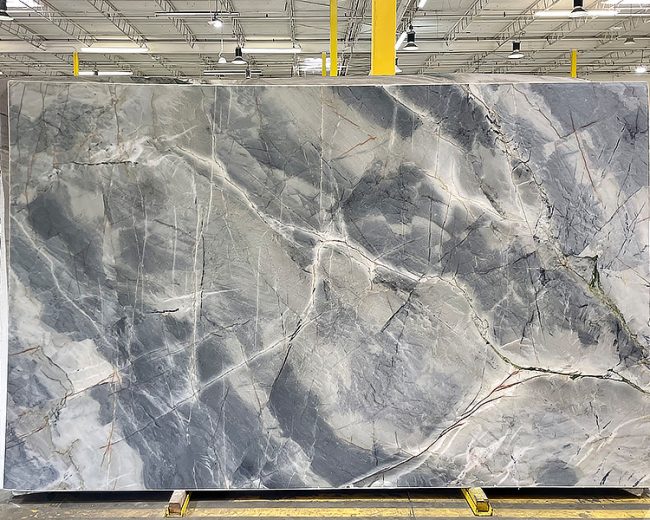
A hotel may require Marble across the lobby and bathrooms, Granite for selected heavy-use areas and Quartzite for statement counters. A villa can combine kitchen countertops, bathroom packages, stairs, fireplaces and custom stone furniture.
The supplier should therefore be able to distinguish among:
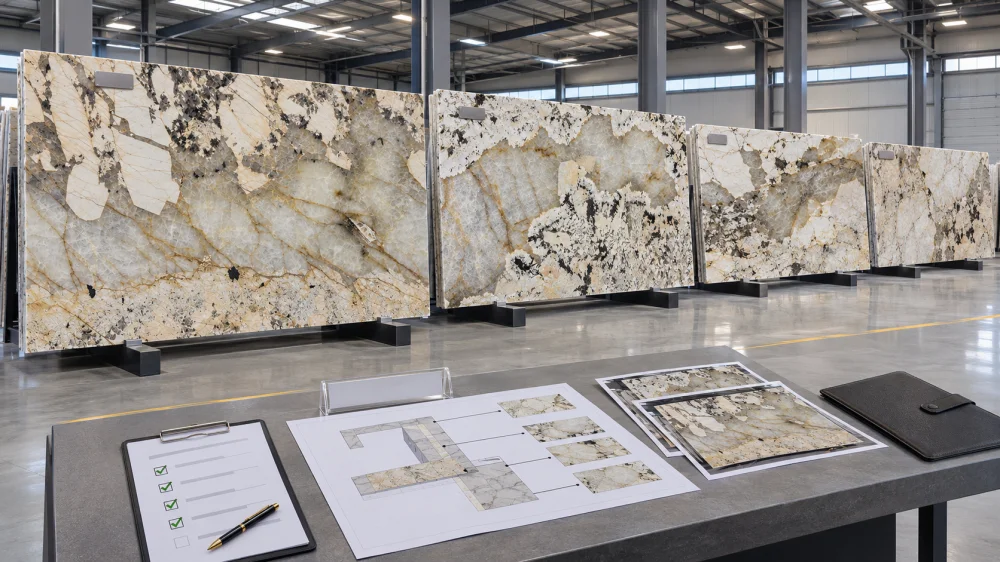
- reference image;
- approved sample;
- current slab or batch;
- reserved project material;
- allocated slab;
- fabricated component;
- replacement or spare material.
Ask how those identities are maintained as the project moves from material approval into fabrication.
For highly variable materials, full-slab or batch evidence should be connected to the room, elevation or component family for which it was approved. A supplier that simply states “same stone” without showing how natural variation will be grouped has not demonstrated project-level control.
Step 3 — Test Drawing and Revision Control
Complex projects rarely stay on one drawing revision from quotation to shipment.
Cabinet dimensions change. Fixture selections are finalized. Openings move. Wall elevations are revised. Site conditions may require a new joint or component split.
A capable project supplier should be able to explain:
- which document currently controls production;
- how superseded drawings are withdrawn;
- how revision changes are communicated to the factory;
- how affected pieces are identified;
- how already fabricated pieces are handled when a revision occurs;
- who approves the revised information before production resumes.
The objective is not paperwork for its own sake. It is preventing an outdated drawing from becoming a finished stone component.
Project Approval Gate
Ask the supplier to show how one real or anonymized component can be traced from drawing revision → material/slab reference → piece ID → QC evidence → crate allocation. If those records cannot be connected, project control may depend too heavily on informal communication.
Step 4 — Verify Production Planning, Not Only Production Capacity
“We can produce a large quantity” is not enough.
Complex project capability means maintaining approved quality while several different component groups move through production at the same time.
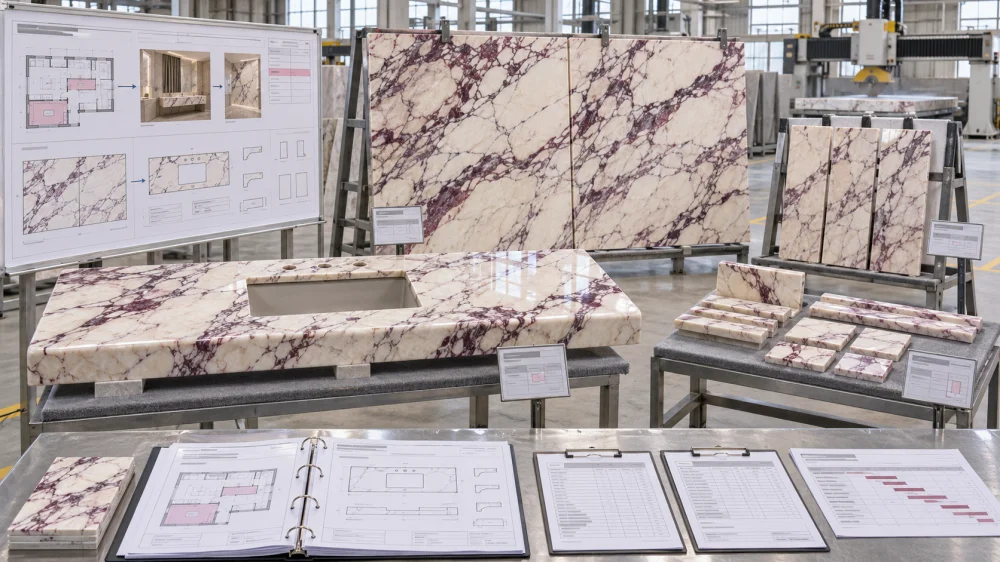
For example, one project may contain:
- large lobby wall panels;
- bathroom vanity packages;
- floor and skirting pieces;
- stairs;
- countertops;
- waterjet details;
- custom furniture.
The buyer should ask how the factory separates those packages and prevents piece identities, materials or drawing revisions from becoming mixed.
Useful evidence may include a production sequence, area-based piece lists, slab allocation plans, first-piece approval or batch-specific QC records.
Step 5 — Separate Machine Capability From Project Coordination
Machine capability still matters, but this article should not duplicate a fabrication-capability audit.
For complex projects, the more important question is whether the factory knows which production process belongs to which project requirement and how the resulting pieces remain connected to the approved design.
A bridge saw, CNC or waterjet may perform individual operations. Manual finishing may complete edges and joints. Dry layout may verify a wall composition. None of these activities proves project capability unless the factory can keep them synchronized.
If critical fabrication is outsourced, ask:
- which operation is outsourced;
- which drawing revision is transferred;
- who inspects the returned work;
- how piece identity is maintained;
- who has final responsibility for corrective action.
Outsourcing itself is not necessarily a problem. Unclear responsibility is.
Step 6 — Ask for Staged QC Evidence
Complex projects should not depend on one final inspection after all stone is complete.
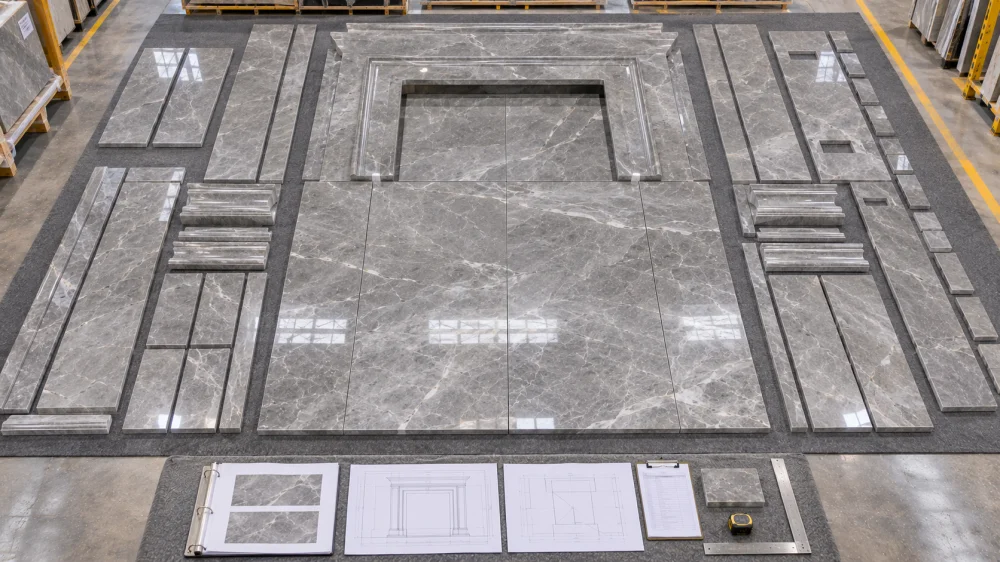
Inspection should follow the main project risks.
Depending on the scope, useful checkpoints may include:
- material or slab approval;
- shop-drawing approval;
- first-piece fabrication;
- dimensional inspection;
- opening and edge checks;
- finish and surface review;
- dry layout or trial assembly;
- piece identification;
- pre-packing approval;
- completed packing evidence.
The buyer does not need hundreds of random workshop photographs. Evidence should prove that the approved requirements were checked at the right stage.
Supplier Claim vs Project Evidence
| Supplier Claim | Pruebas a solicitar | Buyer Verification |
| “We handle large projects.” | Example workflow showing drawings, piece IDs, QC and packing allocation. | Does the evidence demonstrate multi-stage control rather than only large quantity? |
| “We control drawings.” | Revision register or approved-shop-drawing process. | Can obsolete revisions be prevented from entering production? |
| “We have strict QC.” | Stage-specific QC records tied to piece IDs or project areas. | Does inspection correspond to actual project risks? |
| “We can coordinate multiple materials.” | Material schedule, slab/batch references and area allocation. | Can each material be traced to the correct application and approval? |
| “We provide export packing.” | Completed closed-crate photographs and crate-to-piece packing list. | Does the packing protect the actual geometry and preserve project sequence? |
Step 7 — Verify Piece and Area Traceability
Traceability becomes more important as the project grows.
For a single vanity, one missing piece may be easy to identify. For a hotel, villa or commercial package with many similar panels, thresholds, vanity components or floor pieces, an incorrect label can disrupt an entire installation sequence.
A useful traceability chain is:
Project Area → Drawing → Piece ID → Material / Slab → QC → Crate → Packing List → Site Location.
The system does not need to be technologically complex. What matters is that the factory and the site team can reliably identify what each piece is and where it belongs.
Step 8 — Audit Packing as Part of Project Capability
Packing should be planned before finished pieces reach the loading area.
Different components require different protection. Countertops with large openings, long wall panels, tiles, stairs and stone furniture should not automatically use the same internal packing logic.
For a complex project, the packing system should also preserve installation organization. Crates may be grouped by floor, room, elevation or shipment phase where practical.
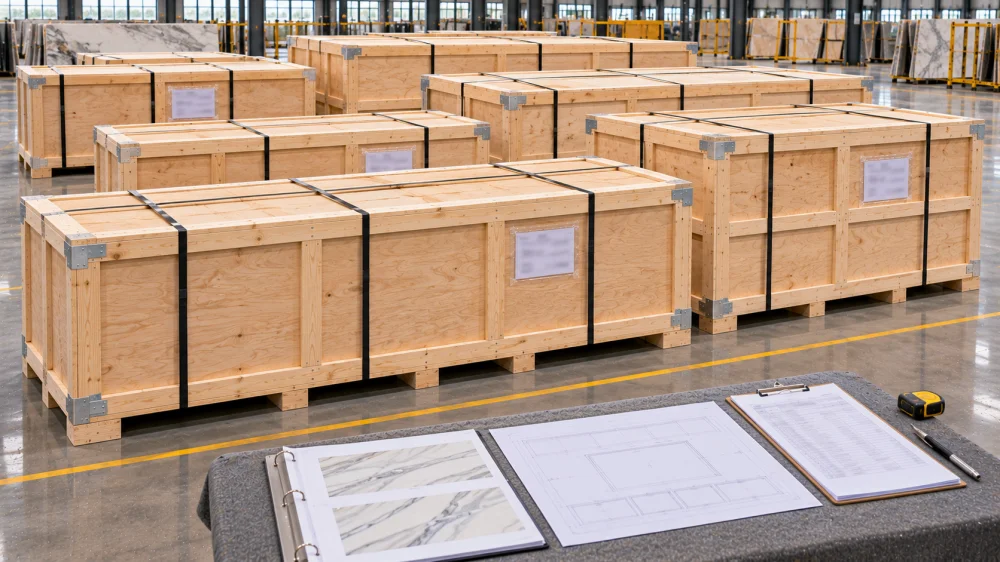
Ask for:
- packing method by product type;
- piece-to-crate allocation;
- room / area grouping where relevant;
- packing list;
- crate identification;
- completed final packing photographs.
Final packing evidence should show fully completed, closed crates with no finished stone exposed outside the packaging. The stone should already have the required internal restraint, thin soft separation where appropriate, edge and corner protection and geometry-specific support before the crate is released for shipment.
Step 9 — Verify Shipping and Project Handover
A factory’s responsibility may end at different points depending on the commercial agreement. The buyer should understand exactly where that boundary is.
For international projects, confirm who coordinates:
- final packing list;
- crate numbers;
- commercial documents;
- shipping documents;
- freight booking where included;
- shipment release;
- destination handover information.
CENTURY STAR’s architectural stone sourcing guide provides broader context for projects where material sourcing, fabrication, QC, packing and logistics must be coordinated across multiple stone applications.
Red Flags When Verifying Complex-Project Capability
Red Flags
- The supplier proves capability only by showing machines.
- Complex RFQ drawings generate no clarification questions.
- No one can identify which drawing revision controls production.
- Slab approval is disconnected from room or piece allocation.
- Production photographs have no piece or project traceability.
- QC is described only as “strict quality control.”
- Different project areas are mixed without a clear identification system.
- Packing is discussed only after all fabrication is complete.
- Final packing photographs show unfinished/open crates or exposed finished stone.
- Outsourced work is used but inspection responsibility is unclear.
- The supplier cannot explain how a replacement piece would be reproduced from project records.
Buyer Checklist Before Approving a Factory for a Complex Project
- Issue a representative RFQ package.
- Review the supplier’s technical questions and assumptions.
- Confirm the current material and slab-approval process.
- Verify how multiple materials or batches are allocated by project area.
- Review the shop-drawing and revision-control workflow.
- Confirm how individual pieces are identified.
- Review the proposed production sequence for different component families.
- Verify critical fabrication processes and outsourced responsibilities.
- Define staged QC evidence before production begins.
- Require dry layout or trial assembly where project risk justifies it.
- Confirm how replacement pieces are traced back to drawings and material records.
- Review packing by product geometry and project area.
- Require completed closed-crate evidence before shipment release.
- Confirm packing list, crate numbers and shipment handover documents.
Conclusión práctica
A factory is ready for a complex stone project when it can maintain one traceable chain from RFQ → material approval → current drawings → production pieces → QC → packing → shipment. Machine ownership and factory size matter only as parts of that system. The strongest supplier evidence shows that approved information survives every handoff without losing material identity, drawing revision, piece location or quality status.
Preguntas frecuentes
1. What does stone factory capability mean for a complex project?
It means more than fabrication capacity. The factory should be able to coordinate RFQ information, natural-stone approvals, drawing revisions, production pieces, QC, packing and shipment records as one controlled project workflow.
2. Is a large factory automatically better for a complex stone project?
No. Factory scale can support volume, but complex-project capability depends on information control, material coordination, technical review, production planning, QC and traceability as well as equipment and capacity.
3. What evidence should I request before approving a stone factory?
Request evidence relevant to the project, such as marked RFQ drawings, current slab or material records, approved shop drawings, piece-identification logic, staged QC examples, dry-layout evidence where appropriate, packing allocation and completed closed-crate photographs.
4. How can I test whether the factory controls drawing revisions?
Ask which document currently controls production, how superseded revisions are withdrawn and how changed pieces are identified. A revision register or equivalent controlled approval workflow can provide useful evidence.
5. How should a factory control multiple natural-stone materials in one project?
Each material or approved slab group should remain linked to the correct area, drawing or component family. The buyer should be able to trace approved material into the corresponding fabricated and packed pieces.
6. Is fabrication evidence enough to verify complex-project capability?
No. Fabrication evidence proves only part of the workflow. Complex-project verification should also cover drawings, material approvals, production coordination, QC, piece traceability, packing and project handover.
7. What should final packing evidence show?
It should show completed, fully closed and reinforced export crates ready for shipment, with no finished stone exposed outside the packaging. Packing records should also allow the buyer to connect crate identities to the relevant project pieces or areas.
8. What is the biggest red flag when selecting a factory for a complex project?
A major warning sign is a supplier that can show attractive products and advanced machines but cannot demonstrate how approved drawings, materials, production pieces, QC records and crates remain connected through the project.