


Doğrudan Cevap: No. Patagonia Quartzite does not need backlighting to create a luxury interior. Backlighting is an optional design treatment that can emphasize its translucent crystalline areas. Whether it is worthwhile depends on the actual slab, the distribution of light-transmitting zones, the intended application, and the feasibility of the complete lighting and support system. Buyers should approve the real slab and a representative lighting test before fabrication.
For a successful backlit project, buyers should evaluate the complete slab, map translucent and opaque areas, test the specified finish and backing assembly, coordinate the lighting system with fabrication drawings, and approve the final visual effect before production release.
1. Patagonia Quartzite: Material Identity and Visual Character
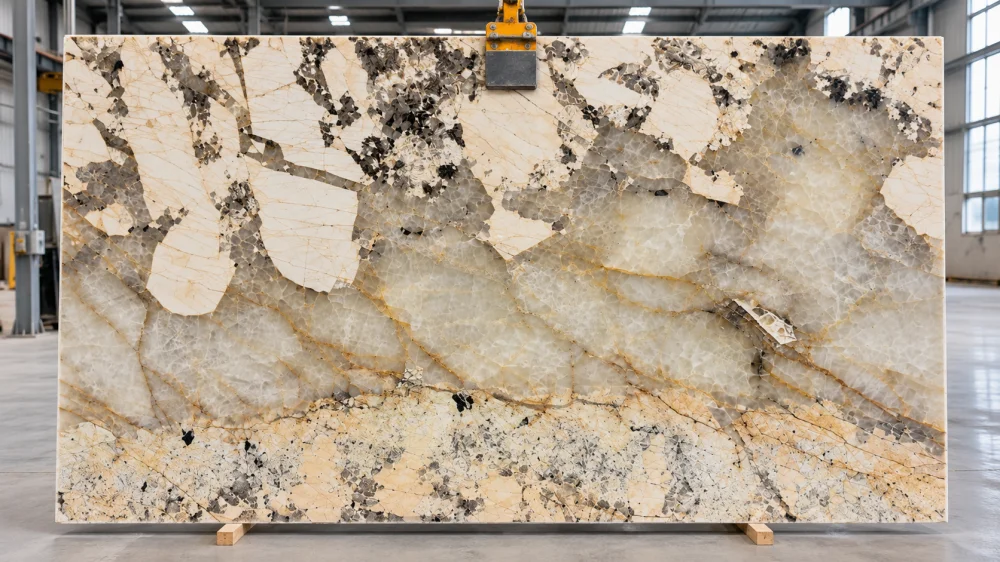
Patagonia Quartzite is a visually complex natural stone often selected for statement interiors rather than ordinary background surfaces. Its appeal comes from the contrast between crystalline fields, irregular mineral fragments, and warm neutral transitions.
Typical visual characteristics include:
- Crystalline areas: Large milky-white, translucent white, or pale grey crystal fields that can create visual depth.
- Warm transitions: Cream, ivory, beige, and occasional light golden mineral zones.
- Dark fragments: Irregular black, charcoal, and deep grey mineral inclusions that create strong contrast.
- Natural composition: Different mineral areas may form block-like, fragmented, or irregular compositions rather than continuous uniform veining.
- Slab variation: Crystal size, distribution, contrast, and apparent light transmission can differ significantly between slabs.
The important distinction is that Patagonia Quartzite is not a uniformly translucent material. Its crystalline zones and darker mineral areas may respond differently when light is introduced behind the stone.
| Faktör | What Buyers Should Know |
| Material Identity | Natural Patagonia Quartzite with a complex crystalline and mineral composition. |
| Main Appearance | Milky-white crystals, cream-beige transitions, and dark mineral fragments. |
| Light Transmission | Selected crystalline areas may transmit light, but the effect is not necessarily uniform. |
| Natural Variation | Crystal distribution, opacity, mineral density, and visual contrast vary by slab. |
| Suitable Design Role | Feature walls, illuminated bar fronts, reception elements, and selected statement furniture. |
| Approval Requirement | Actual slab photographs, transmitted-light testing, layout approval, and assembly verification. |
Buyers exploring different natural Quartzite colors and material options can also review the CENTURY STAR Quartzite collection.
2. Why Does Patagonia Quartzite Look Different Under Backlighting?
Ordinary surface lighting mainly reveals the stone’s external appearance, including color, mineral distribution, surface texture, and reflections. Backlighting introduces light from behind the stone, allowing some crystalline areas to become visually brighter and more prominent.
This changes the way the material is perceived.
Crystalline Areas Become the Main Visual Feature
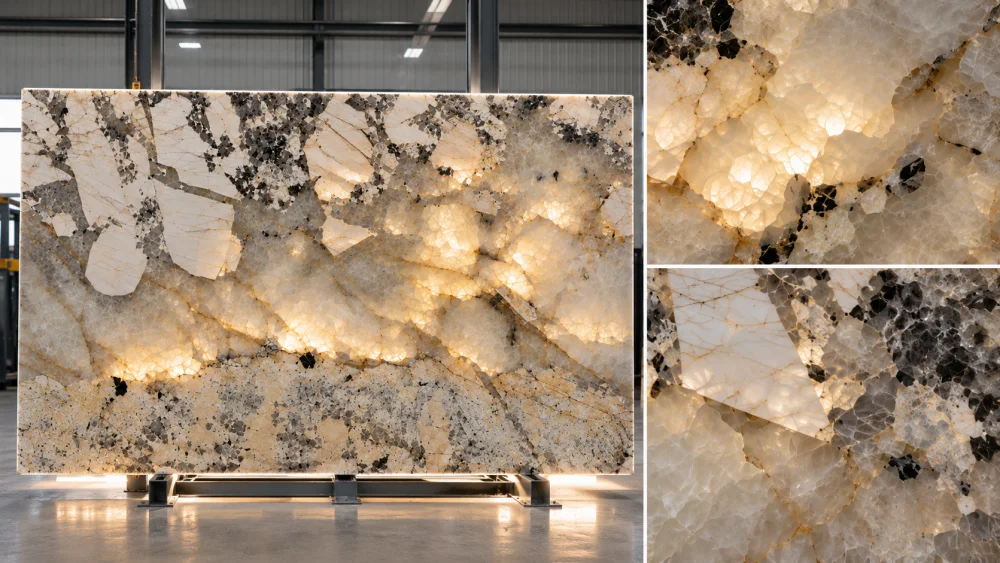
When light passes through suitable crystalline sections, the internal structure can become more noticeable. Individual crystal boundaries, transitions between mineral zones, and previously subtle internal details may become more visually pronounced.
For Patagonia Quartzite, this can create a distinctive contrast between luminous white or pale crystalline regions and darker mineral fragments.
Dark Mineral Areas May Remain Visually Dense
Not every part of the slab will respond equally. Dark mineral fragments and denser areas may transmit less light than the surrounding crystalline sections.
This is not automatically a defect. It is part of the natural composition of the material. However, designers must understand how these areas will appear when illuminated, especially if the stone is intended to create a symmetrical or carefully controlled architectural composition.
Backlighting Does Not Guarantee a Uniform Glow
A common design mistake is assuming that the entire Patagonia Quartzite slab will become evenly illuminated once a lighting system is installed.
Actual results depend on the selected slab, material thickness, mineral distribution, surface finish, backing materials, light source, diffuser, and installation arrangement.
3. Where Does Backlit Patagonia Quartzite Work Best?
Backlighting is most effective when the stone is intended to become a visual focal point. It should support the architectural concept rather than become an unnecessary technical feature.
Feature Walls and Reception Backdrops
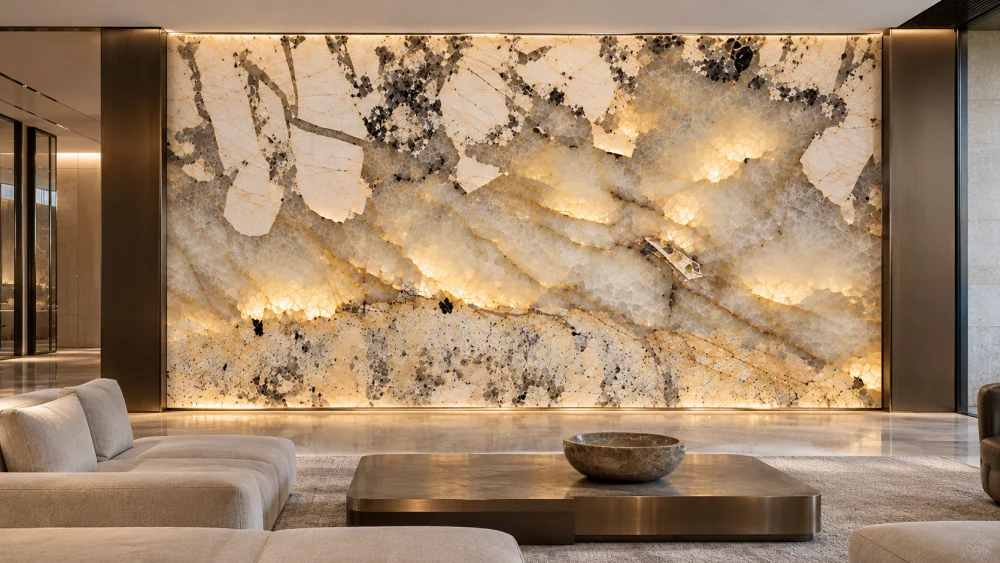
A large Patagonia Quartzite feature wall can combine natural mineral movement with illuminated crystalline areas. In hotel lobbies, luxury villas, and commercial reception spaces, this can create a strong visual identity.
For these applications, designers should coordinate the stone elevation, panel sequence, joints, lighting distribution, and supporting structure as one complete design.
Bar Fronts and Decorative Counters
Selected Patagonia Quartzite slabs can be considered for illuminated bar fronts and decorative counter facades. These applications allow the crystalline structure to become visible from the front while keeping the lighting equipment concealed.
The design must account for panel support, exposed edges, corners, equipment access, and protection against accidental impact.
Kitchen Islands and Statement Furniture
Patagonia Quartzite may also be used in statement kitchen islands, console tables, and custom furniture. However, a conventional countertop and a backlit decorative panel are not the same engineering application.
A backlit island requires coordination between the stone components, internal support structure, lighting cavity, electrical access, and usable countertop areas. The design team should determine whether illumination is necessary on the full visible surface or only on selected vertical sections.
For broader feature-wall planning, see the CENTURY STAR guide to custom Quartzite feature wall projects.
4. How Should Buyers Select Patagonia Quartzite Slabs for Backlighting?
Slab selection is the most important material decision in a backlit Patagonia Quartzite project. The buyer should evaluate the actual stone before the final lighting layout or cutting plan is released.
Start With Complete Slab Inspection
Request clear photographs of each available slab under consistent neutral front lighting. The photographs should show the complete surface rather than only selected close-up areas.
Inspect the following:
- Overall crystalline distribution and visual density.
- Location and proportion of pale translucent-looking areas.
- Distribution of dark mineral fragments.
- Warm beige and cream transitions.
- Natural fissures, repairs, resin treatments, and mesh backing where present.
- Relationship between major visual features and the proposed finished components.
Request Transmitted-Light Evidence
Normal slab photographs cannot establish how the entire surface will perform under backlighting. Buyers should request a transmitted-light test using a representative area of the actual material.
For an important architectural wall or large furniture component, a more complete trial assembly is preferable. The test should represent the proposed stone thickness, finish, backing, diffuser, and light source as closely as practical.
| İnceleme Aşaması | İstenecek Kanıtlar | Alıcı Kararı |
| Full Slab | Complete slab photographs and identification. | Confirm overall appearance and material suitability. |
| Crystal Zones | Close-ups and transmitted-light photographs. | Identify areas that create the intended luminous effect. |
| Material Condition | Records of repairs, resin, fissures, and backing. | Understand fabrication and installation implications. |
| Trial Assembly | Representative illuminated sample or mock-up. | Approve the actual visual effect before production. |
Review the Cutting Layout Before Approval
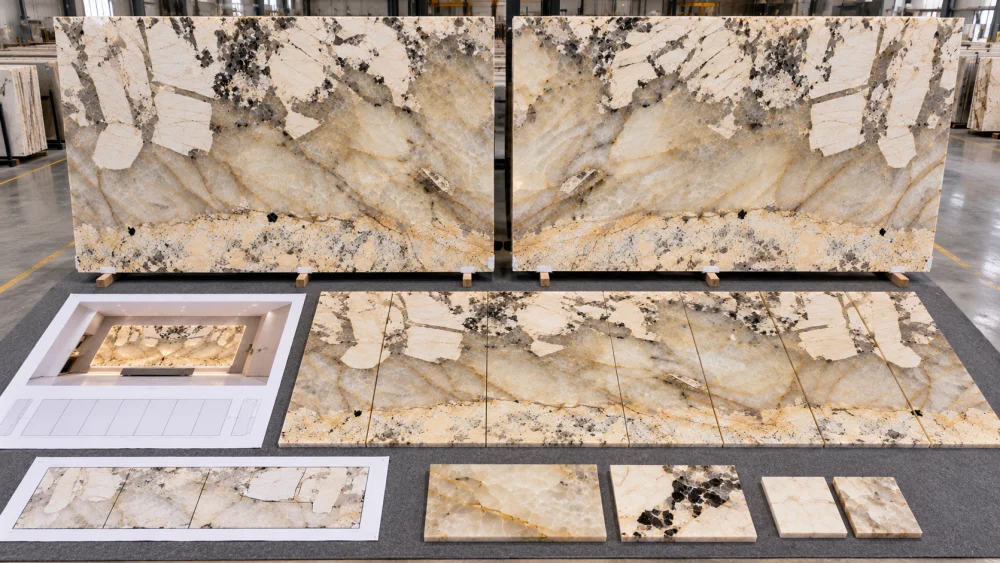
After slab selection, the fabricator should prepare a cutting layout showing the intended positions of finished panels, edges, openings, joints, and any bookmatched relationships.
This is particularly important for Patagonia Quartzite because its irregular crystal fields and dark mineral fragments may create different visual effects across separate panels.
A visually impressive area on the original slab may be lost in an opening or cut into several smaller pieces if the layout is not reviewed beforehand.
For buyers evaluating the actual product range, the Patagonia Quartzite material and product reference provides additional context on its natural appearance and applications.
5. How Do Surface Finishes and Fabrication Affect Backlit Results?
Surface finish should be approved together with the lighting concept. A finish that looks attractive under ordinary factory lighting may create a different visual effect when illuminated from behind.
Polished Finish
A polished surface can create stronger surface reflections and a more defined appearance. It may be suitable when the design aims for a refined, dramatic stone feature.
However, surface reflections should be evaluated separately from actual light transmission through the stone.
Parlatılmış İşlem
A honed finish creates a softer surface appearance with less visible surface reflection. It may suit projects seeking a more restrained architectural effect.
Its appearance under transmitted light should still be tested using the actual slab and proposed assembly.
İmalat Detayları
Before cutting, confirm:
- Finished panel dimensions and thickness.
- Visible edge profiles and returns.
- Openings for equipment, switches, and other interfaces.
- Joint locations and panel sequence.
- Backing and support requirements.
- Locations of existing repairs, resin, or reinforcement.
- Compatibility between adhesives, backing, and the proposed lighting assembly.
Changes to the backing or support arrangement after material approval may affect the final illuminated appearance. Therefore, the approved mock-up should represent the intended production configuration.
6. What Must Be Coordinated Behind the Stone?
A successful backlit installation is not simply a natural stone panel with an LED light source behind it. The stone, lighting, diffuser, cavity, structural support, and maintenance access must work together.
Lighting Distribution
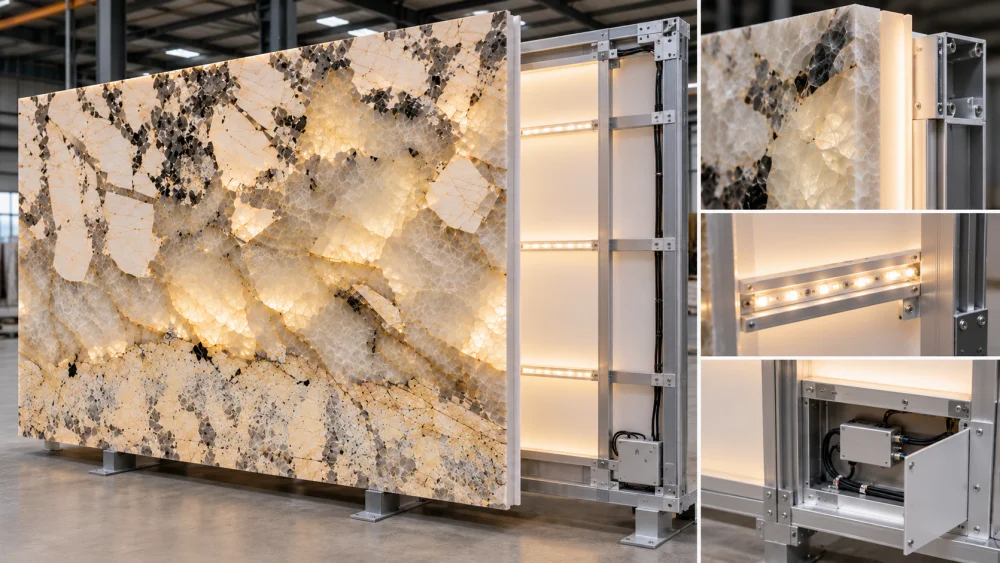
The lighting designer should evaluate the position and distribution of the light sources to avoid visible hotspots, dark bands, uneven brightness, and unwanted shadows.
The objective is to create a controlled illumination effect that complements the natural crystal composition rather than overpowering it.
Diffuser and Backing Arrangement
The diffuser and backing assembly should be selected with the actual stone. The design must allow the intended light distribution while providing the required support for the finished panel.
Any composite construction, transparent backing, or honeycomb support system should be reviewed as a project-specific assembly. A material arrangement suitable for one installation should not automatically be transferred to another.
Maintenance and Electrical Access
Lighting equipment may require future inspection, replacement, or maintenance. Designers should provide a practical access strategy without compromising the appearance of the stone installation.
Heat management, cable routing, power supply location, electrical protection, and local installation requirements must be coordinated by the appropriate qualified professionals.
7. Procurement and QC: What Should Buyers Approve Before Ordering?
For a commercial Patagonia Quartzite backlighting project, material approval and lighting approval should be treated as connected but separate decisions.
The buyer should not release the complete order merely because the stone looks attractive in a warehouse photograph.
Pre-Order Approval Checklist
- Confirm the exact Patagonia Quartzite slab or slab group.
- Obtain complete slab photographs under normal lighting.
- Obtain transmitted-light evidence for the selected material.
- Record slab identification and orientation.
- Review natural crystal distribution and darker mineral zones.
- Confirm surface finish, thickness, repairs, and backing condition.
- Approve the CAD elevation and cutting layout.
- Confirm panel sequence, joints, edge profiles, and openings.
- Review the lighting source, diffuser, support, and maintenance access.
- Approve a representative trial assembly where the project risk justifies it.
- Confirm final QC, component identification, and protective export packing.
For large projects, buyers should also consider whether additional material or retained spare pieces are necessary. Patagonia Quartzite is naturally variable, so future replacement material may not reproduce the same crystal arrangement or visual composition.
8. Frequently Asked Questions
1. Does Patagonia Quartzite need backlighting?
No. Backlighting is optional. Patagonia Quartzite can create a strong visual statement under ordinary lighting. Backlighting should only be introduced when the actual slab has suitable light-transmitting areas and the project benefits from an illuminated design.
2. Can every Patagonia Quartzite slab be backlit?
No. Natural variation affects crystal distribution, opacity, and light transmission. Some slabs may produce a stronger illuminated effect than others. Buyers should request actual slab testing instead of relying on the stone name alone.
3. Does Patagonia Quartzite glow uniformly when illuminated?
Not necessarily. Crystalline areas may transmit more light than darker or denser mineral sections. The final appearance depends on the actual slab and the complete lighting assembly.
4. Is polished Patagonia Quartzite better for backlighting?
Not automatically. Polished surfaces provide a different surface appearance from honed finishes, but surface reflection and internal light transmission are separate considerations. Test the specified finish using the actual slab.
5. Can Patagonia Quartzite be used for a backlit kitchen island?
Yes, selected designs may incorporate backlit Patagonia Quartzite. However, the countertop, vertical panels, internal support, lighting cavity, and electrical access require coordinated engineering. Backlighting should not compromise the island’s functional requirements.
6. What is the most important inspection before ordering backlit Patagonia Quartzite?
The most important inspection is a representative transmitted-light test using the selected material. Ideally, it should include the intended thickness, finish, backing, diffuser, and lighting arrangement so the buyer can evaluate the actual project appearance.
7. Should the buyer approve the complete slab before bookmatching and cutting?
Yes. Review the complete slab photographs, orientation, proposed panel sequence, and cutting layout before fabrication. For high-visibility installations, approve the full visual composition rather than individual pieces separately.
When backlighting is part of the design, the correct decision starts with the actual slab, continues through transmitted-light testing and fabrication planning, and finishes with approval of the complete lighting and support assembly.
For architects, designers, and procurement teams, the safest approach is to approve the material and its illuminated application together before production begins.
Referanslar
This article does not assign universal light-transmission values, guaranteed illumination performance, or fixed engineering specifications to Patagonia Quartzite. Actual material and assembly performance should be verified for each project. Related CENTURY STAR material and feature-wall resources are linked within the article.