


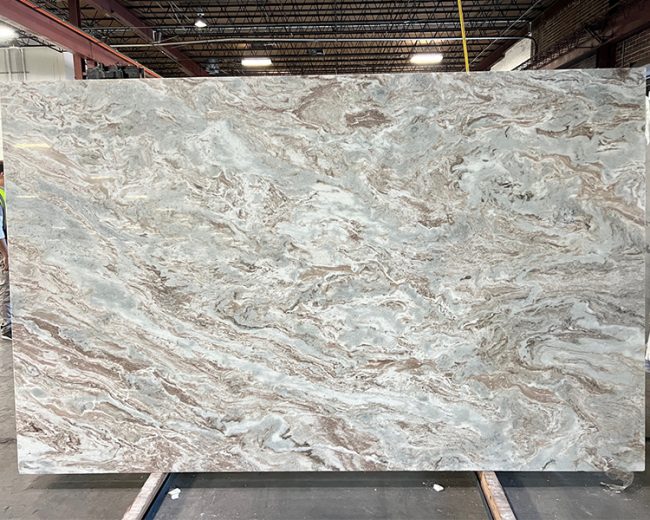

Szybkie podsumowanieChoose Quartzite when the kitchen design prioritizes flowing natural movement, crystalline depth or a more Marble-like visual language and the project can support careful slab selection and fabrication. Choose Granite when the project favors a broad range of granular, crystalline or graphic natural patterns and a well-established countertop fabrication route. Both can perform well in kitchens, but neither material should be selected by category name alone. Buyers should compare the actual slabs, finish, openings, edges, support, maintenance expectations and complete fabricated-project scope.
Quartzite vs Granite Countertops: Which Is Better for a Kitchen?
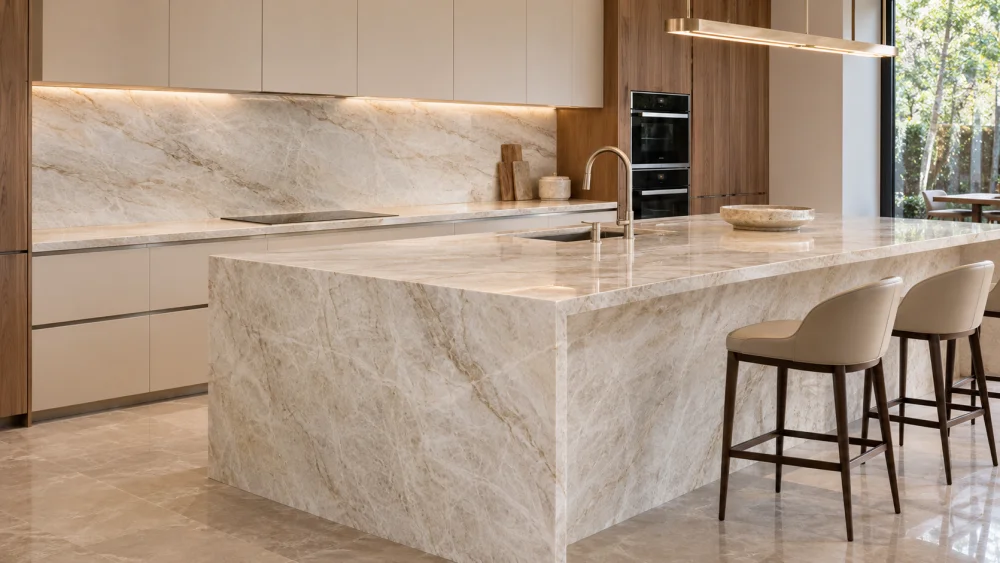
Nie ma uniwersalnego zwycięzcy. Quartzite is often the stronger design choice when the buyer wants expressive veining, cloudy movement or crystalline slab-scale composition. Granite is often the stronger practical choice when the buyer wants a broad selection of proven countertop materials with granular, crystalline or more uniform visual structures.
For actual kitchen performance, both material families include stones suitable for demanding countertop applications. The more useful distinction is not simply “which stone is harder,” but whether the specific slab, finish, countertop geometry and fabrication plan fit the project.
Bezpośredni werdyktChoose Quartzite: when slab-scale movement, natural veining or crystalline visual character is a primary design driver and the project can support detailed slab approval and cutting-layout control.
Choose Granite: when the project prioritizes a broad selection of durable natural-stone countertop options and the desired visual language suits Granite’s granular, crystalline, speckled or strongly patterned varieties.
For either material: approve the actual slabs and fabrication scope before ordering. Commercial stone names alone do not guarantee identical appearance or behavior.
Quartzite vs Granite Kitchen Countertop Decision Matrix
| Czynnik | Kwarcyt | Granit | Najlepszy wybór, gdy |
| Charakter wizualny | Often selected for flowing movement, cloudy fields, crystalline zones or dramatic directional patterns. | Can range from fine granular and speckled structures to bold crystalline or strongly directional patterns. | Select from the actual slab composition, not a category stereotype. |
| Kitchen Performance | Many true Quartzites provide strong hardness, abrasion resistance and countertop suitability. | Granite has a long history of use on heavily used kitchen surfaces. | Both can work well when the actual stone is appropriate for the application. |
| Slab Variation | Strong slab-to-slab movement can make layout approval especially important. | Variation ranges from relatively consistent granular materials to highly expressive slabs. | Use actual slab review whenever visual continuity matters. |
| Produkcja | Hard crystalline zones, fissures and strong movement may require careful cutting and edge planning. | Mature countertop fabrication workflows exist, but mineral structure and natural features still vary by stone. | Choose a fabricator experienced with the exact material and geometry. |
| Konserwacja | Stone-specific cleaning and treatment decisions remain necessary. | Care and sealing decisions also depend on the actual stone and finish. | Do not use a fixed universal sealing schedule for either category. |
| Procurement Control | Full-slab and cutting-layout approval can be especially important for high-movement material. | Actual slab approval remains useful, especially for strongly patterned or multi-slab kitchens. | Approve the complete countertop package rather than the stone name alone. |
The Visual Difference Is Not Simply “Veined vs Speckled”
Quartzite is frequently selected when designers want a natural surface with long flowing veins, broad cloud-like movement, crystalline fields or dramatic color transitions. Materials such as Taj Mahal, Mont Blanc, Blue Roma and Patagonia demonstrate how different the Quartzite visual family can be.
Granite is often associated with granular or speckled patterns because many traditional Granites contain visibly interlocking mineral crystals. However, the commercial Granite category includes a very broad visual range. Some stones are relatively quiet and consistent, while others show sweeping movement, large crystals, contrasting bands or strong graphic structure.
That means the design decision should be made from complete slab images rather than assuming every Quartzite looks like Marble and every Granite looks like salt-and-pepper stone.
Buyers exploring the first material family can begin with the CENTURY STAR Quartzite guide, while the Granite collection provides a broader view of the Granite category.
How Do Quartzite and Granite Compare in Daily Kitchen Use?
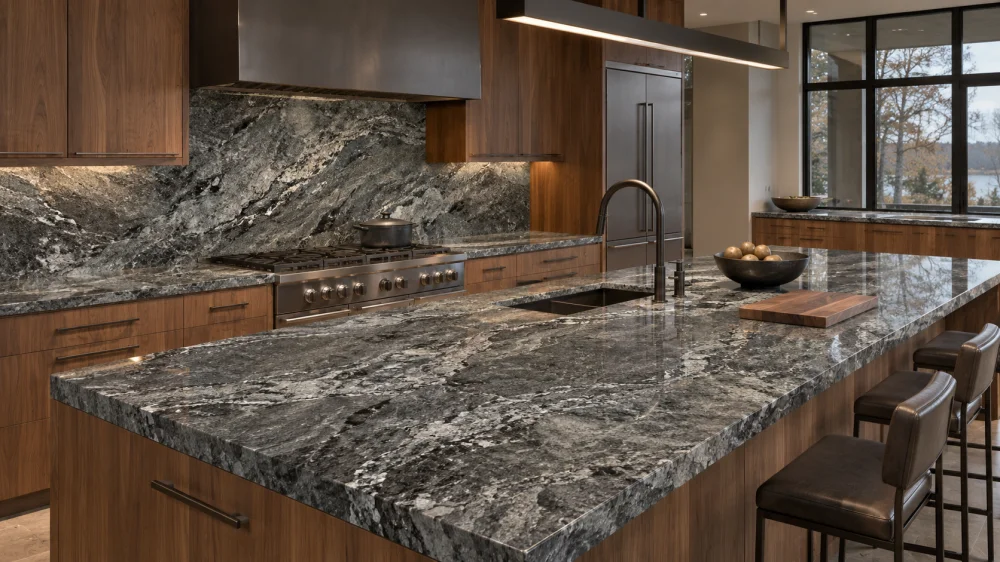
Both categories contain materials capable of serving demanding kitchen countertops. Natural Stone Institute identifies Granite as a long-established choice for kitchen countertops and other heavily used surfaces, while Quartzite can offer exceptional strength, density and hardness depending on the stone.
The practical lesson is that neither category should be reduced to one hardness number or one performance promise.
The actual countertop still contains edges, seams, sink openings, cooktop openings and possibly natural fissures. These areas can chip or crack when fabrication, support or handling is poor even when the stone itself is considered hard.
Buyer Risk
Do not translate “hard natural stone” into “indestructible countertop.” Kitchen performance depends on the actual stone, component geometry, support, cutouts, edge fabrication, installation and use—not only the material-family name.
Scratch, Heat and Stain Expectations Need Context
Both Quartzite and Granite are often chosen for kitchens because many stones in these families provide strong abrasion resistance. That does not mean buyers should cut directly on either surface or assume that every slab responds identically.
Heat exposure should also be managed sensibly. Natural stone may tolerate typical kitchen conditions well, but placing very hot cookware directly on a countertop can create localized thermal stress and can also affect sealers or nearby installation materials. Using trivets remains a practical precaution.
Stain resistance varies with the individual stone, finish, existing resin treatment and exposure. Neither Quartzite nor Granite should be described as universally non-porous or completely stain-proof.
If an impregnating treatment is used, its purpose is to improve stain resistance where appropriate; it does not eliminate all maintenance or make the surface impermeable.
Which Material Works Better for a Large Kitchen Island?
Either can work extremely well.
Quartzite often becomes the first choice when the island is intended to behave as a major natural artwork. Broad movement can be positioned across the top, waterfall panels and visible seating elevation.
Granite can also produce a highly architectural island, particularly when the selected slab contains large crystals, sweeping mineral movement or bold contrast.
For both materials, the key question is whether the chosen slabs can supply the island geometry efficiently. Sink openings, cooktops, waterfall panels, seams and miter strips all affect usable slab yield.
A spectacular slab that cannot accommodate the required pieces without destroying the intended composition may be a weaker project choice than a visually calmer slab with a much better cutting layout.
Quartzite Can Require More Deliberate Slab Layout
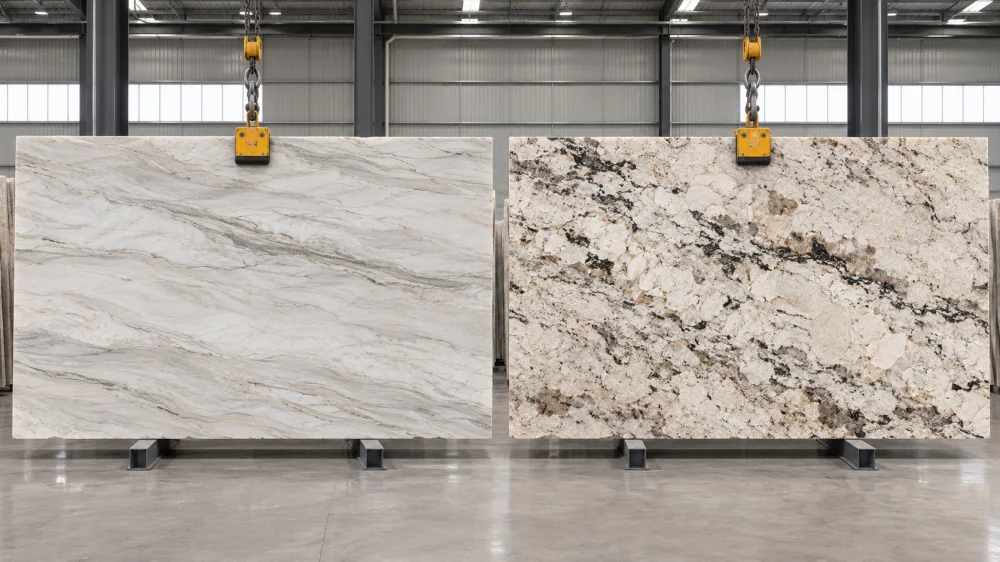
Many premium Quartzites are purchased specifically for their dramatic movement. That increases the importance of placing countertop outlines over actual slab photographs before cutting.
The buyer may need to decide:
- which area becomes the island center;
- where a sink or cooktop removes material;
- which section becomes a waterfall panel;
- how strong directional movement crosses seams;
- whether fissures or crystalline areas enter narrow rails;
- which slab supplies perimeter countertops.
Granite may require the same level of layout control when the material is strongly patterned. The difference is therefore not absolute; it depends on how visually directional the selected slabs are.
Fabrication: Where Do the Real Differences Appear?
Quartzite fabrication can be demanding because true Quartzite is a hard, quartz-rich metamorphic stone. Highly crystalline varieties may require careful tooling, cutting strategy and edge finishing. Natural fissures and mineral transitions should be reviewed before sink or cooktop openings are positioned.
Granite also contains hard mineral components and requires professional stone-fabrication equipment. Its long history as a countertop material means experienced fabricators commonly work with Granite, but that does not eliminate stone-specific differences.
The fabrication comparison should therefore focus on the actual pieces:
| Technical Factor | Kwarcyt | Granit | Procurement Impact |
| Sink / Cooktop Openings | Review crystalline zones, fissures and remaining rails carefully. | Review mineral features, opening geometry and remaining rails. | Final appliance information should be available before production. |
| Krawędź skośna | Crystal-rich edges can require especially careful cutting and finishing. | Edge appearance depends on mineral size and pattern relationship. | Request close-up fabrication evidence for the selected material. |
| Seam Planning | Strong movement may make seam transitions visually prominent. | Granular materials may be more forgiving visually, while graphic Granites may not be. | Review seams on actual slab layouts rather than by material category. |
| Edge / Surface Finishing | Tooling and finishing should suit the actual crystalline structure. | Mineral composition can affect polishing and edge appearance. | Fabricator experience with the exact stone matters. |
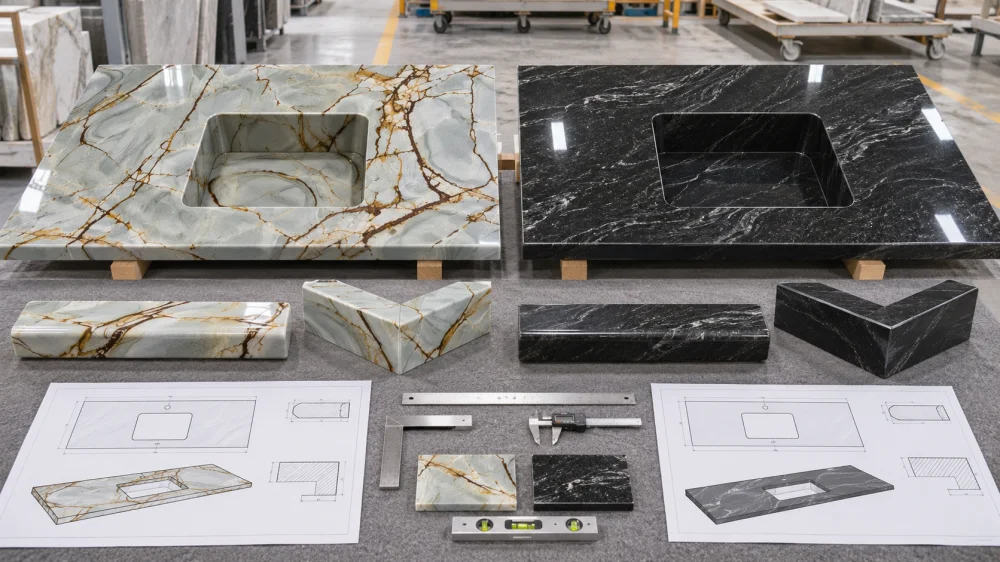
Polished, Honed or Textured?
Both Quartzite and Granite can be specified in different finishes where the selected material and project allow them.
A polished finish usually increases reflection and apparent color depth. A honed finish creates a softer, lower-sheen visual effect. Textured or leathered finishes can change both appearance and tactile character.
The important comparison is not which material category “has the best finish.” Buyers should review a representative finished sample of the actual stone because different minerals and surface treatments can respond differently to the same nominal finish.
Maintenance Is More Similar Than Marketing Often Suggests
For routine kitchen care, both stones benefit from prompt spill cleanup and cleaners intended for natural stone.
Whether sealing is appropriate should be evaluated for the actual slab, finish and previous treatment. A fixed statement such as “Granite must be sealed every year” or “Quartzite never needs sealing” is too broad to be reliable across every commercial stone.
Natural variation also means a buyer should request maintenance instructions that correspond to the completed surface rather than relying solely on the stone-family name.
Który z nich kosztuje więcej?
There is no reliable universal answer.
Some Quartzites can carry a higher material value because of availability, visual rarity, slab selection or fabrication difficulty. Some premium Granites can also be expensive. Common Granites may provide a different budget direction from rare statement stones.
The finished countertop cost depends on:
- specific stone and visual grade;
- current slab availability;
- gross slab quantity;
- usable cutting yield;
- finish;
- otwory na umywalkę i płytę kuchenną;
- edge and miter details;
- seam strategy;
- waterfall panels;
- fabrication difficulty;
- QC and dry-review requirements;
- packing and logistics scope.
For custom projects, comparing one Quartzite slab price with one Granite slab price is therefore less useful than comparing equivalent fabricated countertop packages.
What Should Buyers Approve Before Ordering?
- Confirm whether the material is natural Quartzite or Granite and whether material identity matters to the specification.
- Review current complete slab photographs rather than relying only on small samples.
- Compare all slabs together if the kitchen requires more than one.
- Confirm countertop, island and backsplash geometry.
- Overlay sink, cooktop and other major openings on the actual slab layout.
- Review seam positions and visible edge details.
- Approve the specified finish on representative material.
- Confirm any natural fissures, repairs, resin treatment or backing relevant to fabrication.
- Review the cutting layout before production for strongly patterned materials.
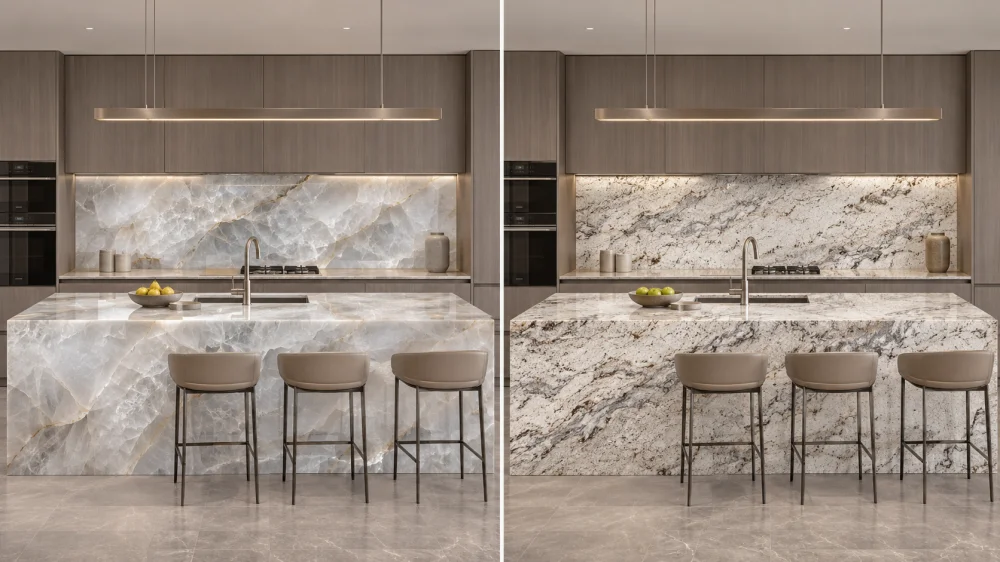
quartzite granite finished kitchen scenario comparison - Define QC evidence and packing scope before shipment.
When the project is already moving from material selection into fabrication, CENTURY STAR’s przewodnik do wycen rysunków producenta kamienia explains what plans, dimensions, edges, openings and fabrication information should be supplied so competing countertop quotations are based on the same scope.
Który powinieneś wybrać?
Choose Quartzite when the kitchen needs stronger slab-scale visual movement, crystalline depth or a natural Marble-like design language and the project team is prepared to manage actual-slab selection and layout carefully.
Choose Granite when the desired design fits the available Granite slabs and the project values a broad range of established countertop materials with strong everyday-use credentials.
Choose by actual slab rather than by stereotype when the project is visually important. A strongly veined Granite can demand more layout control than a quiet Quartzite, while a highly crystalline Quartzite may require more fabrication planning than a relatively uniform Granite.
Praktyczne korzyści
Quartzite vs Granite countertops should be treated as a project decision, not a hardness contest. Compare the actual slabs, visual movement, sink and cooktop geometry, seams, edge fabrication, maintenance expectations, cutting yield and complete commercial scope. Quartzite often wins when dramatic natural movement is the design priority; Granite often wins when the selected Granite delivers the required appearance and a straightforward countertop solution. The right material is the one whose actual slab can be fabricated successfully into the approved kitchen.
Często zadawane pytania
1. Is Quartzite better than Granite for kitchen countertops?
Not universally. Quartzite may be preferable when dramatic veining or crystalline slab movement is a design priority, while Granite may be preferable when the selected Granite provides the desired appearance and established countertop performance. The actual stone and project geometry should determine the final choice.
2. Is Quartzite harder than Granite?
Many true Quartzites are exceptionally hard and dense, while Granite is also a hard and durable natural-stone family. A simple hardness ranking is not enough to predict finished countertop performance because stone composition, natural features, edges, cutouts, support and fabrication all matter.
3. Which has more visual variation, Quartzite or Granite?
Both can vary substantially. Quartzite often features flowing, cloudy or crystalline slab-scale movement, while Granite can range from relatively consistent granular patterns to highly graphic crystalline slabs. Buyers should compare actual slabs rather than relying on category stereotypes.
4. Which is easier to fabricate, Granite or Quartzite?
Granite has a mature countertop-fabrication history, while hard or highly crystalline Quartzites can require especially careful cutting and finishing. However, fabrication difficulty still varies by individual stone, geometry and natural features.
5. Does Quartzite need less maintenance than Granite?
Not necessarily. Both are natural stone and should receive care appropriate to the actual slab, finish and treatment. Neither category should be assigned one universal sealing or maintenance schedule.
6. Which is better for a waterfall kitchen island?
Either can work. The best choice depends on slab size, pattern direction, cutting yield, miter fabrication and the visual relationship between the island top and vertical waterfall panels.
7. Is Quartzite always more expensive than Granite?
No. Material cost varies by individual stone, availability, visual grade and slab selection. Completed project cost also depends on cutting yield, fabrication, edges, openings, QC, packing and logistics.
8. Should buyers approve full slabs before fabrication?
Yes when slab variation materially affects the design. Full-slab approval is especially useful for islands, waterfall panels and strongly patterned materials because a small sample cannot represent the complete countertop composition.
Referencje
- Natural Stone Institute — Granite material guidance.
- Natural Stone Institute — Sandstone and Quartzite material guidance.
- Natural Stone Institute — Natural Stone Countertops: Considerations for Marble, Granite, Quartzite and Soapstone.