




Żółty marmurowy zasłonowy mur Venus
Geological DNA: The Gentle Armor of Venus Beige
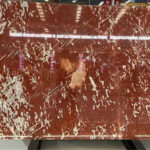
Venus Beige marble originates from the mountains of northern Greece, where a warm palette ranging from cream to light coffee is veined with cloud-like or lightning-shaped patterns. Thanks to its low colour variation and soft light-scattering, the stone offers both high aesthetics and reliable performance: density 2.78 g/cm³, water absorption ≤ 0.25 %, flexural strength ≥ 6 MPa. The deposit was formed by Jurassic-era marine carbonates that metamorphosed over millions of years; the average crystal size is only 0.2 mm, so the polished surface reaches 90 gloss units without the dazzling glare common in white marbles. Wire-saw quarrying delivers a 32 % block-yield—lower than granite—but the scarcity of cracks and continuous colour bands raise slab productivity by 15 % over ordinary beige stones. Certified to ISO 14001, the quarry re-seeds drought-resistant grasses in winter and uses PV-pumped water for dust suppression in summer, achieving “green extraction”. With Ira ≤ 0.2 and Ir ≤ 0.3, the stone easily meets Class A radioactivity limits for hospitals and schools. Its extremely low iron content limits yellowing: after 500 h of UV-ageing, ΔE ≤ 0.8, laying a mineral foundation for long-term façades.
Venus Beige Marble Four Strengths: Beauty, Plasticity, Structure, Sustainability
As a cladding material, Venus Beige offers four core advantages. First, its low-saturation warm tone neutralises the cold feel of glass and aluminium; at sunrise or sunset, iron-bearing mica produces a golden shimmer that softens the cityscape. Second, design flexibility is exceptional: slabs can be cut to 1 800 × 900 mm for almost seamless horizontal grids; five-axis water-jets carve 20 mm-wide Chinese strokes or 300 mm-radius 3-D curves; five finishes—polished, honed, brushed, antique, flamed + brushed—allow micro-pattern collages with 20 %–60 % reflectance variation. Third, structural compatibility: the linear expansion coefficient ≈ 4.5 × 10⁻⁶ /°C is close to that of aluminium (≈ 6.5 × 10⁻⁶ /°C); under a 60 °C summer gradient, a 30 m stack shortens only 1.2 mm relative to its mullions, reducing shear. Fourth, green credentials: shipping to China adds ≈ 280 kg CO₂-e/m², 18 % less than Italian equivalents; coupled with 90 % recyclable aluminium frames, the system easily contributes to LEED v4.1 MRc1-2 credits.

Urban Stage: Offices, Hotels, Retail, Culture
Venus Beige façades now span high-end offices, five-star hotels, retail malls and cultural venues. In supertall towers, a 1 : 2 rhythm with Low-E glass cuts solar gain and bird collisions. Hotel porte-cochères use 30 mm cantilevered slabs (6 m span) back-lit with 4 000 K LEDs, achieving ≥ 0.6 illuminance uniformity and becoming nighttime landmarks. Street-front retail pairs the warm marble with anodised copper whose gradual greening contrasts with the stone’s stability, creating a “time-lapse” façade. Libraries and museums carve “book-page” folds or “mountain silhouettes” into the panels, matching matte finishes to anti-glare requirements for cultural contexts. Even a high-speed rail station deployed 20 mm stone/aluminium-honeycomb ceilings (28 kg/m²) to reduce dead load by 55 % and save steel.
System Build-up: Thickness, Anchor, Water, Thermal
Height dictates thickness: ≤ 30 m uses 25 mm; 30–60 m uses 30 mm; ≥ 60 m or typhoon zones adopt ≥ 35 mm plus mesh and under-cut anchors. Three fixing modes are common: (i) under-cut (M8 A2 stainless) delivering ≥ 3 kN per point for seismic zone 8; (ii) hook-on SE rails, 30 % faster and allowing ± 3 mm thermal slip; (iii) honeycomb composite for soffits or retrofits, 20 mm stone + 20 mm aluminium honeycomb, halving weight while keeping ≤ 0.5 mm deflection. Open-jointed rear-ventilation uses 8 mm vertical and 6 mm horizontal gaps backed by 1.2 mm galvanized steel; the 40 mm cavity lowers summer surface temperature 8–10 °C and winter U-value by 0.15 W/(m²·K). All mullions are 6063-T5 aluminium, 2.5 mm wall for 4.5 m span, anodised AA25 and salt-spray-tested 3 000 h for coastal durability.

Safety Details: Six-Sided Shield, Mesh Anti-Burst, Node Plus
Every panel is factory-coated with a fluorocarbon emulsion (surface tension < 28 mN/m) on all six sides to block alkali and oil. Slabs ≥ 25 mm receive a glass-fibre back mesh that keeps fragments bonded after fracture, meeting BS 8300 “fail-safe” criteria. L-shaped monolithic corners (50 mm thick) eliminate vulnerable joints. Under-cut holes are 15 mm deep, leaving 10 mm stone above the base to resist spalling; 2 mm EPDM isolators separate stainless steel from aluminium to prevent galvanic corrosion. Neutral silicone weather-seal (± 25 % movement) is inset 3 mm to avoid streaking. In supertyphoon zones, two 5 mm stainless safety pins per slab provide 0.8 kN redundant load even if the anchor fails. All fasteners are A2-70 stainless, ≤ 5 % red-rust area after 1 000 h neutral salt spray, ensuring a 30-year maintenance-free life.


Digital Construction: RFID Traceability, 5-Axis CNC, Nano Care
Quarry blocks are laser-scanned to build 3-D “texture maps” before cutting; designers can pre-select slabs online. RFID tags record coordinates, cracks and colour bands for lifetime traceability. In the factory, gangsaws slice blocks; infrared cameras sort slabs with ΔE ≤ 1.5 into the same batch; 5-axis CNC machines drill anchor holes, kerfs and chamfers in one pass (± 0.2 mm). Water-borne fluorocarbon is roller-coated at 40 °C and cured for 48 h; panels are then packed in EPE foam, corner-protected and kiln-dried wooden crates with ≤ 45 % RH for sea transport. On site, total-station layout keeps error ≤ 1 mm; 10 % of steel welds are ultrasonically tested and coatings measured ≥ 80 µm DFT. π-shaped adjustable brackets allow ± 5 mm in X-Y-Z, achieving ≤ 1 mm flatness in 2 m. Masking tape protects the stone during sealant gunning; final neutral detergent (pH ≈ 7.5) wash removes site dirt. Nano-fluorocarbon refresh every 18 months maintains a “lotus effect” ≥ 10 years, cutting soiling by 60 % and halving high-altitude cleaning cycles.
Case & Future: From Hongqiao to Shenzhen Bay—A Venus Legend
From the 120 m Grade-A tower at Shanghai Hongqiao—where alternating stone and glass slices west-facade cooling loads by 12 % and earns LEED Gold—to the double-curved podium of Shenzhen Bay Hotel whose 3 mm brushed, fingerprint-free panels become an Instagram icon boosting occupancy 8 %, Venus Beige proves that natural stone can meet safety, energy and sustainability mandates. A Hangzhou library engraved with “book-fold” reliefs and rear-ventilated cavities keeps energy use 35 % below the national baseline, free of colour change, leak or breakage after three years. Looking ahead, the quarry will introduce PV-powered cable cranes and electric forklifts, targeting a further 22 % CO₂ cut by 2026. Meanwhile, Chinese façade contractors are pressing off-cuts into recycled tiles for interior partitions, moving towards “zero-waste stone”. As light keeps shifting across these façades, the Venus legend continues—transmitting natural beauty to the next urban generation in an ever more responsible way.