


Is Patagonia Quartzite a Good Choice for Countertops?
Yes, Patagonia Quartzite can be an excellent countertop material when the project is prepared to manage its strong natural variation through actual-slab selection and deliberate cutting-layout planning.
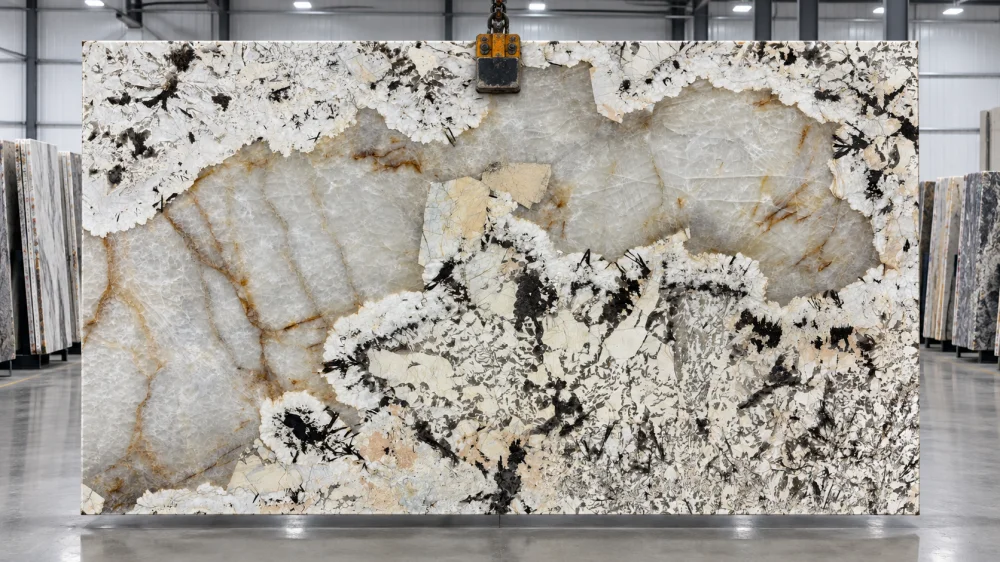
Its attraction comes from the same characteristics that make fabrication planning more demanding. A representative slab may combine large milky-white to pale-grey crystalline areas, cream and beige zones, smoky transitions, darker mineral fragments and restrained warm mineral accents. These areas can change quickly across the slab.
For a countertop or island, that means the finished visual composition depends heavily on where the top, waterfall panels, backsplash pieces, sink openings and smaller components are positioned.
Do not approve Patagonia Quartzite only as a beautiful slab. Approve the slab together with the countertop drawing. The strongest crystal area may be perfect for the center of an island but unsuitable if a sink opening removes most of it or if a narrow rail crosses a visually or fabrication-sensitive natural feature.
Patagonia Quartzite Countertop Snapshot
| Czynnik | Co powinni wiedzieć kupujący |
| Charakter wizualny | Highly variable crystalline composition with light translucent-looking zones, cream-beige areas, smoky transitions and controlled dark mineral fragments. |
| Best Countertop Role | Large focal islands, statement countertops, waterfall ends and other surfaces where slab-scale geology can remain visible. |
| Priorytet wyboru | Approve complete slabs and the exact cutting relationship, not only a hand sample. |
| Layout Priority | Position large crystal fields, darker fragments and major mineral transitions intentionally within finished components. |
| Priorytet produkcji | Review openings, narrow rails, edges, miters and natural features on the actual stone before machining. |
| Buyer Risk | A visually approved slab can still produce a poor countertop if critical areas are lost through cutouts or allocated to secondary pieces. |
Why Crystal Zones Matter More on a Countertop
Patagonia Quartzite is visually different from a stone with one consistent directional vein system. Its large crystalline and fragmented geological areas behave more like distinct visual fields.
A kitchen island may therefore include one broad translucent-looking crystal mass, a cream-beige transition, smoky areas and concentrated dark fragments within a single finished piece.
This can be extremely effective when the composition is intentional. It can also look unbalanced if the strongest area is cut in half, removed by a sink, hidden behind an appliance or transferred unintentionally to a narrow waterfall panel.
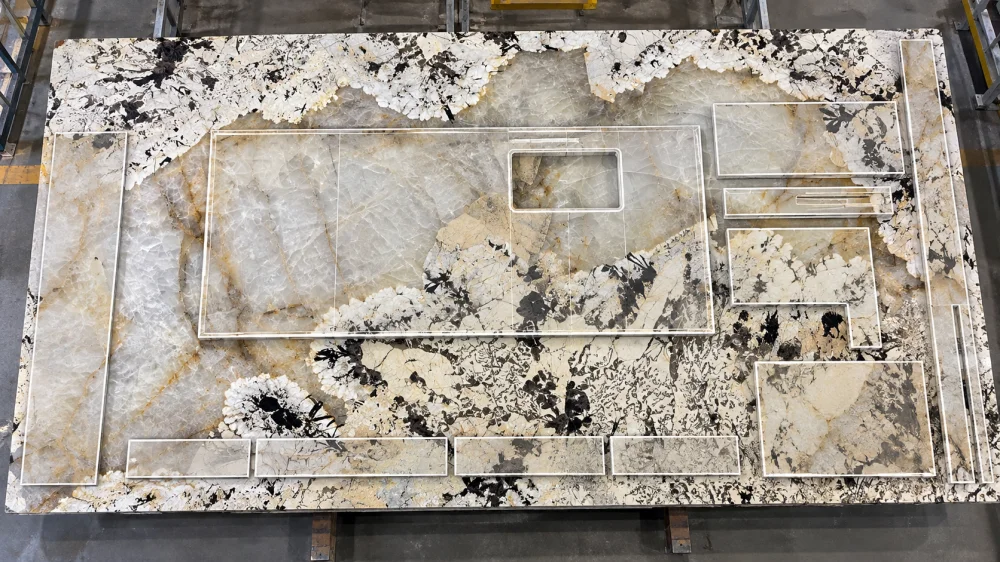
The first design task is to identify which area of the slab should become the primary visible surface.
Start with the Main Countertop or Island Top
The largest and most visible component should normally be positioned first.
For a kitchen island, this means placing the top outline over the actual slab image before allocating smaller pieces. The designer and fabricator can then evaluate where the major crystal fields, dark fragments and warm mineral transitions will appear.
The layout should consider the main viewing direction as well. An island seen from a living room may need a different focal composition from one viewed primarily from the kitchen work zone.
Once the main top is established, waterfall ends, perimeter countertops, backsplash pieces and edge strips can be allocated around that decision.
Sink and Cooktop Openings Can Remove the Best Part of the Slab
This is one of the most important fabrication risks with Patagonia Quartzite countertops.
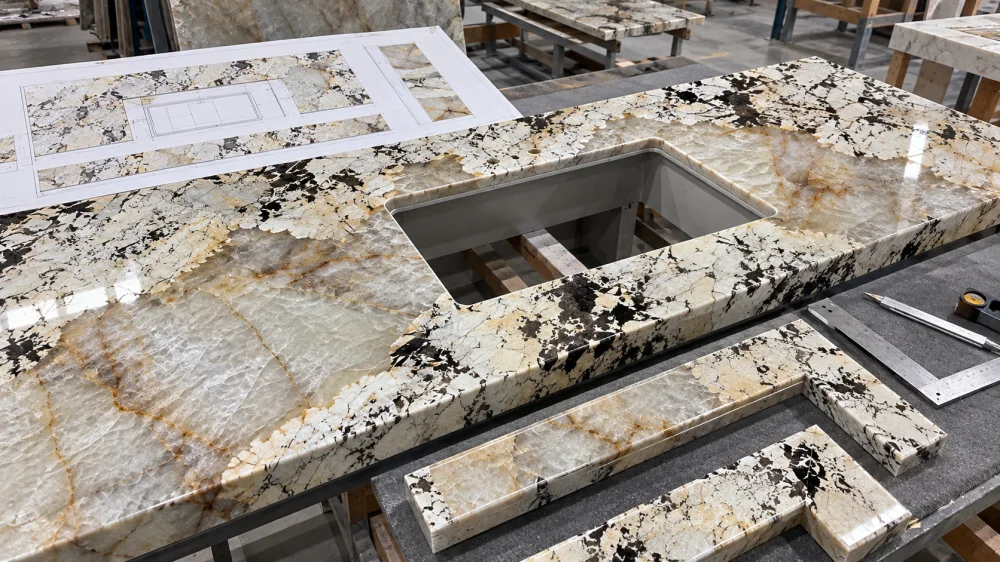
A dramatic crystalline area may look ideal in the center of an island until the sink or cooktop is overlaid on the drawing. If the opening removes much of the approved feature, the final countertop may look completely different from the slab photograph the buyer originally selected.
Large openings also create narrower stone areas around the cutout. The actual natural features in those rails should be reviewed before fabrication rather than assuming that every part of the slab behaves identically.
This is why countertop drawings and actual slab images should be reviewed together before production release.
Do not place a sink or cooktop only from the architectural plan and then assume the slab can adapt around it. Overlay the opening on the real Patagonia slab first. If a major crystal transition, fissure-like feature or repaired area interacts with the opening, the fabricator should review whether repositioning the component or selecting another slab area is preferable.
Waterfall Panels Need to Be Allocated at the Same Time
Waterfall ends should not be treated as secondary pieces cut later from whatever remains.
With Patagonia Quartzite, the visual difference between a large pale crystal area and a darker fragmented area can be significant. If the island top is calm and light while the waterfall end is taken from a completely unrelated dark zone, the finished object may look disconnected.
The waterfall panel should therefore be considered when the main top is positioned. Exact vein continuation is not always necessary, but the visual relationship should be intentional.
For projects where waterfall continuity is especially important, the broader CENTURY STAR guide on Quartzite kitchen island procurement explains how slab approval, CAD layouts, cutouts, waterfall relationships, QC and packing should be managed as connected stages.
Actual Slab Approval and Cutting-Layout Approval Are Different
A buyer may approve a Patagonia slab because the overall color and geological composition are attractive. That is only the first approval.
The second approval is the cutting layout: where the island, perimeter countertops, waterfall panels and other visible pieces will actually be cut from the approved material.
CENTURY STAR’s guide to Zatwierdzenie płyty z naturalnego kamienia na miejscu przed wykonaniem makes this distinction clear. A slab can be acceptable as material but still fail as a countertop layout if the most important visual areas are lost or critical natural features land in undesirable fabrication zones.
For Patagonia Quartzite, this two-stage approval is particularly useful because the slab often contains visibly different geological regions.
What Should Buyers Inspect in the Actual Slab?
- Complete slab composition: review the full geometry, not only close-up beauty areas.
- Crystal-zone distribution: identify which crystalline areas should remain visible in the finished top.
- Dark mineral fragments: determine whether concentrated dark zones are desired in focal surfaces or better placed elsewhere.
- Warm transitions: compare cream, beige and gold-toned areas across the slab group.
- Naturalne cechy: review fissure-like areas, repairs, resin or mesh backing where present.
- Slab-to-slab variation: if several slabs are needed, evaluate them as one project group.
- Finish condition: make sure the approved visual evidence represents the finish being ordered.
Istniejący Kwarcyt Patagonia page can serve as the broader material reference, while the countertop project should still be approved from the exact slabs allocated to the job.
Edge Design Can Expose a Different Part of the Stone
Countertop edges are visually important with highly varied stone.
A simple finished edge shows the natural section at the perimeter. A mitered or built-up thick-look edge introduces an additional strip that may come from a different part of the slab.
If the top contains a pale crystal field but the visible edge strip comes from a concentrated dark zone, the resulting edge can look disconnected unless that contrast was intended.
The fabrication drawing should therefore identify visible edges, miter strips and returns before the final slab allocation is released.
What About Seams?
Seam location should balance transport, fabrication, installation and visual composition.
For Patagonia Quartzite, a seam can become especially visible when one side of the joint is dominated by a pale crystalline zone and the other by a darker mineral field.
This does not mean every seam must reproduce perfect geological continuity. Natural stone is not printed material. The goal is to avoid unnecessary visual conflict while maintaining a practical fabrication and installation strategy.
Polished or Honed Patagonia Quartzite?
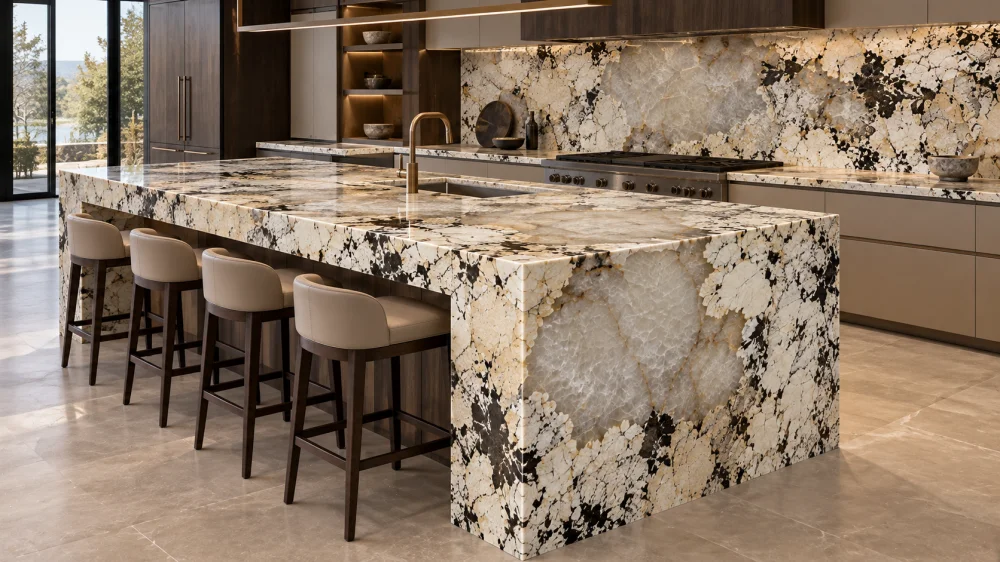
The finish changes how crystal depth, reflection and color contrast are perceived.
A polished surface can emphasize crystalline depth and stronger color contrast. A honed surface can reduce reflection and create a softer visual character.
The correct finish depends on the interior concept, lighting and maintenance expectations. Buyers should review representative finished material rather than assuming that a raw or warehouse slab photograph predicts the installed appearance exactly.
Countertop Performance Should Be Evaluated on the Actual Material
Patagonia is commercially sold as Quartzite, but the stone name alone should not be used to promise universal performance.
Natural stone can vary in mineral composition, fissure structure, treatment and finish. Countertop suitability should therefore combine correct material identification, the actual slab condition, fabrication planning, installation and maintenance.
Natural Stone Institute guidance for countertops similarly emphasizes understanding the characteristics of the actual natural stone and setting appropriate expectations for fabrication, installation, care and maintenance.
For routine care, neutral stone-compatible cleaning is preferable, spills should be addressed promptly, and sealing should be evaluated for the actual stone and finish rather than assigned to a fixed universal schedule.
QC Should Follow the Approved Slab Layout
Quality control is strongest when it verifies a decision that was already approved.
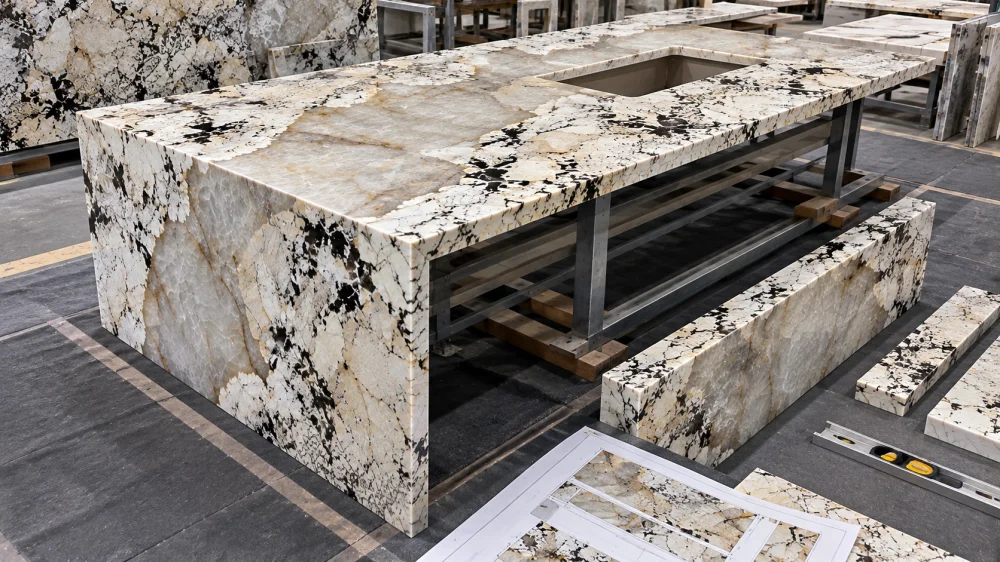
Before cutting, the project should have an identifiable slab group, drawing revision, cutting layout, finish and visible-edge requirements.
After fabrication, inspection can then check whether the finished pieces correspond to that approved information.
Useful QC items may include:
- piece identification;
- overall component relationship;
- otwory na umywalkę i płytę kuchenną;
- visible edge and miter quality;
- finish consistency;
- waterfall orientation;
- surface condition;
- relationship of major crystal zones to the approved layout.
Patagonia Quartzite Countertop Procurement Checklist
- Confirm that the material being supplied is the approved Patagonia Quartzite.
- Review complete actual slabs rather than only samples or cropped photographs.
- Compare all required slabs together if the project needs more than one.
- Confirm countertop, island and waterfall geometry.
- Overlay sink, cooktop and other major openings on the actual slab layout.
- Approve the position of major crystal zones and dark mineral areas.
- Confirm seams, edges, miter strips and visible returns.
- Approve the selected finish on representative material.
- Keep slab approval separate from final cutting-layout approval.
- Define what QC evidence must be reviewed before packing.
Patagonia Quartzite countertops work best when the slab’s dramatic geology is treated as part of the fabrication plan rather than as decoration added after the drawing is complete. Approve the actual slab, identify the primary crystal zones, position the main top first, overlay sink and cooktop openings, coordinate waterfall panels and visible edges, then verify that fabrication follows the approved layout. The strongest countertop is not simply the most dramatic slab—it is the slab whose natural composition can be converted successfully into the required countertop geometry.
Często zadawane pytania
1. Is Patagonia Quartzite good for countertops?
Yes, it can be an excellent countertop and island material when the actual slabs are carefully selected and the layout accounts for major crystal zones, natural features, cutouts, edges and fabrication requirements.
2. Why is slab layout especially important with Patagonia Quartzite?
Patagonia can contain large visually different geological zones within one slab. The cutting position determines whether crystalline areas, cream transitions and darker fragments appear in the intended parts of the finished countertop.
3. Can a sink cutout affect the appearance of a Patagonia countertop?
Yes. A sink or cooktop can remove a large part of an important crystal zone or create narrow rails near natural features. The openings should therefore be overlaid on the actual slab before cutting.
4. Is Patagonia Quartzite suitable for waterfall islands?
Yes. Waterfall islands can showcase the stone effectively, but the top and vertical panel should be allocated together so their color, crystal zones and overall geological movement create an intentional relationship.
5. Should the full Patagonia slab be approved before fabrication?
Yes. Full-slab approval helps buyers assess complete geological variation, while a separate cutting-layout approval confirms where the countertop pieces will actually be positioned within that slab.
6. Does Patagonia Quartzite need sealing?
It depends on the actual material, finish and existing treatment. A compatible impregnating treatment may improve stain resistance where appropriate, but sealing does not make natural stone completely stain-proof.
7. What should be checked before Patagonia Quartzite countertops are packed?
Check piece identity, finish, visible edges, cutouts, miter or waterfall relationships, surface condition and whether the important crystal zones correspond to the approved slab layout.
8. Is every Patagonia Quartzite slab suitable for the same countertop design?
No. Slab composition varies naturally, and different crystal distributions, dark fragments and usable areas can make one slab more appropriate than another for a particular island or countertop geometry.
Referencje
- Natural Stone Institute — Natural Stone Countertops: Considerations for Kitchen and Bath Applications.
- Natural Stone Institute — Care & Cleaning of Natural Stone.