


How Should a Stone Dining Table Be Designed for Knock-Down Export Assembly?
Begin by deciding which parts of the dining table should remain separate during transport, then engineer the connections, support and final appearance around that decision.
For many large custom stone tables, shipping the complete table as one permanently assembled object is not the most practical option. A large stone top can be difficult to lift, pass through doors or elevators, protect inside a crate and safely position at the destination. A sculptural pedestal may also create a very different packing risk from the flat tabletop.
A controlled knock-down design can separate the table into a removable tabletop, one or more base components and any concealed support elements required by the design. These parts are fabricated and trial-assembled together at the factory, identified individually, packed separately or in coordinated crates, and reassembled on site.
Design the table as Stone + Slab Composition + Top + Base + Support + Connection + Trial Assembly + Component ID + Packing + Site Reassembly. Knock-down construction should be part of the furniture concept, not an emergency solution added after fabrication.
Why Design the Table for Knock-Down Assembly?
The main benefit is not simply reducing crate size. A controlled assembly strategy can improve several parts of the project simultaneously.
- Handling: Individual components may be easier to lift and control than one complete stone table.
- Site access: Separate pieces may pass through doors, corridors, elevators or stairways that would restrict a fully assembled table.
- 포장: A flat tabletop and a sculptural pedestal can receive different protection instead of being forced into one universal crate arrangement.
- QC: The factory can trial-assemble the complete table before packing, then inspect each component independently.
- Replacement: Clear component identification can make future reference or replacement work more manageable.
However, a knock-down table creates additional engineering responsibilities. Connections must align repeatedly, the top must sit correctly on the base, concealed hardware must remain accessible, and the assembled furniture must retain the intended visual proportion.
1. Decide the Component Split Before Choosing the Connection
Start by determining what should travel as separate furniture components.
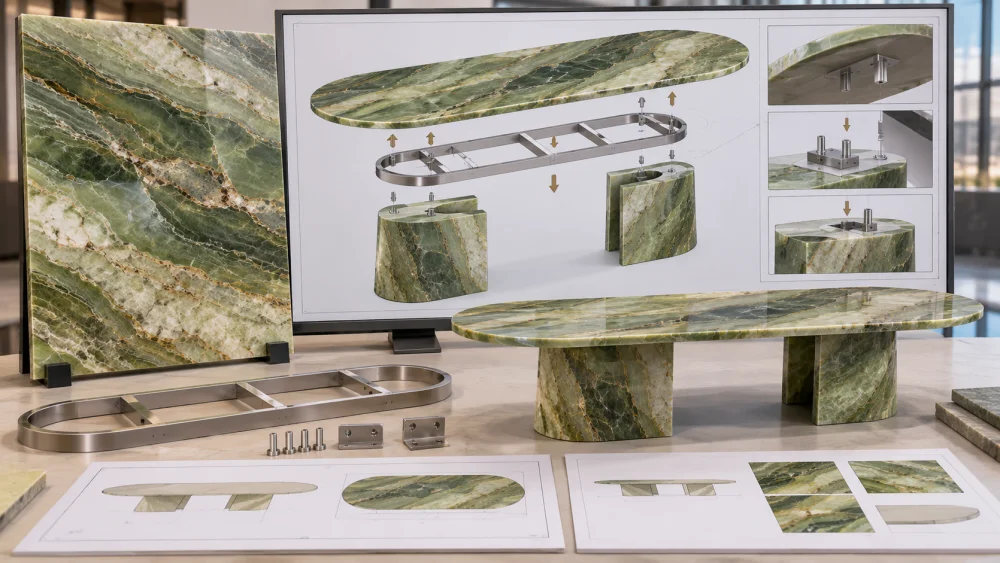
A relatively straightforward design might use a removable tabletop and one complete pedestal. A larger table could use a tabletop plus two bases. A sculptural pedestal may itself need to divide into several transportable sections.
The correct split depends on:
- tabletop length, width or diameter;
- stone weight and component geometry;
- base form and support footprint;
- visible joints;
- destination access;
- lifting method;
- crate dimensions and transport handling;
- how many assembly steps are acceptable on site.
A table should not be divided into more pieces simply because it is technically possible. Every removable component introduces another joint, identification point and assembly operation that must remain controlled.
Knock-Down Design Decision Matrix
| 디자인 요소 | 공학적 고려사항 | 구매자 결정 |
| Tabletop | Large flat stone component requires controlled lifting, support and edge protection. | Confirm whether the top travels separately from the base. |
| Base / Pedestal | Geometry may be bulky, hollow, stone-clad or made from several structural components. | Decide whether the base remains complete or separates into transport sections. |
| Connection | Must transfer the intended loads while allowing repeatable assembly. | Approve connection concept before stone fabrication. |
| Hidden Support | Support geometry affects stability, span and connection access. | Coordinate support with both top and base. |
| Site Access | Door, corridor, lift and stair restrictions can control component size. | Confirm destination access before finalizing the component split. |
| 포장 | Different furniture components have different fracture and handling risks. | Approve a component-specific packing strategy. |
2. Select the Stone and Slab With Furniture Assembly in Mind
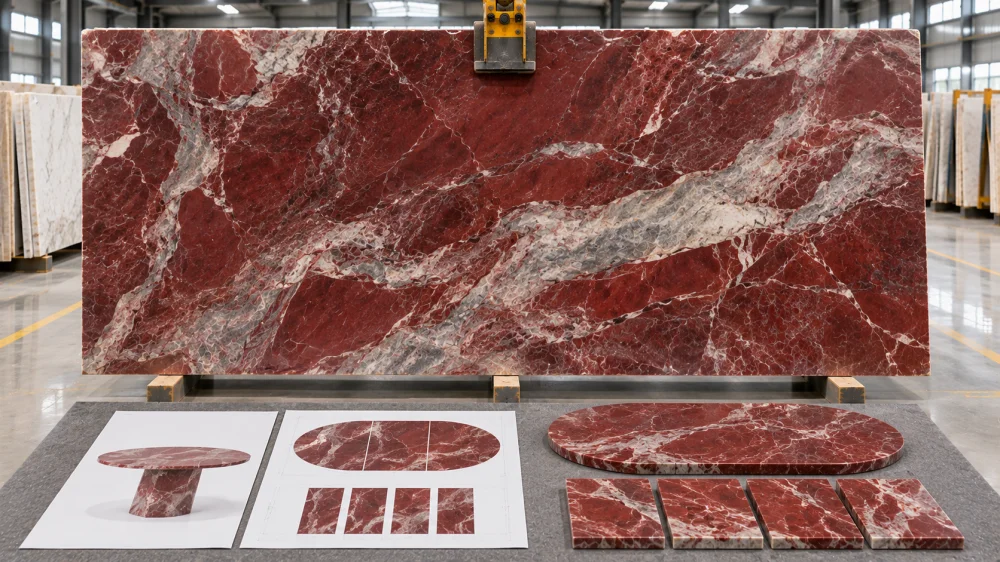
Knock-down design does not remove the importance of slab selection. In fact, detachable furniture can expose more stone surfaces and more visible joints than a simple architectural installation.
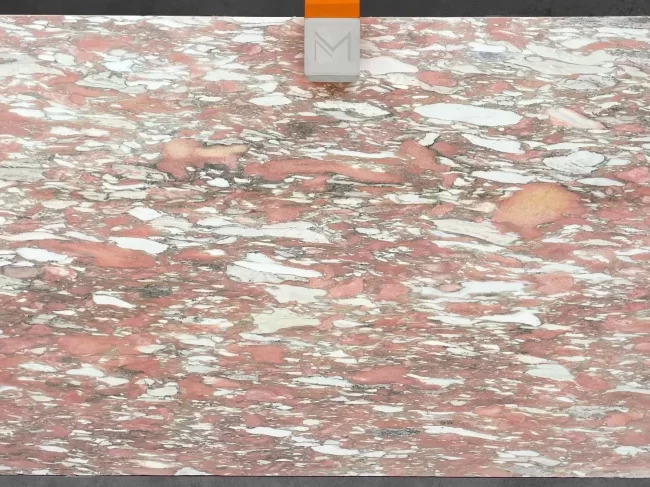
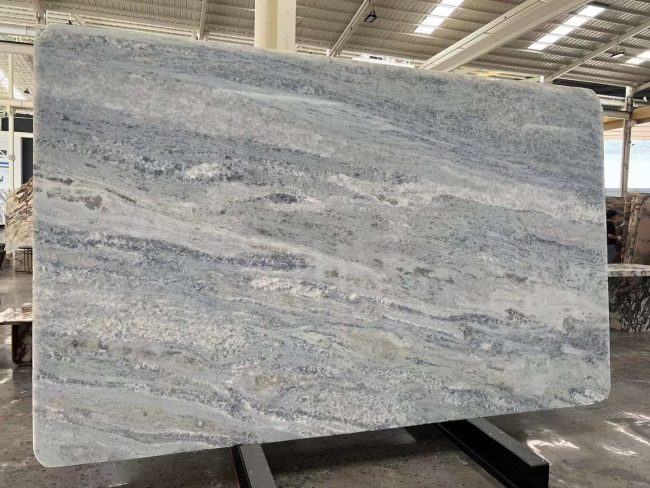
The tabletop should be positioned intentionally within the approved slab so that the strongest mineral movement, crystal field or vein composition appears in the principal viewing area.
The base may require another section of the same slab or a coordinated slab group. If the pedestal is stone-clad or fabricated from several pieces, the relationship between front faces, sides, corners and connection zones should be reviewed before cutting.
The broader CENTURY STAR 고급 식탁 가이드 explains why actual slab composition, tabletop proportion, base design, connection and export packing need to be developed as one furniture system.
For highly expressive materials, furniture-specific product references such as 랑그도크 대리석 also demonstrate why the tabletop, visible edge and pedestal should be considered together rather than selecting stone for each component independently.
3. Design the Base as a Support System, Not Just a Sculpture
A sculptural stone pedestal may define the visual identity of the table, but its first engineering responsibility is to support the top.
The design team should review:
- support footprint beneath the tabletop;
- tabletop projection beyond the support;
- hidden structural plates or frames where required;
- load transfer through pedestal components;
- connection access during assembly;
- base stability after final tightening or locking;
- floor interface and adjustment strategy where relevant.
The base design must also account for transportation. A pedestal that is visually elegant but impossible to secure inside a crate creates unnecessary export risk.
Do not assume that making the stone base heavier automatically makes the dining table more stable. Stability depends on the complete relationship among tabletop geometry, center of mass, support footprint, structural system, connections and final assembly.
4. Choose Connections for Repeatable Assembly
The connection system should allow the table to be assembled at the factory, dismantled for export and assembled again at the destination without relying on improvisation.
Depending on the furniture design, connections may involve concealed mechanical fasteners, threaded inserts, structural plates, brackets or another project-specific system. No single hardware detail is appropriate for every natural-stone table.
The connection design should answer five questions:
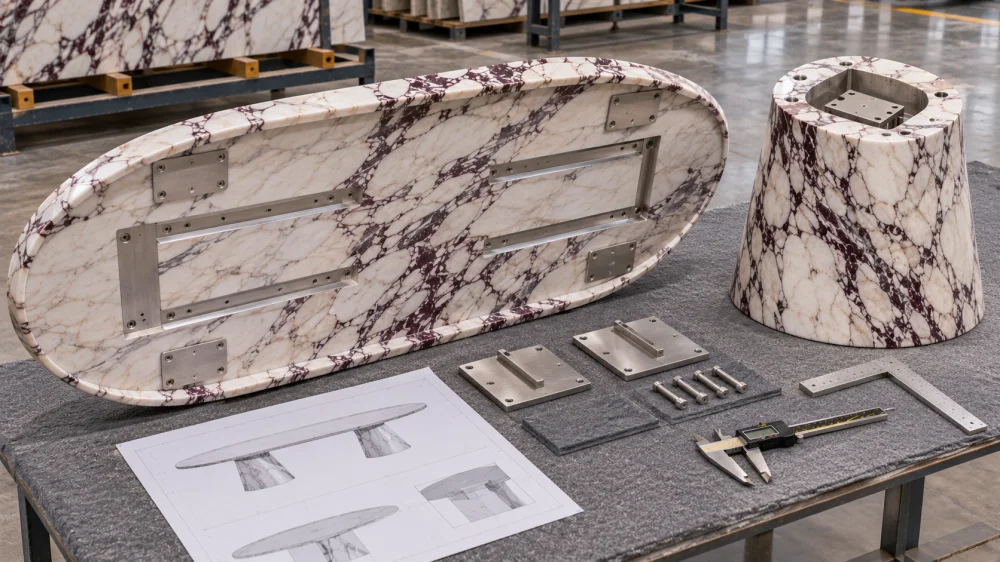
- Can the components locate themselves accurately during assembly?
- Can the installer access the connection without damaging finished stone surfaces?
- Does the connection support the required furniture geometry?
- Can the table be dismantled without destroying bonded decorative parts?
- Will the visible result remain clean after final assembly?
The selected hardware, support system and connection dimensions should be engineered for the actual table rather than copied from another furniture design.
5. Keep Structural Joints and Visual Joints Under Separate Control
Not every visible stone joint should also serve as the principal structural connection.
A decorative miter, veneer joint or cladding seam may be designed for visual continuity, while the furniture load is transferred through a concealed frame or internal connection system.
This distinction is especially important with stone-clad hollow bases. The external stone shell may create the appearance of a massive monolithic pedestal while an internal structural system provides the actual assembly logic.
Designers should therefore review both:
- what the guest sees; 그리고
- what actually holds the furniture together.
6. Trial Assembly Is the Most Important Pre-Packing QC Stage
A knock-down dining table should be completely assembled at the factory before it is exported whenever the design permits.
Trial assembly can verify:
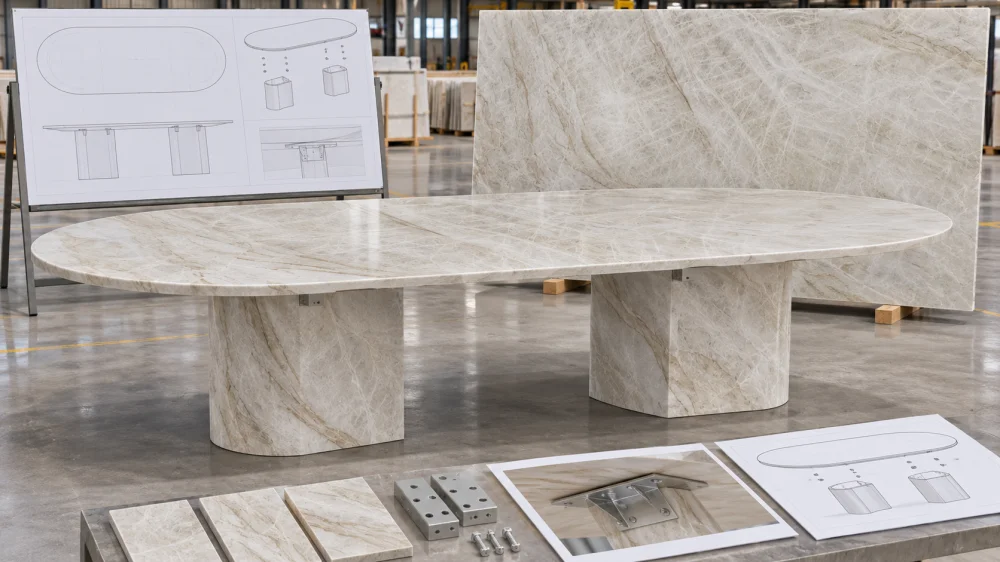
- tabletop-to-base alignment;
- 연결점 정렬;
- 지원 문의;
- overall table height and proportion;
- visible joint quality;
- edge relationship;
- orientation of the slab pattern;
- base stability;
- assembly access;
- whether the proposed disassembly sequence actually works.
This is also the stage to identify whether a connector is difficult to reach, whether a base component needs to be rotated during assembly, or whether the tabletop requires a different lifting approach.
Natural Stone Institute’s current Dimension Stone Design Manual includes a dedicated stone-furniture chapter covering stone surfacing used as table tops rather than continuously supported cabinetry, reinforcing the need to treat furniture as its own engineered application.
7. Create a Controlled Assembly Sequence
The destination team should not need to reverse-engineer the table from photographs.
Before shipment, define the intended reassembly sequence. For example:
- Position the primary base component.
- Install any concealed structural element.
- Connect secondary pedestal sections where applicable.
- Verify base orientation and level.
- Prepare the tabletop lifting route.
- Lower the top onto the intended support points.
- Align locating features and connection points.
- Complete the approved mechanical connection.
- Perform final visual and stability inspection.
The real sequence should be developed from the actual furniture. A complex table may require a different order, lifting method or temporary support.
8. Component Identification Must Survive the Entire Export Process
Piece identification is particularly important when several dining tables are supplied for a hotel, restaurant or multi-unit project.
The factory should maintain a connection between:
Drawing → Table ID → Component ID → Trial Assembly → QC → Crate → Site Reassembly.
If a project has multiple visually similar pedestals or several top-and-base combinations, component identities should not be lost during packing.
The same applies to concealed hardware. Connection parts and installation accessories should be allocated to the correct table package rather than packed as one anonymous group of loose hardware.
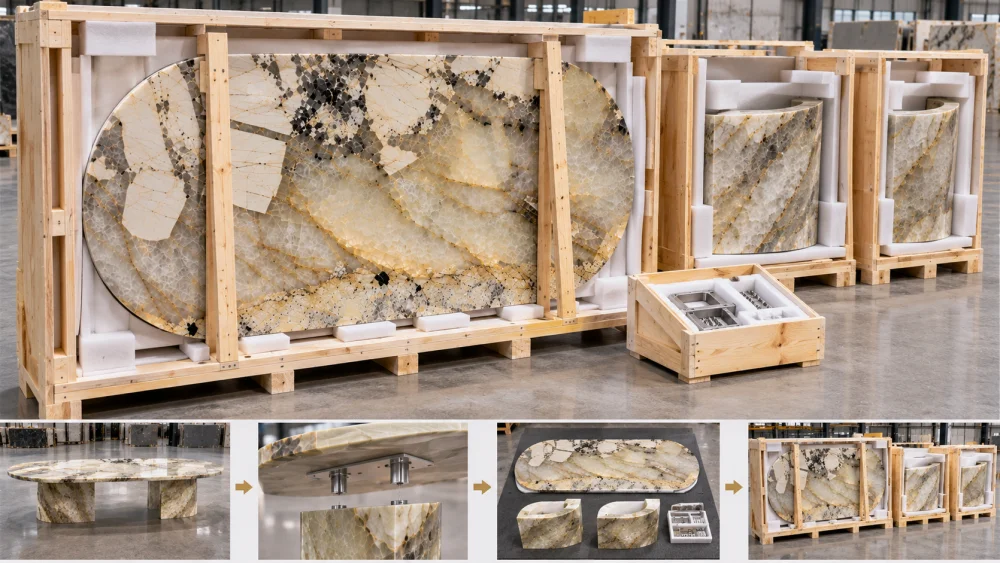
9. Packing Must Follow Furniture Geometry
A stone tabletop and a sculptural pedestal should not automatically receive the same protection.
For a large tabletop, a typical export strategy may require vertical support inside a reinforced wooden frame, with the stone securely restrained, complete edge and corner protection and only the thin protective separation actually needed between stone surfaces.
The base should be protected according to its geometry. A cylindrical pedestal, angular stone-clad base and irregular sculptural support each require different internal timber restraints and contact points.
| Packing Element | 주요 위험 | Protection Strategy |
| Large Tabletop | Flexure, edge impact and surface contact | Vertical restrained support, thin soft separation, reinforced edge and corner protection |
| Pedestal / Base | Movement, local impact and projecting geometry | Geometry-specific blocking, padded contact points and secure internal restraint |
| Connection Hardware | Loss, mixing or incorrect table allocation | Table-specific identification and protected accessory package |
| Assembly References | Installer cannot reconstruct factory-approved configuration | Current drawing, component references and assembly sequence supplied with project records |
Current CENTURY STAR furniture-related material pages also distinguish table tops and stone furniture from other product formats and recommend geometry-specific packing rather than one universal crate arrangement.
10. Design for the Destination, Not Only the Factory
The table may assemble perfectly in the factory but still fail as a delivery strategy if the destination cannot accommodate the components.
Before production release, collect relevant access information such as:
- delivery entrance;
- door clearances;
- corridor turns;
- elevator access;
- stair conditions;
- temporary site storage;
- assembly area around the final table position;
- lifting equipment restrictions.
This information does not replace site engineering, but it can prevent the furniture from being designed as one component that is physically impossible to move into the room.
Buyer Specification Checklist for Knock-Down Stone Dining Tables
- Final table shape and overall dimensions.
- Natural stone or visual material direction.
- Actual slab approval requirement.
- Tabletop thickness and visual edge concept.
- Base material and geometry.
- Support footprint and hidden structure concept.
- Removable top, removable base or multi-part knock-down strategy.
- Connection method and assembly access.
- Number of identical or related tables.
- Component and hardware identification system.
- Factory trial-assembly requirement.
- QC evidence required before disassembly.
- Destination access constraints.
- Top and base packing strategy.
- Crate-to-component allocation.
- Site assembly information and final inspection requirement.
For a strong Quartzite furniture reference, 샹그릴라 규암 is currently presented for dining-table applications and illustrates why custom stone furniture requires deliberate slab selection and fabrication rather than generic cut-to-size processing.
Define the component split before fabrication, develop the base and support system with the tabletop, make the connections accessible and repeatable, trial-assemble the complete table, identify every piece, then pack the top, base and hardware according to their individual risks. Export assembly works best when dismantling and reassembly are part of the original furniture design—not decisions made after the table is already complete.
자주 묻는 질문
1. What is a knock-down stone dining table?
A knock-down stone dining table is designed with removable components, such as a detachable tabletop, pedestal or multi-part base, so the furniture can be trial-assembled at the factory, dismantled for transport and assembled again at the destination.
2. Should a large stone dining table be shipped fully assembled?
Not necessarily. A fully assembled table may be difficult to handle, protect and move through the destination. A controlled removable-top or knock-down design can be more practical when the connections and support system are engineered in advance.
3. Can the stone tabletop simply sit loose on the base?
That should not be assumed. The required restraint and connection depend on the actual tabletop, base geometry, support system and furniture design. The appropriate connection should be developed for the specific table.
4. Should a knock-down stone dining table be trial-assembled before export?
Yes, where the design permits. Trial assembly verifies top-to-base alignment, connection points, support contact, visible joints, overall proportion, stability and the practical disassembly sequence before packing.
5. Can a stone pedestal also be made in removable sections?
Yes, some sculptural or large bases can be divided into transportable components. However, every additional joint creates another structural, visual and assembly condition that must be controlled.
6. How should the tabletop be packed for export?
The packing should reflect the actual tabletop geometry. Large tops commonly require strong vertical support, secure internal restraint, thin soft separation where needed, and reinforced edge and corner protection. The exact crate design should be developed for the specific piece.
7. How should connection hardware be packed?
Hardware should remain linked to the correct furniture component or table ID and be protected from loss or mixing. For projects with multiple tables, the identification system should remain consistent from trial assembly through site installation.
8. What information should a buyer provide before designing a knock-down stone table?
Provide the table dimensions and shape, material direction, base concept, desired visual edge, quantity, assembly preference and destination-access constraints. Drawings or design references are particularly important for large or sculptural tables.
참조
- Natural Stone Institute — Dimension Stone Design Manual, Chapter 19: Stone Furniture.