



How Can Buyers Verify a Stone Factory’s Real Fabrication Capability?
Test the factory against the type of custom work you actually need. A factory may be capable of cutting standard tiles but not controlling a bookmatched reception wall, complex vanity, large waterfall island or custom stone furniture package. The relevant question is not “What machines do you have?” but “Can your current people, equipment, drawings, process controls and QC system repeatedly produce this specific scope?”
For procurement teams, capability verification should follow a practical chain:
Project Requirement → Drawing Review → Material / Slab Evidence → Process Plan → Trial or Comparable Fabrication Evidence → QC Method → Packing / Traceability → Buyer Approval.
- Send a representative drawing or fabrication detail.
- Ask the factory to explain its production route before quoting capability.
- Verify which processes are done in-house and which are outsourced.
- Request project-relevant fabrication evidence, not generic machine photographs.
- Check how actual stone variation is connected to cutting and layout decisions.
- Ask what QC evidence is recorded before packing.
- Verify piece identification, crate allocation and revision control.
- Use a sample, mock-up or trial component when the risk justifies it.
A Large Factory Is Not Automatically the Right Factory
Factory scale can matter, particularly when a project requires many coordinated pieces or repeated production. But floor area, employee count and machine quantity do not prove that the supplier can control a complex custom stone package.
Custom fabrication depends on the relationship between several systems:
- drawing interpretation;
- stone selection and slab allocation;
- cutting and machining;
- manual finishing;
- edge and joint control;
- piece identification;
- dimensional and visual QC;
- packing and logistics.
A factory can own advanced machinery yet still lose control if the approved drawing revision is not connected to production or if finished pieces cannot be traced back to the approved layout.
Step 1 — Start the Factory Audit With a Real Project Requirement
The best capability audit begins with the work the buyer actually needs.
If the project includes countertops, show the supplier the sink openings, miters, waterfalls, visible edges and seam conditions. If it includes wall panels, provide the panel elevation, openings, returns and vein-direction requirements. For furniture, provide the top geometry, base concept, visible joints and assembly logic.
CENTURY STAR’s guide to disegni di preventivo per fabbricazione di pietra explains why plans, elevations, dimensions, openings, visible edges and drawing revisions should be exposed at quotation stage. Those same inputs are useful when verifying fabrication capability because they reveal whether the supplier can interpret the real scope rather than respond to a generic product inquiry.
A competent supplier should be able to identify missing information, technical interfaces and assumptions instead of silently filling gaps.
Step 2 — Ask the Factory to Explain the Production Route
Do not begin by asking for a machine list. Ask how the component will be produced.
For a custom piece, the supplier should be able to explain the major sequence from approved drawing to finished inspection. The exact equipment may differ by geometry and material, but the process explanation should make technical sense.
For example, a buyer may ask:
- Which operation establishes the primary geometry?
- Which details require CNC, waterjet, bridge saw or manual finishing?
- How are miters or complex visible edges completed?
- How are openings verified before machining?
- How is a highly variable slab connected to the cutting plan?
- Which stages require manual inspection?
A clear production route is stronger evidence than a photograph of an expensive machine with no connection to the project.
Factory Capability Verification Matrix
| Fase di approvvigionamento | What to Confirm | Prove da richiedere | Risk if Missed |
| Revisione del disegno | Factory understands component geometry and interfaces | Marked drawing, clarification list or proposed shop-drawing logic | Production starts from misunderstood geometry |
| Material Control | Actual stone can be allocated to the required components | Slab photos, sample approval or cutting-layout evidence | Visual or natural features conflict with fabrication |
| Lavorazione | Equipment and hand-finishing process fit the geometry | Relevant production evidence or trial component | Machine capability is assumed rather than demonstrated |
| QC | Inspection points match project risks | QC checklist, measurements, close-ups or dry-layout evidence | Errors are discovered only after packing or installation |
| Traceability | Pieces remain connected to current drawings and approvals | Piece IDs, revision control and packing records | Correct pieces are produced but installed in the wrong position |
| Packing / Handover | Finished geometry is protected for the real transport route | Internal packing and closed-crate evidence | Fabrication quality is lost during transport |
Step 3 — Verify Drawing Capability, Not Only Cutting Capability
A custom stone factory must be able to translate architectural intent into controlled production information.
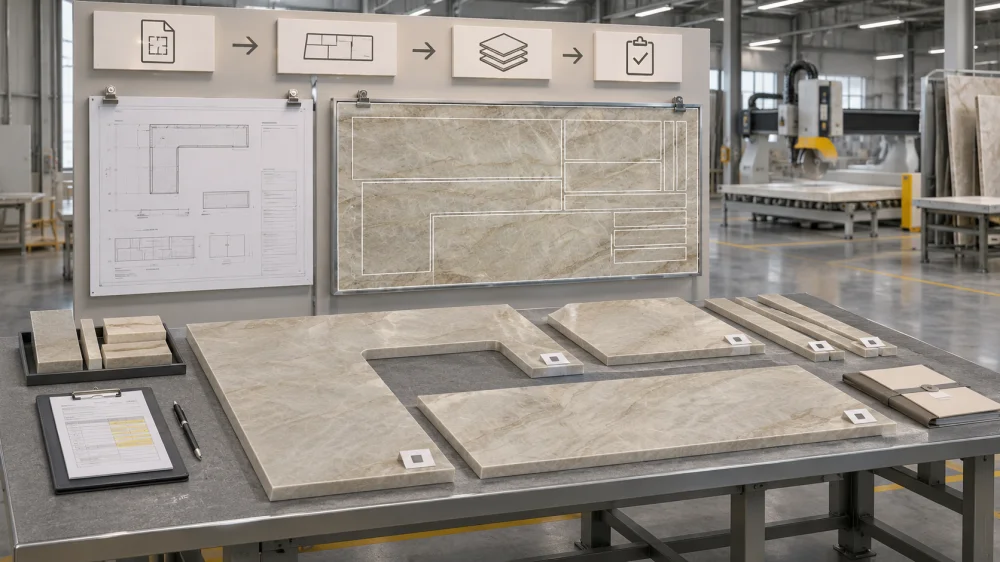
The buyer should verify whether the supplier can distinguish among:
- architectural or design drawings;
- quotation-stage information;
- shop drawings;
- cutting lists or fabrication files;
- approved revisions.
A strong technical team should not treat an early design PDF as an automatic cutting file. Unresolved dimensions, edge details, openings or installation interfaces should be identified before fabrication release.
This is particularly important when several drawings change during the project. Ask the factory how it prevents an obsolete revision from entering production.
Ask for a project-relevant example showing the chain from design drawing → shop drawing → piece identification → finished component. The purpose is not to collect confidential customer information; it is to verify that the factory has a controlled technical conversion process.
Step 4 — Check Whether the Factory Can Control Actual Natural Stone
Fabrication capability for natural stone is not only about machining geometry.
Marble, Quartzite, Granite, Onyx, Travertine and other stones can vary in veining, fissures, crystalline zones, pores, repairs and slab-to-slab appearance. A factory producing custom work should be able to connect those characteristics to the cutting plan.
For visually important projects, verify whether the supplier can:
- photograph or document actual slabs;
- reserve an approved slab group where appropriate;
- map components onto the selected material;
- control vein or pattern direction;
- identify natural features that affect narrow pieces or openings;
- conduct dry layout when project risk justifies it.
Without this step, a factory may fabricate dimensions correctly while producing a visually unacceptable project.
Step 5 — Match Machines to the Required Work
Equipment matters, but the buyer should evaluate equipment in relation to the project rather than by brand count.
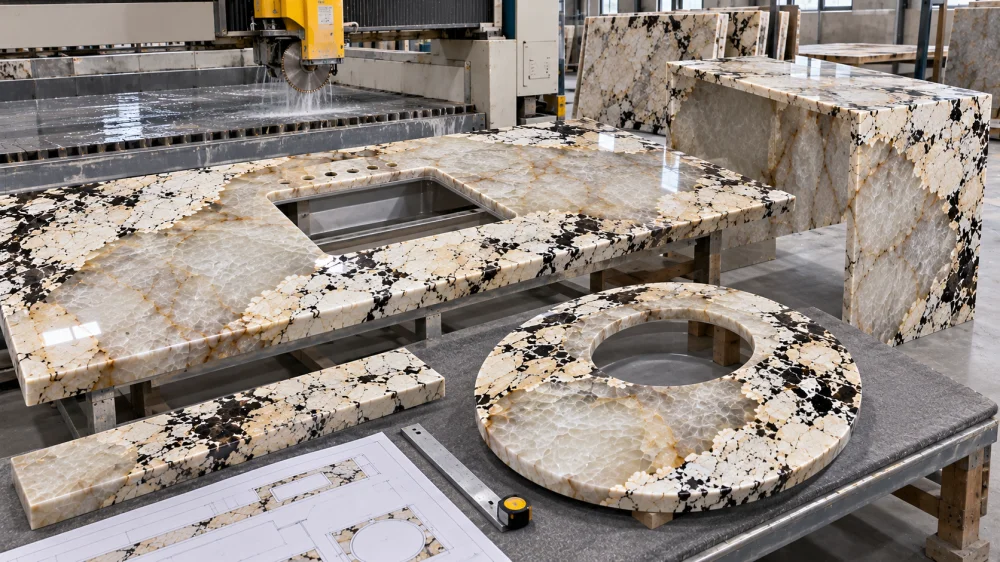
A bridge saw may be suitable for one operation, a CNC may be valuable for another, and a waterjet may be appropriate for selected intricate geometry. Many custom details still depend on experienced hand finishing, assembly and inspection after automated machining.
Questions should focus on capability:
- Can the factory produce the required shape?
- Can it machine openings and visible details consistently?
- Can it finish edges after machine cutting?
- Can it control related pieces as one assembly?
- Can it repeat the result across multiple units?
Machine ownership by itself does not answer these questions.
Step 6 — Use a Trial Piece or Mock-Up for High-Risk Details
For unusual geometry, demanding edge work, new material combinations or large repeat quantities, a trial component can be stronger evidence than a catalogue of past projects.
The trial does not always need to reproduce the entire project. It should reproduce the fabrication risk that matters.
Examples include:
- a representative miter corner;
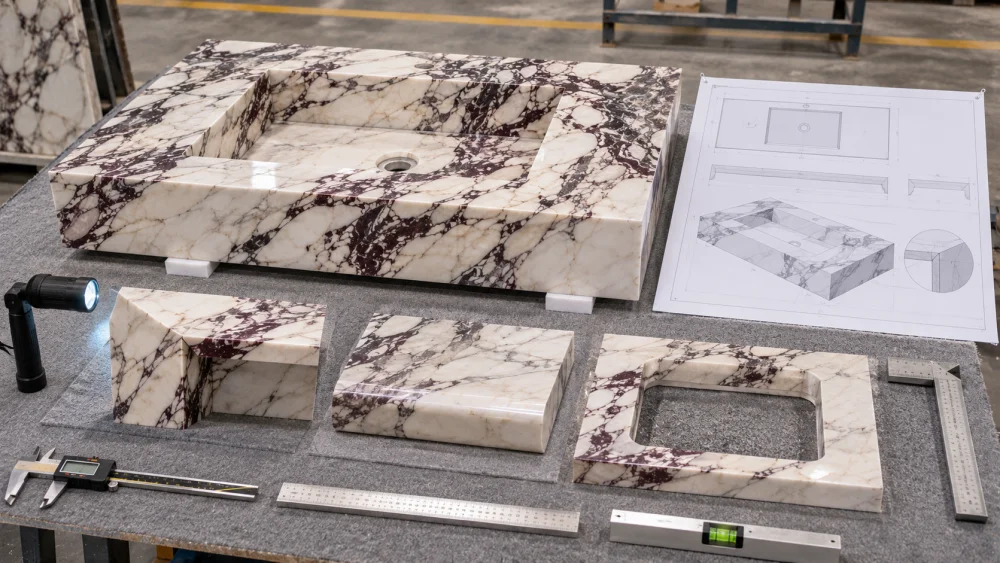
calacatta violet marble trial piece first article qc - a shaped edge section;
- a sink or fixture opening;
- a curved component;
- a bookmatched joint;
- a furniture connection detail;
- a finish transition.
The buyer can then review material behavior, edge quality, assembly, finish and dimensional control before larger-scale production begins.
Step 7 — Verify QC as a Process, Not a Final Photograph
A finished product photograph shows appearance at one moment. It does not prove that the factory has a repeatable quality-control system.
Ask where inspection occurs in the production process.
Depending on the project, useful control points may include:
- incoming slab or material approval;
- drawing / revision release;
- first-piece inspection;
- dimensional checks during fabrication;
- edge, miter and opening inspection;
- dry assembly or dry layout;
- surface / finish inspection;
- piece identification;
- packing inspection.
The factory should be able to explain what gets checked and how the result is recorded.
Step 8 — Test Repeatability for Multi-Piece and Repetitive Projects
One excellent sample does not prove that fifty or five hundred related pieces will remain coordinated.
Hotels, multi-unit residential projects, retail rollouts and commercial interiors may require repeated vanities, countertops, wall panels, thresholds, furniture parts or other component families.
For this type of project, ask how the supplier controls:
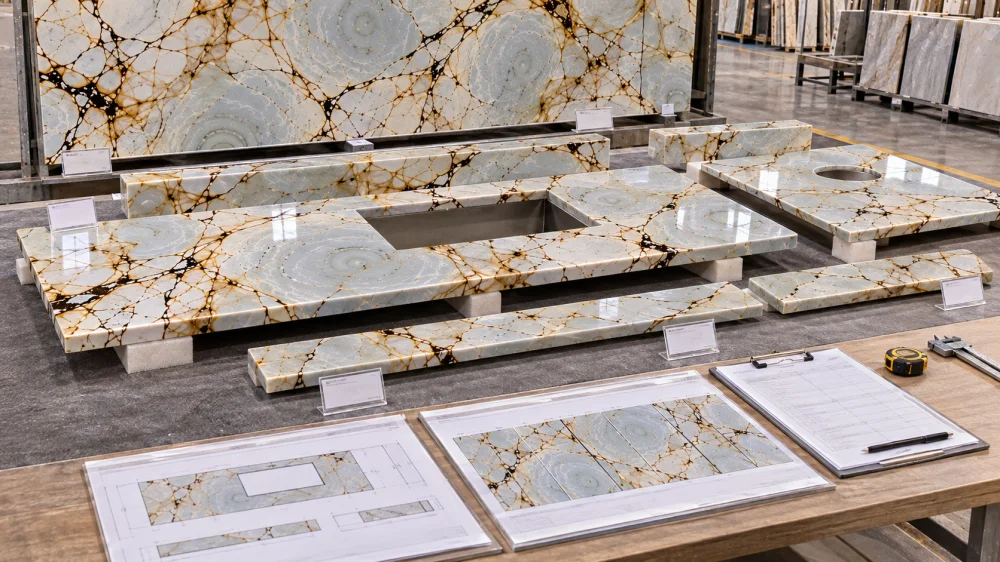
- piece numbering;
- drawing revisions;
- material batches;
- finish consistency;
- repeated geometry;
- replacement pieces;
- packing by room, area or installation sequence.
Production capacity is therefore not only “pieces per day.” It is the ability to maintain approved requirements while volume increases.
Step 9 — Verify What Is Actually In-House
Outsourcing is not automatically a problem. Many professional supply chains use specialized subcontractors.
The procurement risk appears when the buyer assumes a critical process is controlled in-house but the supplier cannot explain where it is performed, who controls the drawing revision or how QC is transferred between companies.
Ask which operations are:
- performed in the main factory;
- performed at another controlled facility;
- outsourced to a specialist;
- inspected before returning to the project workflow.
The important issue is responsibility and traceability, not whether every machine sits under one roof.
Step 10 — Check Packing as Part of Fabrication Capability
A factory that produces accurate stone but cannot protect it for delivery does not provide a complete project capability.
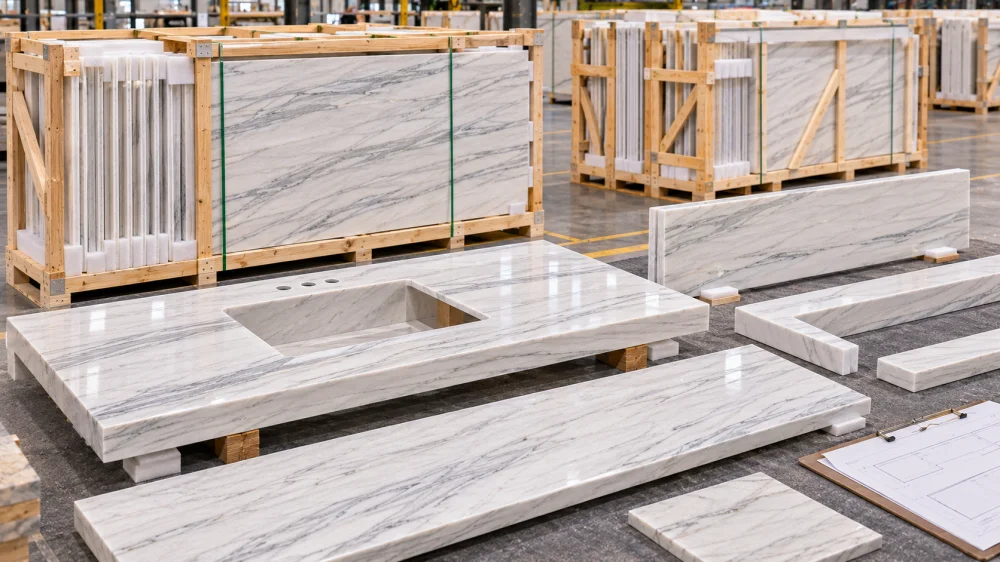
Packing should respond to the product geometry. Slabs, tiles, finished countertops, wall panels and stone furniture should not automatically use the same internal support logic.
Buyers should verify how the factory protects:
- finished edges;
- angoli;
- large openings;
- thin or long components;
- polished surfaces;
- piece labels or project sequence.
The broader CENTURY STAR guide on architectural stone sourcing treats fabrication, QC, packing and logistics as one procurement system rather than independent activities.
Supplier Claims vs Evidence
| Supplier Claim | Prove da richiedere | Buyer Verification |
| “We can fabricate any custom project.” | Relevant drawing-to-finished-piece example or trial component | Does the evidence match the required geometry and finish? |
| “We have advanced machines.” | Production route for the buyer’s actual component | Can the factory explain which operation each machine performs? |
| “We have strict QC.” | Inspection checklist and project-relevant QC evidence | Are inspection points connected to actual project risks? |
| “We control the whole project.” | Drawing revision, piece IDs, slab allocation and packing traceability | Can one finished piece be traced back to its approved information? |
| “We have large capacity.” | Production plan and repeatability controls relevant to the order | Can quality and identification remain controlled as quantity increases? |
Red Flags During a Stone Factory Capability Audit
- The factory shows machines but cannot explain the process for your drawing.
- Complex drawings produce no clarification questions.
- The supplier cannot distinguish quotation drawings from production drawings.
- Actual slab or material variation is disconnected from cutting decisions.
- All QC evidence consists of finished beauty photographs.
- There is no clear piece-identification or revision-control system.
- Critical processing is outsourced but responsibility is unclear.
- Trial fabrication is rejected even when the detail is genuinely high risk.
- Packing is described only as “standard export packing.”
- The factory cannot explain how replacement pieces would be reproduced.
Buyer Checklist Before Approving Fabrication Capability
- Send a representative drawing or component detail.
- Confirm the supplier understands the current drawing revision.
- Ask for clarification questions before judging technical capability.
- Review how the actual stone will be selected and allocated.
- Ask the factory to explain the complete production route.
- Verify machine capability against the required geometry.
- Check the role of manual finishing and assembly.
- Request a trial component when project risk justifies it.
- Review first-piece and in-process QC logic.
- Verify piece identification and revision traceability.
- Confirm which processes are in-house or outsourced.
- Review packing protection for the actual component geometry.
- Confirm how repeat production and replacement pieces are controlled.
For a broader supplier-level assessment beyond fabrication alone, CENTURY STAR’s natural stone supplier and factory evaluation guide expands the review to material access, quotation transparency, export coordination and overall delivery-system reliability.
A capable custom stone factory should be able to prove a controlled chain from drawing → material → process → finished component → QC → packing. Do not award capability simply because the supplier owns CNC, waterjet or bridge-saw equipment. Use project-relevant drawings, actual slab evidence, trial details, inspection records and traceability to verify whether the factory can repeat the required quality at the required scale. The most important evidence is not that a machine exists—it is that the entire production system produces the approved result consistently.
Domande frequenti
1. What is the best way to verify a stone factory’s fabrication capability?
Give the factory a representative project requirement and verify how it converts drawings into production information, selects material, chooses the fabrication process, inspects finished work and protects the components for delivery. Project-specific evidence is stronger than generic factory photographs.
2. Does a CNC machine prove that a stone factory can handle custom projects?
No. CNC equipment can be valuable for suitable operations, but custom fabrication also depends on drawing interpretation, material behavior, programming, manual finishing, assembly, QC and handling. Equipment must be evaluated as part of the complete production system.
3. Should buyers request a trial piece before placing an order?
For high-risk geometry, unusual edges, new material combinations or large repeat orders, a trial piece can be useful. It should reproduce the specific fabrication risk that the buyer needs to verify rather than functioning as a generic sample.
4. How can buyers verify factory QC?
Ask what is inspected at each relevant production stage and request project-appropriate evidence such as first-piece checks, dimensions, edge or opening close-ups, dry-layout images, finish inspection and packing records.
5. Is outsourcing a fabrication process a red flag?
Not automatically. The important questions are who performs the work, which drawing revision controls it, who inspects the result and whether responsibility remains clear. Uncontrolled outsourcing is a risk; transparent specialist subcontracting can be part of a professional supply chain.
6. How do buyers verify production capacity?
Do not rely only on stated daily output. Review whether the factory can maintain material control, drawing revisions, piece identification, finish consistency, QC and packing as order quantity increases.
7. What documents should be checked during a factory audit?
Useful evidence can include current project drawings, revision records, work orders, cutting or slab-layout references, QC checklists, piece-identification records and packing documentation. The exact documents should match the project scope.
8. What is the biggest mistake when auditing a stone fabrication factory?
A common mistake is focusing on factory size and machine brands while ignoring the information flow between drawings, material, fabrication, inspection and packing. Custom-project capability depends on that complete control chain.