


Taj Mahal vs White Macaubas Quartzite: Which Is Better for a Luxury Kitchen?
Taj Mahal Quartzite is generally the stronger design direction for warm, softly layered kitchens, while White Macaubas Quartzite is usually better suited to bright, contemporary kitchens where linear stone movement should reinforce the architecture.
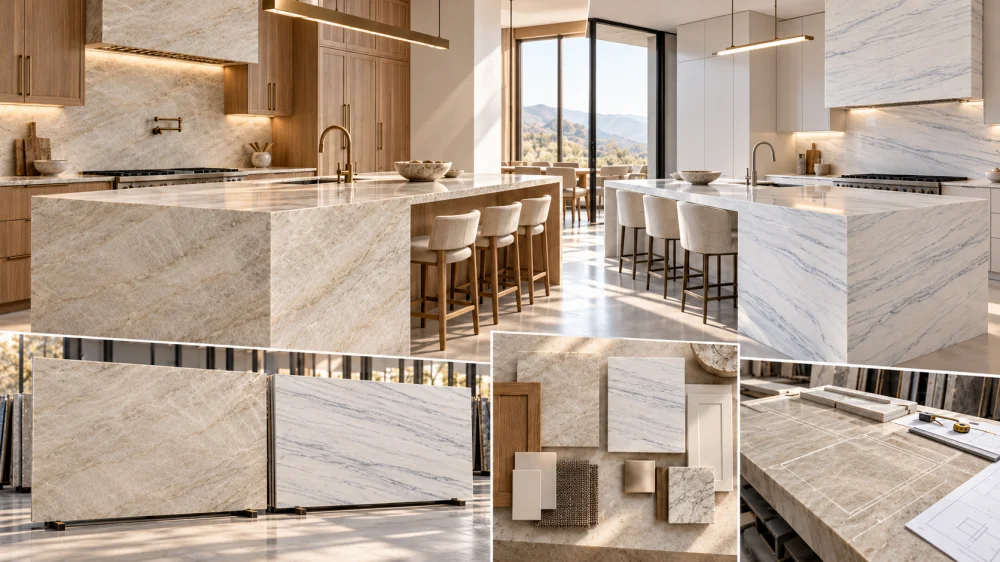
This is a conditional design verdict rather than a universal performance ranking. Both are natural Quartzites used for kitchen countertops, islands and backsplashes, and both can vary substantially from slab to slab.
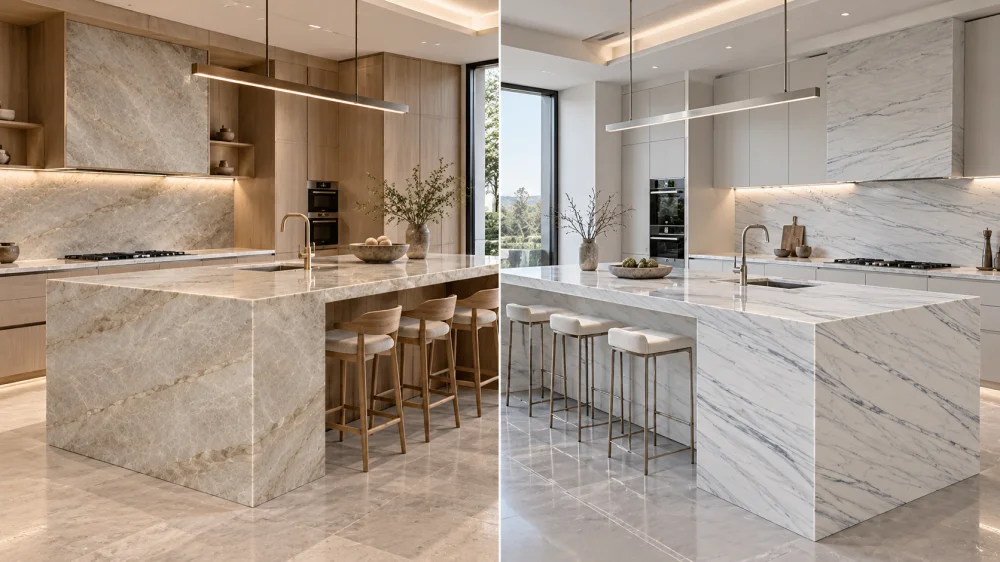
Taj Mahal commonly presents a warm cream, light beige to pale greige background with broad low-contrast cloudy movement and restrained taupe lines. White Macaubas generally reads lighter, with a white to pale-grey field crossed by finer, elongated grey or blue-grey mineral bands.
For a North American luxury kitchen, that difference influences much more than countertop color. It affects cabinet selection, island proportions, waterfall direction, seam visibility, backsplash layout and how the kitchen reads under daylight and artificial lighting.
Choose White Macaubas: when a lighter surface and more clearly directional grey veining are part of the architectural concept.
For waterfall islands: approve the actual slabs and cutting layout before deciding, because pattern direction and usable yield can materially affect the finished result.
Side-by-Side Kitchen Decision Matrix
| Fattore | Quarzite Taj Mahal | Quarzite bianca di Macaubas | La scelta migliore quando |
| Tonalità generale | Warm cream, beige and pale greige | White, off-white and pale grey | Choose according to cabinet and flooring undertones |
| Modello | Broad, soft cloudy movement with restrained flowing bands | Finer, elongated and more directional grey mineral lines | Taj Mahal for visual softness; White Macaubas for linear definition |
| Cabinet Pairing | White oak, walnut, cream, mushroom and taupe | White, pale grey, light timber and dark contrasting cabinetry | Compare actual samples under project lighting |
| Large Island | Creates a calm and softly continuous surface | Can visually emphasize the island’s length | Choose based on whether the island should feel soft or directional |
| Finiture a cascata | Coordinate broad tonal and vein movement | Control the rotation and continuation of long lines | Approve actual-slab CAD layout before cutting |
| Maintenance | Depends on actual stone, finish and treatment | Depends on actual stone, finish and treatment | Do not select based on generic stain-proof claims |
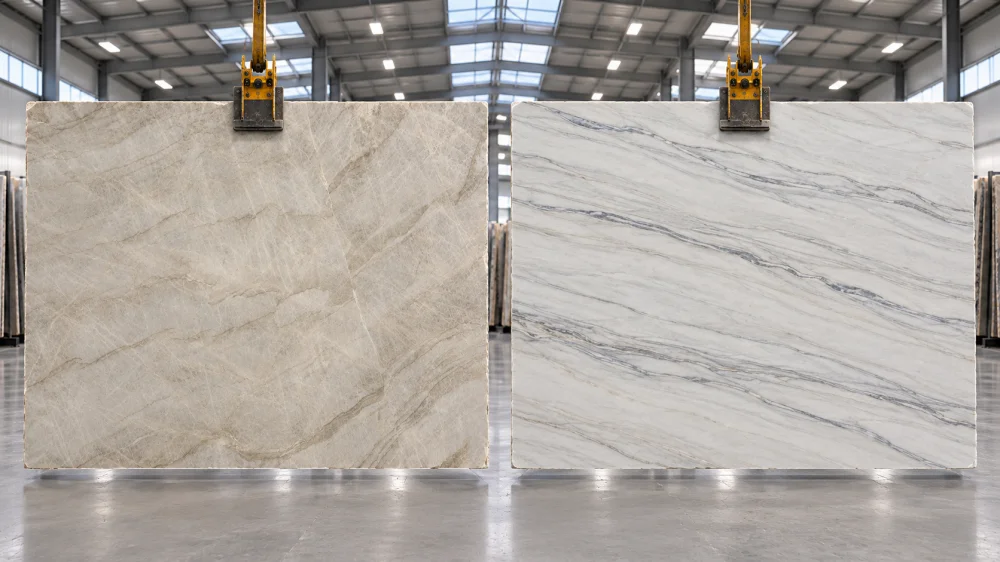
The Main Visual Difference: Warm Flow vs Linear Movement
The difference between the two materials becomes much clearer at full-slab scale than from small samples.
Quarzite Taj Mahal is generally selected for its warm, restrained character. The strongest slabs tend to show a cream-white to light greige field with broad natural clouds, layered mineral movement and soft taupe lines rather than strong black veining.
Across a large island, that structure can create an understated surface that feels active without becoming the dominant graphic element in the room.
White Macaubas takes a different approach. Its lighter white-to-grey field is typically crossed by long, relatively parallel grey or subtle blue-grey mineral bands. These lines make direction much more visible, which means rotating a panel can significantly change the finished composition.
Neither commercial name should be treated as a fixed visual specification. Buyers should define an acceptable color and pattern range and then approve the actual slabs reserved for the project.
Which One Works Better with White Oak and Walnut Cabinets?
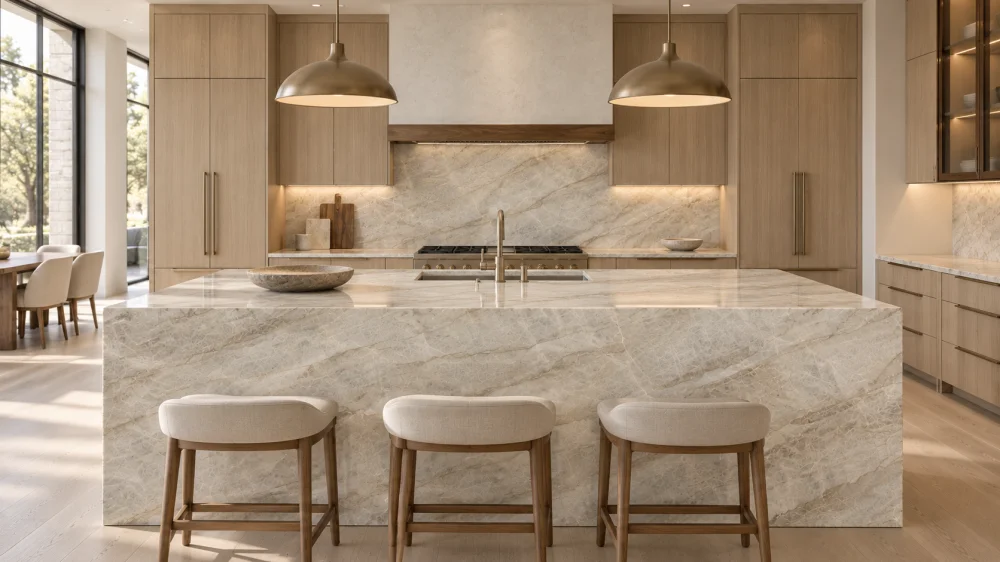
Taj Mahal is often the easier pairing with warm natural timber. Its cream and greige undertones can bridge white oak, walnut, warm-white paint, brushed brass or bronze and beige flooring without creating a sharp cool-versus-warm contrast.
This is one reason it remains relevant to many current North American kitchen palettes built around warm wood and quieter neutral colors.
White Macaubas can also work effectively with timber, but its lighter background and more directional grey bands create a different result. Against warm oak, the countertop may become a clearer visual contrast rather than blending into the palette.
For walnut or very dark cabinetry, either material can work. Taj Mahal softens the contrast, while White Macaubas can create a brighter, more graphic surface above the darker cabinetry.
What About White and Light Grey Kitchens?
White Macaubas is particularly useful when the project already uses white, soft grey or cooler neutral cabinetry and the designer wants the stone to introduce controlled linear movement without adding a strong color.
Taj Mahal can still work with white cabinetry, but it changes the room in another direction. Its warmer tone can prevent an all-white kitchen from feeling excessively cool and may coordinate more naturally with warm timber flooring or beige architectural finishes.
The buyer should avoid selecting from website images alone. A cabinet sample and stone sample may appear compatible individually but behave differently when placed under the actual lighting temperature and beside the flooring and backsplash.
Which Is Better for a Long Kitchen Island?
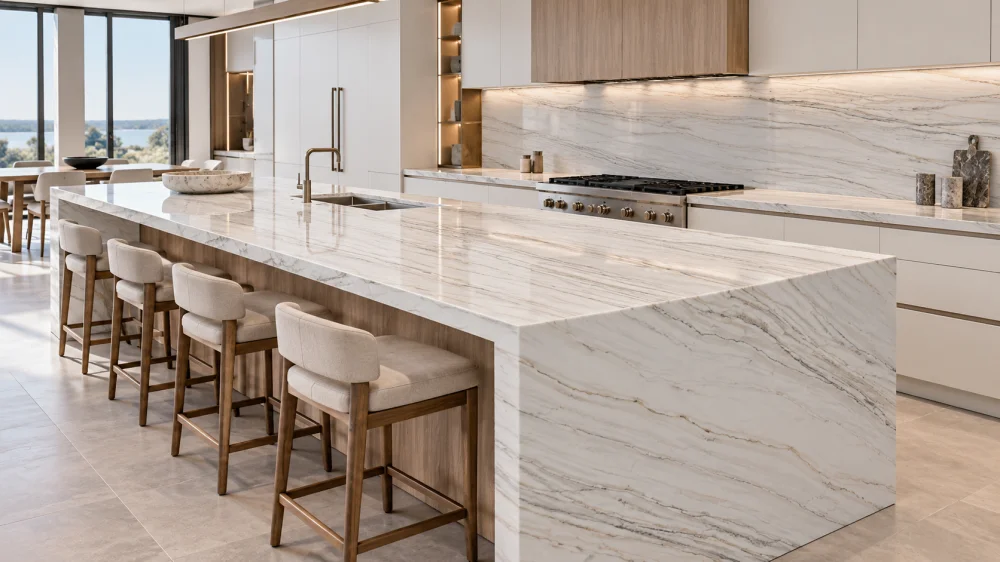
This depends on the visual objective.
For a long Taj Mahal island, the broad cloudy movement can create a relatively calm continuous surface. The main planning issue is normally the balance of light and darker mineral zones and how the movement sits around sinks, cooktops or waterfall ends.
For White Macaubas, direction becomes a stronger design decision. Running long grey bands along the island can emphasize its length and reinforce the horizontal architecture. Turning the same pattern across the island creates a different rhythm.
This direction should be agreed before cutting. Rotating a component purely to increase slab yield can undermine the visual concept even when the cutting arrangement looks efficient on paper.
Before approving White Macaubas for a long island, identify which direction the principal linear veins should run. Before approving Taj Mahal, identify where the strongest cloudy or banded areas should appear. Then test both decisions against the actual slab dimensions and island geometry.
Waterfall Ends Make the Comparison More Important
A waterfall island introduces a vertical surface that makes pattern continuity more visible.
With Taj Mahal, the design usually focuses on maintaining compatible broad movement between the top and side panel. Exact vein continuation may not always be possible or necessary, but an abrupt tonal or directional change can weaken the composition.
White Macaubas requires more deliberate attention to the long linear bands. If the top runs horizontally and the waterfall panel is rotated without planning, the pattern can change direction sharply at the miter.
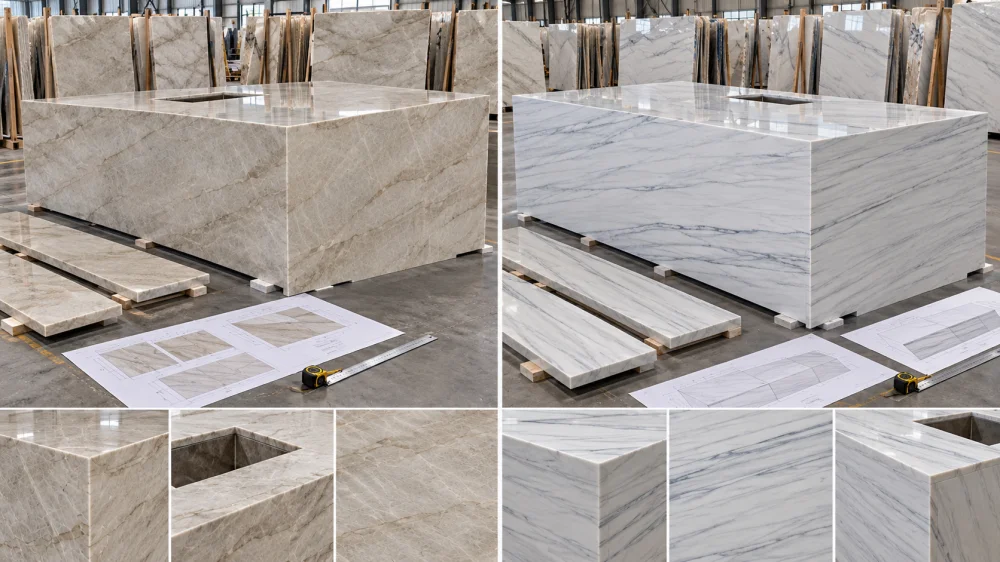
This can be intentional, but it should be an approved design decision rather than a fabrication surprise.
For larger custom islands, CENTURY STAR’s Quartzite kitchen island procurement guide explains why actual-slab approval, cutting yield, CAD layout, waterfall planning, QC and export packing should be managed as one connected workflow.
Does One Perform Better in a Kitchen?
Both are commercially categorized as natural Quartzite, but buyers should avoid assuming that the name alone proves identical performance.
Natural Quartzite can vary in mineral composition, fissure structure, resin treatment, repaired areas and surface behavior. The actual slab and finish therefore matter more than a simple material-name comparison.
Neither Taj Mahal nor White Macaubas should be sold as universally stain-proof, scratch-proof or maintenance-free. Prompt cleanup, appropriate cleaning products, cutting boards and trivets remain sensible practices for natural stone kitchen surfaces.
Natural Stone Institute guidance also emphasizes that proper care depends on the geological composition of the stone and notes that sealing can improve stain resistance without making a surface stain-proof.
Polished vs Honed: Does Finish Change the Decision?
Yes. Finish changes how both stones interact with light and how their mineral movement is perceived.
A polished Taj Mahal can show greater depth in its warm cloudy layers. A honed finish generally reduces reflection and creates a softer, quieter visual effect.
With White Macaubas, polishing can make the contrast between its lighter background and fine grey bands more apparent. Honing can soften that contrast and work effectively with matte contemporary cabinetry.
The finish should be reviewed on representative material rather than selected only by name. A sample viewed under showroom lighting may not predict how a large island appears beside windows, pendants and recessed lighting.
How Do Fabrication Requirements Differ?
The same kitchen drawing can create different cutting priorities with these two stones.
For Taj Mahal, slab planning often focuses on maintaining a balanced distribution of broad mineral movement and keeping visually important areas away from undesirable cut positions.
For White Macaubas, the fabricator must pay particular attention to line direction, rotation and the relationship between the top, backsplash and waterfall panels.
For both stones, the cutting layout should identify:
- main island top;
- waterfall end panels;
- aperture per lavello e piano cottura;
- seam positions;
- visible edge strips or returns;
- major natural features;
- required pattern direction;
- remaining usable material.
The wider CENTURY STAR Quartzite guide can be used as a supporting material-category reference, but final engineering decisions should always be based on the specific slabs and project geometry.
Quale costa di più?
There is no responsible universal answer without current project quotations.
The completed kitchen cost depends on more than the commercial stone name. Relevant drivers include current material availability, visual grade, slab dimensions, number of slabs required, usable cutting yield, finish, edge work, sink and cooktop openings, waterfall fabrication, seam planning, QC, packing and delivery.
Taj Mahal can become more expensive if a project requires a narrow warm color range or specific movement that reduces acceptable slab choices. White Macaubas can create additional yield pressure when strong linear direction restricts how pieces may be rotated.
For procurement, the meaningful comparison is therefore the total approved stone package rather than a raw slab rate.
What Should Buyers Approve Before Ordering?
- Cabinet and flooring palette: compare stone undertones beside the approved finish samples.
- Actual slabs: approve full-slab photographs or the physical slabs rather than only small samples.
- Acceptable visual range: define background tone, vein density and natural variation.
- Island direction: establish the preferred movement before CAD nesting.
- Waterfall relationship: review the top and side panels together.
- Cutting layout: confirm gross slab quantity and actual usable yield.
- Finish: approve polished, honed or another selected surface on representative material.
- Fabrication details: confirm edges, miters, seams, sink and cooktop openings.
- Prove di controllo qualità: define the photographs, measurements or dry-layout review appropriate to the project.
Quale dovresti scegliere?
Scegli il quarzite Taj Mahal if the kitchen should feel warm, restrained and naturally connected to white oak, walnut, cream, taupe and other soft neutral finishes.
Choose White Macaubas Quartzite if the kitchen should feel lighter and more architectural, with long grey mineral lines playing an intentional role across islands, countertops and waterfall panels.
If both materials suit the palette, compare actual candidate slabs over the approved kitchen drawings. The final decision should consider not only which slab looks more attractive in isolation, but which material produces the strongest whole-kitchen composition and can be fabricated efficiently within the real project geometry.
The Taj Mahal vs White Macaubas Quartzite decision is mainly a choice between warm, low-contrast flowing movement and lighter, more directional linear movement. Taj Mahal is often the easier fit for warm timber-driven luxury kitchens; White Macaubas can be especially effective in contemporary kitchens where the island’s length and pattern direction should be visually emphasized. Whichever stone you select, approve the actual slabs, cabinet undertones, cutting direction, waterfall relationship, finish, fabrication scope and QC evidence before production.
Domande frequenti
1. Is Taj Mahal or White Macaubas Quartzite better for kitchen countertops?
It depends on the design. Taj Mahal is generally better suited to warm kitchens with soft natural movement, while White Macaubas is often preferred when the design needs a lighter surface with more directional grey veining. Actual slab selection remains essential for both.
2. Which Quartzite works better with white oak cabinets?
Taj Mahal often pairs naturally with white oak because its warm cream, beige and greige tones can connect closely with the timber. White Macaubas can also work when the designer wants a brighter contrast and more linear movement.
3. Is White Macaubas lighter than Taj Mahal Quartzite?
White Macaubas generally reads as a whiter or pale-grey material, while Taj Mahal normally has a warmer cream-to-greige appearance. Natural variation means the actual slabs should still be compared before approval.
4. Which is better for a waterfall kitchen island?
Both can work. Taj Mahal can create softer transitions between top and waterfall panels, while White Macaubas can create strong directional continuity. The preferred option depends on actual slab dimensions, vein direction, cutting yield and the approved miter layout.
5. Is White Macaubas more durable than Taj Mahal Quartzite?
A universal ranking should not be made from the commercial names alone. Performance depends on the actual stone, mineral composition, natural features, treatments, finish and fabrication condition.
6. Do Taj Mahal and White Macaubas Quartzite need sealing?
It depends on the actual stone, finish and previous treatment. A compatible impregnating sealer can improve stain resistance where appropriate, but it does not make either surface completely stain-proof.
7. Which one is more expensive?
There is no fixed universal price ranking. Current slab availability, visual grade, usable yield, fabrication, waterfall requirements, finish, QC, packing and delivery all influence the final project cost.
8. What should buyers approve before fabrication?
Approve the actual slabs, acceptable color and vein range, island geometry, seam strategy, vein direction, cutting layout, finish, edges, openings and waterfall relationship. These approvals should remain traceable through fabrication and QC.
Riferimenti
- Natural Stone Institute — Care & Cleaning of Natural Stone: https://www.naturalstoneinstitute.org/consumers/care/
- Natural Stone Institute — Technical Resources: https://www.naturalstoneinstitute.org/technical/