


Why Curved Marble Cracks During Fabrication and How to Prevent It

Curved marble often looks smooth and controlled in finished projects, but behind that appearance lies one of the highest-risk stages in stone fabrication. Cracks can appear during cutting, during dry fitting, during transport, or even after installation when stress has already been built into the panel.
What makes curved stone more vulnerable than flat panels is simple: once geometry changes, internal stress changes too. Every curve introduces different pressure points, especially when thickness is reduced, veins run across weak directions, or support structures are not perfectly aligned.
This is why تشققات الرخام المنحنية are rarely random accidents. In most cases, the stone was already carrying hidden risk before the visible crack appeared.
Why Curved Marble Is More Vulnerable Than Flat Stone
Flat stone distributes internal tension relatively evenly. Curved fabrication changes this balance. When marble is divided into narrow segments, thinned for radius work, or processed at the back to fit a curve, some zones become structurally weaker than others.
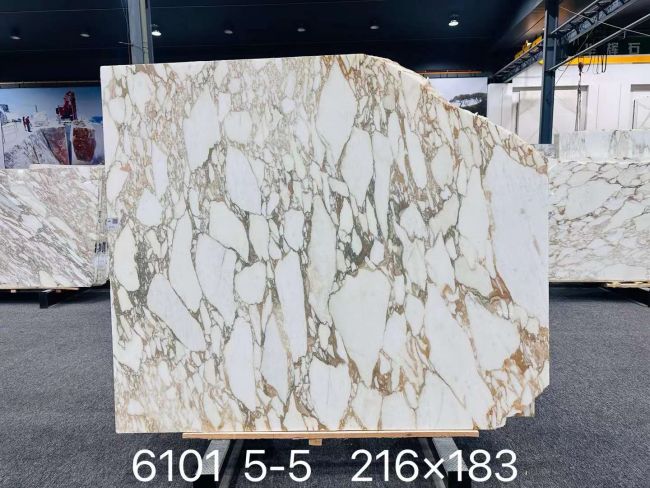
Materials with open veins, directional movement, or natural fissures become even more sensitive because the curve may force pressure into already vulnerable lines.
This explains why two slabs from the same material can behave differently: one survives fabrication smoothly, while another develops edge fractures or mid-panel cracks under similar processing conditions.
The Five Most Common Causes of Curved Marble Cracking
1. Vein direction crossing structural stress lines
If strong veins run across the main stress direction of the curved panel, cracking risk increases significantly. Veins often act as natural weakness channels when cutting or handling begins.
2. Excessive thickness reduction
To achieve tighter curves, fabricators often reduce thickness. If too much material is removed without reinforcement planning, the remaining stone loses stability.
3. Uneven backing support
A curved panel depends heavily on accurate backing or substrate support. Small gaps create pressure concentration during installation.
4. Improper edge handling during transport
Curved pieces often contain narrow edge zones that are more vulnerable than flat rectangular panels. Transport vibration can trigger cracks if packaging is weak.
5. Hidden internal fissures not visible before cutting
Some cracks begin from natural internal weaknesses that are difficult to detect from slab surface inspection alone.
Curved Marble Crack Risk Table
| Curved Marble Cracks Risk Factor | Curved Marble Cracks How It Causes Cracks | Curved Marble Cracks Typical Stage | Curved Marble Cracks Prevention Priority |
|---|---|---|---|
| Wrong vein direction | Stress follows weak natural lines | Cutting / lifting | Very high |
| Over-thinning | Loss of load stability | Fabrication | Very high |
| Substrate mismatch | Point pressure after installation | Installation | عالية |
| Poor crate support | Transport vibration damage | Shipping | عالية |
| Natural hidden fissures | Delayed crack propagation | Any stage | Medium to high |

Expert Interpretation: Two Mistakes That Cause Most Failures
Expert answer 1: Most cracks begin before fabrication is blamed
By the time a crack becomes visible, the stone usually already contained stress from poor slab selection, wrong cut planning, or unsupported geometry. The visible crack is often the final stage of an earlier decision.
Expert answer 2: Reinforcement cannot fully correct bad geometry
Fiberglass, mesh, and backing systems help, but they do not replace correct structural logic. If the curve forces stress into weak stone zones, reinforcement only delays failure.
How to Reduce Cracking Risk Before Production Starts
- Check vein direction before assigning curved zones
- Avoid using highly fractured slab areas in narrow segments
- Define minimum safe thickness for each curve radius
- Confirm substrate dimensions before final fabrication
- Use transport packing designed specifically for curved geometry
Why Cracks Sometimes Appear After Installation
Some curved marble panels leave the factory without visible damage but crack later because installation conditions introduce delayed stress. Common reasons include uneven wall backing, temperature movement, adhesive concentration, or support gaps behind narrow sections.
This is why successful curved stone work depends on both fabrication quality and installation discipline.

How Century Star Approaches Crack Prevention in Curved Marble
At Century Star, crack prevention begins at slab selection rather than after fabrication starts. Vein direction, stress zones, thickness logic, and transport path are considered together before a curved piece is approved for production. The objective is not only to make the stone fit the design, but to ensure the design respects how natural stone behaves under real conditions.
الأسئلة الشائعة
1) Why does curved marble crack more easily than flat marble?
Because curvature changes internal stress distribution and often requires thinner or segmented fabrication.
2) Can reinforcement fully stop curved marble cracking?
No. Reinforcement helps, but cannot correct poor geometry or weak slab selection.
3) Does marble thickness affect crack risk?
Yes. Thinner sections usually carry higher risk if unsupported.
4) Are some marble types unsuitable for curves?
نعم. الأحجار الرخامية شديدة التصدع أو غير المستقرة تتطلب رقابة أكثر صرامة.
5) Can transport create cracks after fabrication?
نعم. غالبًا ما يتسبب ضعف دعم الصناديق في تأخير حدوث الأضرار.
6) Why do cracks appear after installation?
Because hidden stress may only release once the stone is fixed into place.