


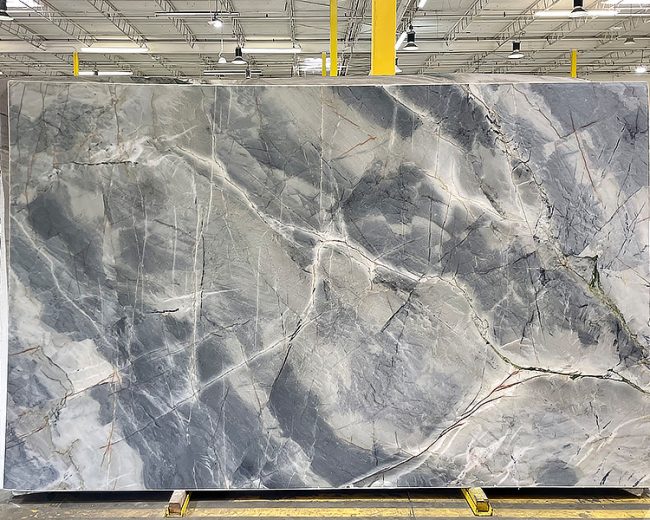


Riepilogo rapidoChoose natural Quartzite when the kitchen needs a natural stone surface with generally stronger resistance to everyday abrasion and mild household acids, provided the actual stone is correctly identified and approved. Choose Marble when expressive veining, softer visual character and the natural development of patina are more important and the owner accepts greater sensitivity to acidic foods and drinks. Neither material should be selected from the category name alone. Buyers should compare actual slabs, finish, countertop geometry, cutouts, seams, fabrication requirements, maintenance expectations and complete project cost before ordering.
Quartzite vs Marble Countertops: Which Is Better for a Kitchen?
For kitchens where lower acid sensitivity and a more forgiving everyday-use profile are priorities, correctly identified natural Quartzite is generally the stronger choice. For design-led kitchens where Marble’s particular veining and character are the priority—and the owner accepts etching and patina—Marble can still be the better material.
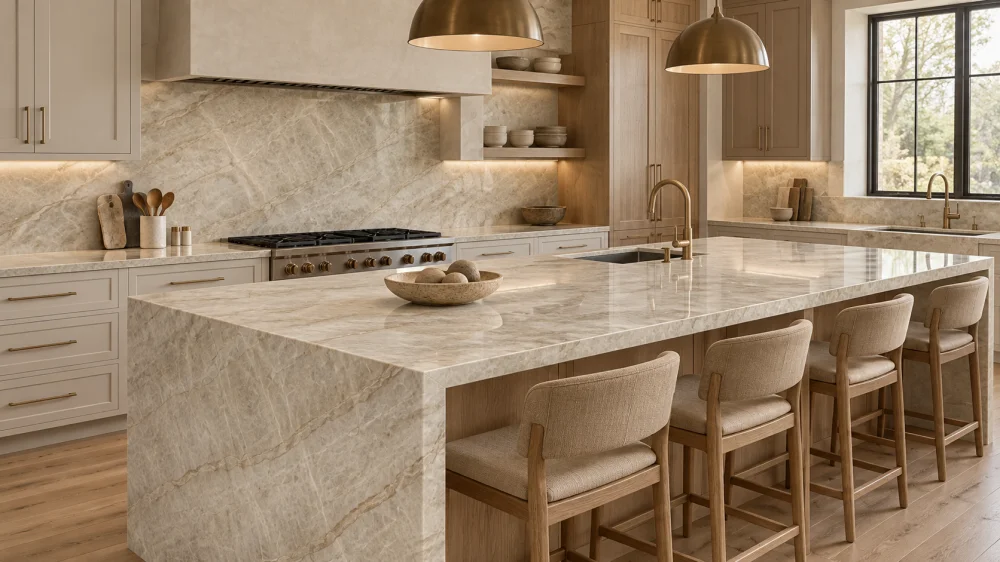
This is not an absolute ranking. Quartzite and Marble are broad natural-stone categories containing many individual materials, and commercial stone names do not guarantee that every slab behaves identically.
The key distinction is mineralogical. True Marble is principally associated with calcite and is vulnerable to mild acidic substances commonly encountered in kitchens. Natural Quartzite is a silica-rich metamorphic stone and is generally more resistant to typical kitchen acids, although the exact material still needs to be verified and acidic cleaners should not be treated as universally safe.
Verdetto direttoChoose Quartzite: when daily-use practicality, lower sensitivity to common food acids and natural slab character need to work together.
Choose Marble: when the exact Marble’s veining, color and sculptural character are central to the design and the client understands that etching and patina can occur.
For either material: approve the actual slabs, finish and cutting layout rather than relying only on a sample or commercial name.
Quartzite vs Marble Kitchen Countertop Decision Matrix
| Fattore | Quarzite | Marmo | La scelta migliore quando |
| Carattere Visivo | Ranges from quiet flowing patterns to strongly crystalline or graphic slabs | Often selected for elegant veining, cloudy movement and classic natural character | Choose the actual slab composition that fits the kitchen design |
| Sensibilità agli acidi | True natural Quartzite is generally more resistant to mild kitchen acids | Calcite-based Marble is vulnerable to acid etching | Quartzite when acid sensitivity is a major owner concern |
| Abrasion / Daily Use | Generally offers a harder-wearing profile, subject to the actual stone | More vulnerable to scratching and surface wear than many Quartzites | Quartzite for lower tolerance of visible daily-use change |
| Patina | Natural use marks still possible and maintenance remains necessary | Etching and wear may become part of the material’s long-term character | Marble when the client accepts evolving natural patina |
| Lavorazione | Actual mineral structure, fissures and hard crystalline areas can affect cutting strategy | Edges, cutouts and surface protection still require careful fabrication and handling | Use a fabricator experienced with the specific selected stone |
| Maintenance | Stone-specific cleaning and sealing decisions still apply | Requires acceptance of acid sensitivity and appropriate cleaning practices | Match material to the client’s maintenance tolerance |
The Visual Difference Is More Complex Than “Modern vs Classic”
Both Quartzite and Marble can support traditional, transitional and contemporary kitchens. The material family does not determine the style by itself.
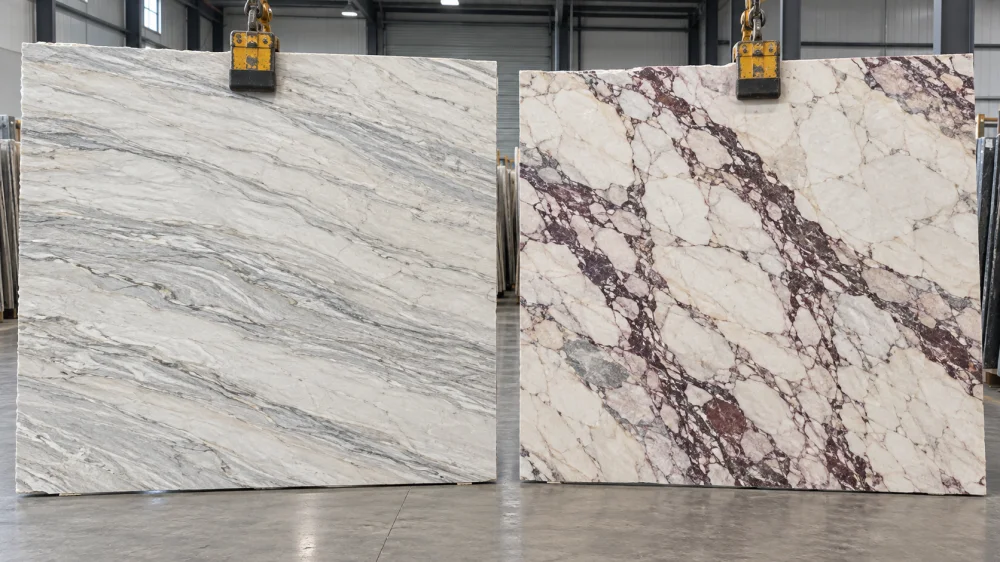
Quartzite can range from calm cream and pale-grey stones such as Taj Mahal and Mont Blanc to highly graphic Blue Roma, Patagonia or strongly colored varieties. Some slabs show long directional bands; others contain large crystalline fields or irregular geological transitions.
Marble is equally varied. Carrara-type materials can create restrained grey movement, while Calacatta, Statuario, Calacatta Viola and other expressive Marbles can become the primary visual feature of the entire kitchen.
The practical design question is therefore: how much visual authority should the countertop or island have within the room?
Buyers exploring the Quartzite family can review the broader CENTURY STAR Quartzite guide, while the Marble collection provides a wider view of available Marble directions. Final specification should still be based on actual project slabs.
Acid Etching Is the Most Important Everyday Difference
This is one of the clearest practical distinctions for kitchen buyers.
True Marble contains calcite, which reacts with mild acids. Lemon juice, vinegar, tomatoes, wine and acidic cleaning products can dull or etch a polished Marble surface. A sealer does not remove this mineralogical sensitivity.
Natural Quartzite is siliceous and is generally more resistant to the mild acids commonly found in kitchens. However, that does not justify describing every commercial Quartzite as acid-proof. Stone identity, trace minerals, surface treatments and the actual slab still matter.
Buyer Risk
Do not approve a countertop only because a quotation says “Quartzite.” If acid resistance is a critical project requirement, confirm that the material has been correctly identified and request appropriate material information or representative evaluation rather than relying on the commercial name alone.
Does That Mean Marble Is a Bad Kitchen Countertop?
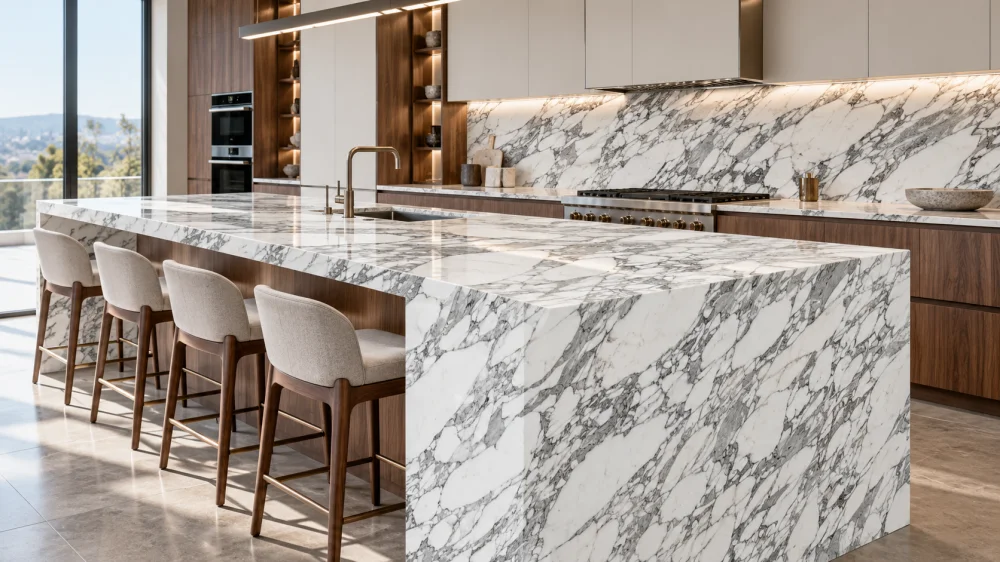
No. It means the owner must understand how Marble behaves.
Marble has been used for kitchen work surfaces for generations, and many clients intentionally select it because no substitute reproduces the exact depth, veining and tactile character of the natural material they want.
The trade-off is that the surface can develop etches and other signs of use. In some projects, that natural aging is accepted as patina. In others, the client expects the countertop to remain visually unchanged and may therefore be dissatisfied with Marble even when the stone is technically functioning as expected.
The correct specification depends partly on expectation management. A design team should not promise a Marble kitchen with the maintenance behavior of a different material.
Which Is Better for a Large Kitchen Island?
Either can be excellent, depending on the actual slabs.
A large Quartzite island can emphasize broad geological movement, crystalline depth or directional bands. A Marble island can create dramatic continuous veining or a more refined soft-grey composition.
For both materials, island geometry should be reviewed before slab approval. Sink and cooktop openings can remove important visual areas, while waterfall ends require additional pieces that should relate intentionally to the main top.
The best slab is therefore not necessarily the most dramatic slab in the warehouse. It is the slab that can be converted successfully into the required island geometry.
Slab Variation Matters for Both Materials
Natural Quartzite and Marble are not manufactured patterns. Background tone, veining, mineral zones, fissures and other geological features can change between slabs.
For multi-slab kitchens, buyers should review the entire group together. Selecting one beautiful slab and allowing unrelated material to complete the remaining countertops can create undesirable differences in tone and pattern scale.
This is particularly important when the kitchen has an island plus perimeter countertops, full-height backsplash pieces or visible waterfall ends.
Fabrication: Quartzite and Marble Require Different Attention
The fabrication challenge should be evaluated for the actual stone rather than reduced to “Quartzite is hard” or “Marble is easy.”
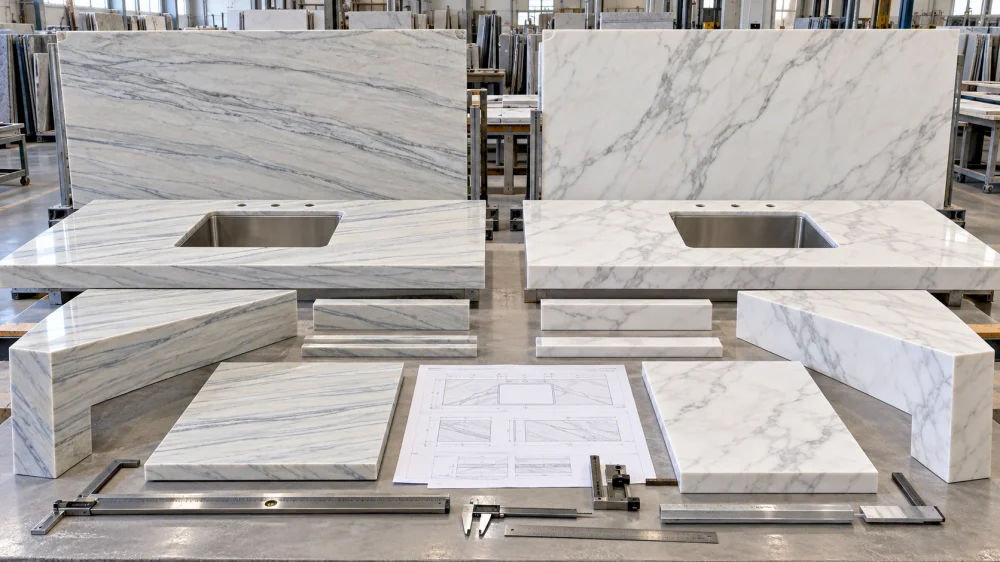
Quartzite can contain hard crystalline structures, natural fissures and transitions that influence cutting, polishing and edge preparation. Highly expressive slabs may require careful positioning to keep key mineral features away from problematic narrow sections or openings.
Marble is generally more susceptible to abrasion and surface scratching during handling. Its visible veins, repaired areas and natural features still need to be considered around sink rails, miters, corners and other fabricated details.
In either case, visual slab approval and fabrication approval should remain separate decisions.
Polished or Honed: Which Finish Works Better?
Both Quartzite and Marble can be supplied in different finishes depending on the actual material and fabrication requirements.
A polished finish generally emphasizes color depth, contrast and reflected light. On Marble, it can also make acid etching more visually apparent because an etched area interrupts the surrounding polish.
A honed finish produces a softer, lower-sheen appearance. It does not eliminate Marble’s reaction to acids, but the overall visual character is different and may suit kitchens where a quieter, more architectural surface is desired.
Quartzite finish selection should also consider the actual slab, mineral structure and maintenance expectations. Representative finished samples are more useful than relying only on terminology.
What About Staining and Sealing?
Neither material should be promised as universally stain-proof.
Whether an impregnating treatment is appropriate depends on the actual stone, finish, existing treatment and intended use. Sealing can improve resistance to staining, but it does not create an impermeable countertop.
For Marble, an impregnating sealer also does not prevent acid etching. Staining and etching are different mechanisms and should not be confused.
For either material, routine care should use products appropriate for natural stone, and spills should be addressed promptly.
Cost: Which One Is More Expensive?
There is no reliable universal winner.
Some premium Marbles can cost more than many Quartzites, while rare or visually exceptional Quartzites can cost more than common Marbles. Material names alone therefore do not provide a useful project-level price ranking.
The completed countertop budget can be affected by:
- specific stone variety and visual grade;
- current slab availability;
- number of slabs required;
- usable cutting yield;
- finish;
- aperture per lavello e piano cottura;
- edge and miter details;
- waterfall panels;
- seam planning;
- fabrication complexity;
- QC and dry-layout requirements;
- packing and delivery scope.
Buyers should compare equivalent fabricated packages rather than simply asking whether Marble or Quartzite has a lower price per slab.
Which Material Fits Different Buyer Priorities?
| Project Scenario | Better Fit | Perché | Controllo dell'acquirente |
| Busy kitchen with low tolerance for acid etching | Quartzite, conditionally | True Quartzite generally offers stronger resistance to common mild kitchen acids | Verify actual material identity and finish |
| Design-led kitchen where specific veining is the priority | Marble or Quartzite | The individual slab composition matters more than the category | Compare actual full slabs and cutting layouts |
| Client accepts patina and wants classic Marble character | Marmo | Etching and surface change are accepted as part of ownership | Explain acid sensitivity before specification |
| Large statement island with unusual geological movement | Often Quartzite | Many Quartzites offer broad crystalline or graphic slab compositions | Confirm slab yield, openings and waterfall relationship |
What Should Buyers Request Before Ordering?
A material comparison should end with evidence, not adjectives.
- Confirm the material category: natural Quartzite or Marble should be clearly identified.
- Review the actual slabs: compare complete slab photographs or physical slabs rather than small samples alone.
- Define acceptable variation: background tone, vein density and major natural features.
- Confirm countertop geometry: island dimensions, sink, cooktop, seams, edges and waterfall panels.
- Request a cutting layout: especially when slab movement or yield strongly affects the design.
- Approve the finish: use representative polished, honed or other finished material.
- Clarify maintenance expectations: particularly acid sensitivity and expected patina for Marble.
- Confirm sealing strategy: only for the actual stone and treatment system.
- Compare equivalent quotations: material, fabrication, QC, packing and commercial scope should match.
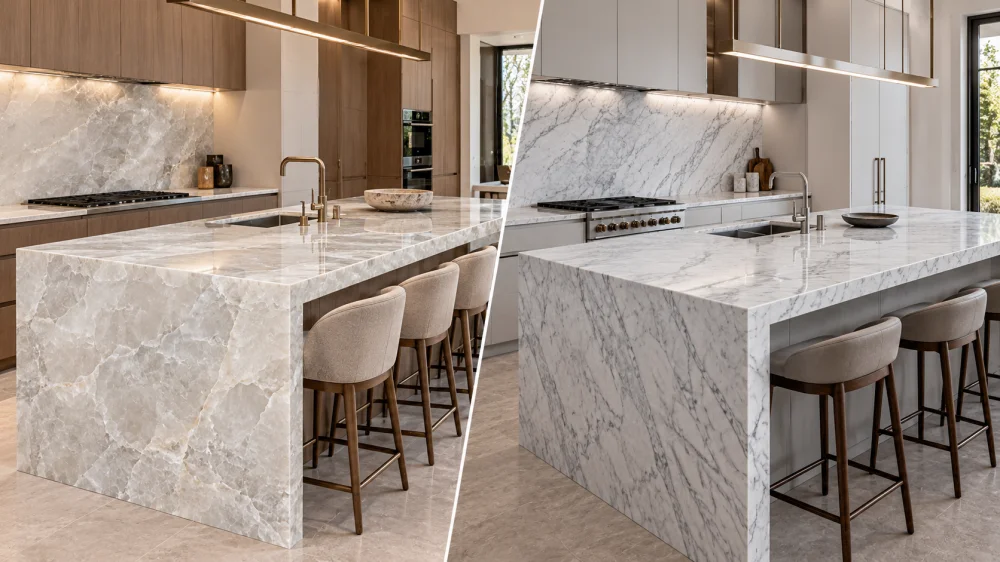
quartzite marble finished kitchen scenarios
For project teams managing a broader material decision, CENTURY STAR’s architectural stone sourcing guide explains how material selection, slab approval, cutting yield, fabrication, QC and logistics should be connected rather than treated as separate purchases.
Quale dovresti scegliere?
Choose Quartzite when the project needs natural-stone character but the owner has relatively low tolerance for acid etching and wants a generally harder-wearing kitchen surface. Confirm that the selected material is correctly identified natural Quartzite and review the actual slabs before fabrication.
Choose Marble when the exact Marble’s color and veining are integral to the architecture and the owner understands that acidic foods can etch the surface and that patina may develop over time.
For both materials, a good specification goes beyond the category label. The final decision should connect the actual slab to the kitchen palette, countertop geometry, fabrication strategy, maintenance expectations and complete project budget.
Un'idea pratica da prendere in considerazione
The key Quartzite vs Marble countertop difference is not simply “hard stone versus soft stone.” Quartzite is generally the more practical direction when lower acid sensitivity and abrasion resistance matter, while Marble remains a compelling choice when its specific natural character is worth accepting etching and patina. Whichever category you choose, verify the actual stone, approve the complete slabs, coordinate the cutting layout and openings, confirm finish and maintenance requirements, and compare the same fabrication and delivery scope before ordering.
Domande frequenti
1. Is Quartzite better than Marble for kitchen countertops?
Quartzite is often the stronger practical choice when lower sensitivity to common kitchen acids and a harder-wearing surface are priorities. Marble can be the better design choice when its specific veining and character are more important and the owner accepts etching and patina.
2. Does Marble etch more easily than Quartzite?
True Marble is calcite-based and is vulnerable to mild acids such as citrus juice and vinegar. Natural Quartzite is siliceous and is generally more resistant to common kitchen acids, although the actual material should still be verified.
3. Does sealing stop Marble from etching?
No. An impregnating sealer may improve stain resistance, but it does not change Marble’s calcite mineralogy and therefore does not eliminate acid etching.
4. Is Quartzite maintenance-free?
No. Natural Quartzite still requires appropriate cleaning and may require a stone-specific sealing strategy depending on the actual material, finish and treatment. It should not be described as stain-proof or maintenance-free.
5. Which material is better for a waterfall kitchen island?
Either can work. The correct choice depends on the actual slab composition, island geometry, waterfall orientation, seams, openings and fabrication plan. Full-slab layout is more important than the material category alone.
6. Is Quartzite always more expensive than Marble?
No. Prices vary by individual stone, availability, visual grade, slab yield and fabrication scope. Premium Marble can cost more than some Quartzites, while rare Quartzites can cost more than many Marbles.
7. Should buyers approve full slabs before fabrication?
Yes, particularly for large islands, waterfall panels and strongly veined or crystalline materials. Full-slab approval establishes the visual material, while a cutting-layout review confirms where the finished countertop pieces will actually come from.
8. How should architects choose between Marble and Quartzite?
Start with the client’s visual priorities, maintenance tolerance and expected kitchen use. Then compare actual slabs, finish, countertop geometry, fabrication requirements, care expectations and complete project quotations before making the final selection.